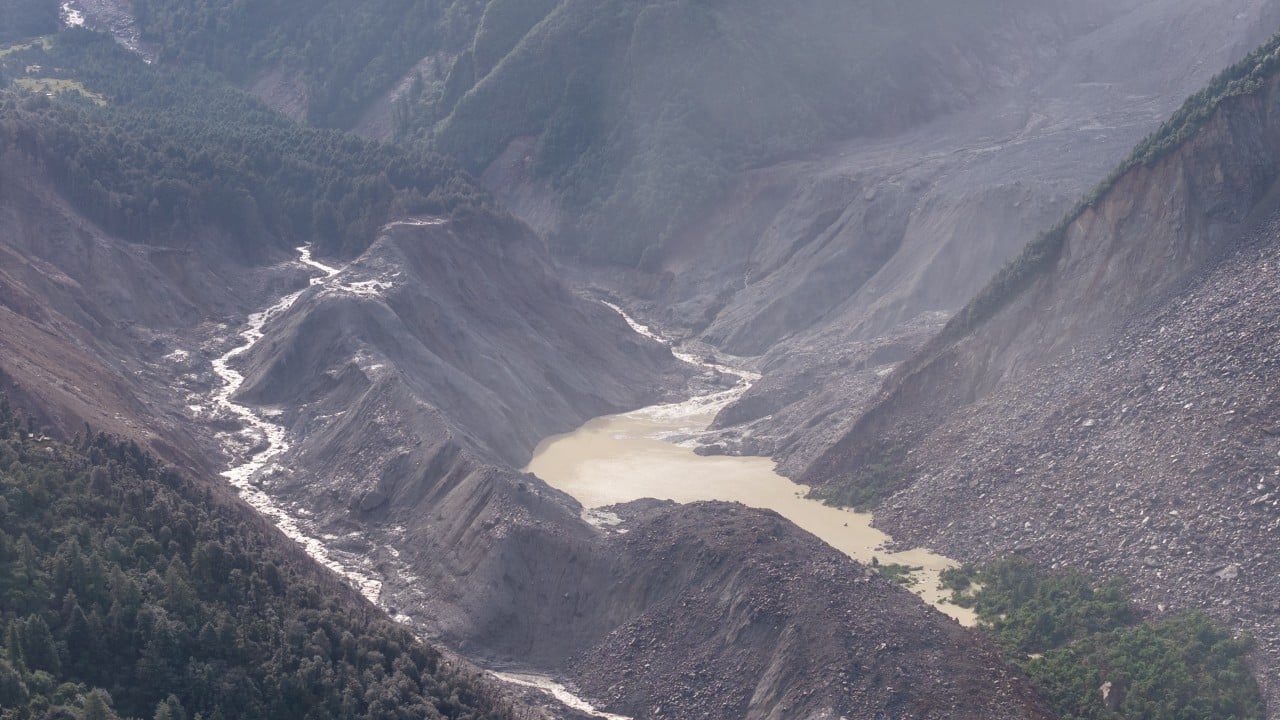
High in the rugged terrain of the Tibet Autonomous Region, a colossal body of water is pressing against a fragile wall of loose rock, earth, and shattered ice. Formed in the wake of a sudden glacier collapse that triggered catastrophic flash floods across the China-Nepal border, this massive debris dam now holds millions of cubic meters of trapped water. With inflow rates projected to swell the reservoir by an additional three million cubic meters over a matter of days—a volume equivalent to roughly twelve hundred Olympic swimming pools—authorities on both sides of the frontier have scrambled to sound urgent alarms.
The disaster began not with seasonal monsoons, but with a high-altitude structural failure. Satellite analysis and hydrological reports point to a massive chunk of glacier breaking away at high elevation, crashing down thousands of meters into the river valley, and creating an instant natural blockade. When these landslide dams form, they act as ticking time bombs. Water accumulates rapidly behind the unstructured barrier of debris, creating an unstable reservoir with no natural outlet. As the water level climbs, hydrostatic pressure mounts exponentially against an earthen wall that lacks any engineered spillway or structural reinforcement.
The immediate downstream consequences have already proven devastating. Hundreds of lives have been lost, entire communities have been buried under thick blankets of mud, and critical infrastructure including hydropower projects and cross-border trade routes have been severely compromised. Search and rescue operations near the border zones have been forced into temporary suspensions as engineers monitor the overflowing barrier lake, knowing that a sudden, unmanaged structural failure could unleash a secondary wall of water and debris into valleys already scarred by the initial catastrophe.
Managing a crisis of this magnitude requires a delicate mix of high-frequency remote sensing and rapid tactical intervention. Emergency response teams have deployed drones to map the shifting perimeter of the lake, while specialized engineering units utilize 3D modeling to assess the structural integrity of the blockage. Yet, physical access to the site remains heavily constrained. Steep, unstable cliffs surround the shoreline, and roads leading to the border crossings are choked with feet of dense mud and rock fragments. Excavating a controlled drainage channel through the debris dam is the standard procedure for mitigating a landslide lake outburst flood, but executing such earthworks while the water is actively overflowing and threatening collapse puts engineering crews directly in harm's way.
The underlying driver of these recurring disasters extends far beyond local meteorology. High mountain Asia is warming at a rate significantly faster than the global average, destabilizing ancient ice masses, expanding high-altitude glacial lakes, and increasing the frequency of catastrophic slope failures. What happened along the Chhochen and Purepu Tsangpo river systems is part of a broader, systemic vulnerability spanning the entire Himalayan arc. As permafrost thaws and seasonal weather patterns become increasingly erratic, the probability of sudden multi-hazard events—where an initial ice collapse triggers a landslide dam, which in turn threatens a catastrophic outburst flood—continues to escalate.
Communities strung along vulnerable river corridors like the Bhotekoshi and Trishuli face an anxious wait as water levels at the border continue to fluctuate. Early warning systems and cross-border data sharing have improved significantly over past decades, offering precious hours of lead time that save countless lives through immediate evacuations to higher ground. However, structural mitigation remains a massive challenge in terrain governed by extreme geology and relentless tectonic activity. Every monsoon season and high-temperature summer now brings the region closer to the next structural test of its mountain defenses.