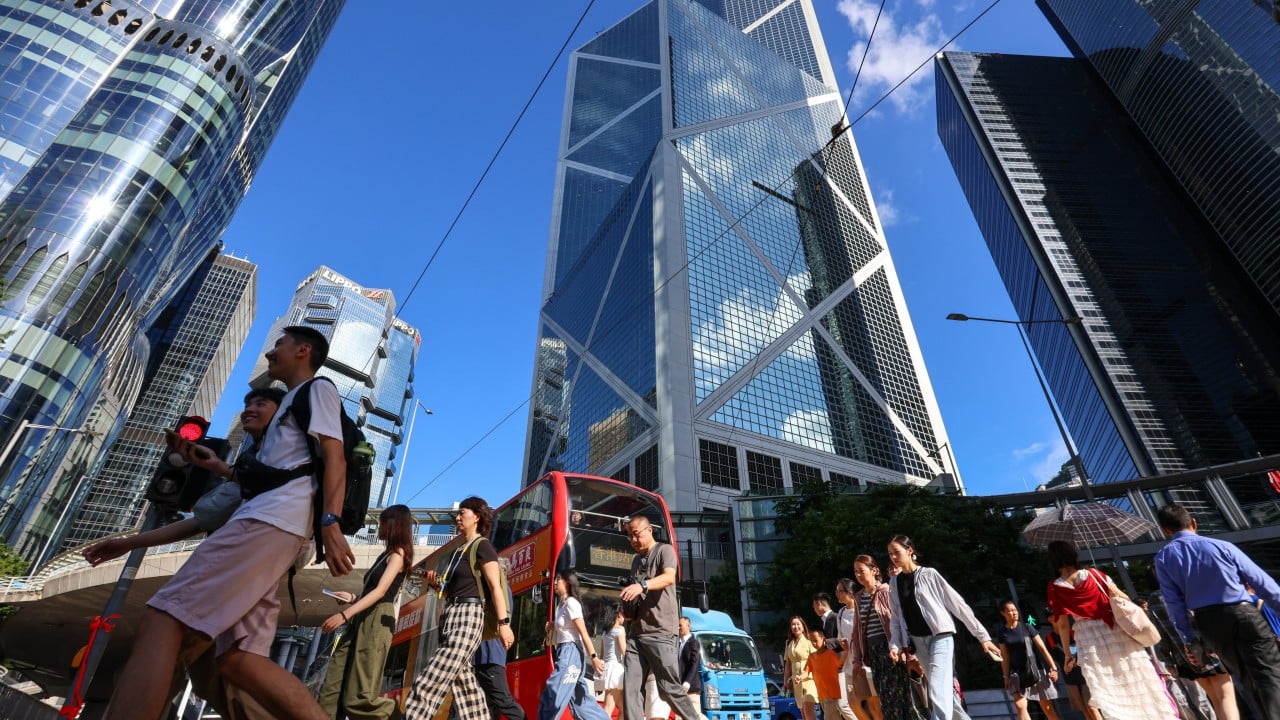
Hong Kong’s viability as a safe haven depends entirely on the delta between its institutional infrastructure and the volatile geopolitical environment surrounding it. The city does not function as a sovereign fortress; it operates as a sophisticated specialized interface. To assess whether it remains a "safe haven," one must quantify the integrity of the three systemic pillars that define its utility: capital mobility, judicial predictability, and the USD peg mechanism. When these pillars are compromised, the city transitions from a hedge against risk to a concentrated vector of risk itself.
The Mechanics of Capital Fluidity
The primary function of a financial safe haven is the friction-free entry and exit of liquidity. Hong Kong’s value proposition is built on the absence of foreign exchange controls, a feature codified in Article 112 of the Basic Law. This creates a structural "liquidity vent" for regional capital.
Total deposits in the banking system and the net flow of the Aggregate Balance serve as the critical telemetry for this pillar. A safe haven requires a surplus of trust in the currency’s convertibility. The stability of the Hong Kong Dollar (HKD) is maintained via the Linked Exchange Rate System (LERS), which mandates that the Monetary Base is at least 100% backed by US dollars.
The system operates on an automatic interest rate adjustment mechanism. If capital outflows occur, the HKD weakens toward the 7.85 weak-side convertibility undertaking. The Hong Kong Monetary Authority (HKMA) then buys HKD and sells USD, shrinking the monetary base. This contraction forces interbank rates (HIBOR) upward, attracting capital back into the currency to capture the yield spread against the US dollar (LIBOR/SOFR). The city’s status as a safe haven is not a matter of sentiment but a function of the HKMA’s willingness to endure high interest rates to protect the peg.
The Judicial Predictability Deficit
Investment capital seeks environments with low "arbitrary risk." In this context, the Hong Kong judiciary historically provided a common law framework that acted as a firewall against the opaque regulatory shifts seen in mainland jurisdictions.
The erosion of this firewall introduces a risk premium that is difficult to hedge. If the legal system transitions from a "rules-based" to a "discretionary" model, the cost of contract enforcement rises. We observe this shift through the migration of dispute resolution clauses in international contracts. When firms move their seat of arbitration from the Hong Kong International Arbitration Centre (HKIAC) to the Singapore International Arbitration Centre (SIAC), they are effectively pricing in a decline in Hong Kong’s safe-haven status.
This transition is quantified by the "Legal Certainty Discount." Investors are willing to pay higher taxes or operating costs in exchange for a predictable legal outcome. If Hong Kong loses this predictability, the "Safe Haven" label becomes a misnomer, as the legal system becomes an active variable in the risk equation rather than a constant.
Geopolitical Sandwiching and Sanction Risk
The most significant threat to Hong Kong’s safety is its exposure to secondary sanctions. As a high-functioning node in the global financial network, Hong Kong is uniquely vulnerable to the decoupling of the US and Chinese economies.
The city’s utility as a safe haven is predicated on its "dual-access" status. It provides Western investors access to Chinese growth and Chinese entities access to global capital. However, this position creates a bottleneck. If the US Treasury restricts the ability of Hong Kong-based banks to clear USD transactions, the city’s primary economic engine stalls.
We must distinguish between "Internal Safety" (low domestic crime, physical security) and "Financial Safety" (asset protection from seizure or devaluation). While Hong Kong remains physically safe, its financial safety is increasingly tied to the geopolitical climate. The risk of being caught in a crossfire of financial restrictions—such as the freezing of assets or the suspension of SWIFT access—negates the traditional definition of a haven.
The Real Estate Yield Trap
A safe haven generally offers an asset class that preserves value during downturns. In Hong Kong, this has historically been the residential and commercial property markets. However, the current environment reveals a fundamental breakdown in the "Property-as-Proxy" hedge.
The cost of carry for Hong Kong real estate has shifted due to the US Federal Reserve’s "higher-for-longer" interest rate stance. Because the HKD is pegged to the USD, Hong Kong is forced to import US monetary policy regardless of its domestic economic health. This creates a "Negative Carry" scenario:
- Mortgage Costs: HIBOR-linked mortgages rise in tandem with US rates.
- Rental Yields: Local economic stagnation prevents rents from rising at the same pace as debt servicing costs.
- Capital Gains: The lack of liquidity and high interest rates suppress valuation multiples.
When the primary store of wealth in a city becomes a liability, the city ceases to function as a safe haven for local and regional wealth. The "wealth effect" reverses, leading to decreased domestic consumption and further economic contraction.
Institutional Resilience vs. Regulatory Drift
The survival of Hong Kong as a financial node depends on maintaining a "high-trust" regulatory environment. Organizations like the Securities and Futures Commission (SFC) must balance the need for integration with mainland markets with the requirement to meet international standards (IOSCO).
Regulatory drift occurs when local standards begin to prioritize political alignment over market efficiency. This is often subtle, appearing in the form of "soft" guidance to banks or shifts in listing requirements for the Hong Kong Stock Exchange (HKEX). For an analyst, the indicator of health is the diversity of the listing pool. A safe haven attracts global issuers; a "satellite market" attracts only regional firms that cannot list elsewhere.
Current data suggests a narrowing of the issuer base. As the HKEX becomes increasingly dominated by mainland Chinese firms, its correlation with mainland indices approaches 1.0. This eliminates the diversification benefit that investors seek in a safe haven. If the Hong Kong market simply mirrors the volatility of the Shanghai or Shenzhen markets, it loses its strategic purpose as an offshore hedge.
The Human Capital Flight and Knowledge Decay
The "Safe" in safe haven also refers to the preservation of professional expertise. A financial center is a dense network of lawyers, accountants, auditors, and analysts who facilitate complex transactions.
The migration of mid-to-senior level professionals—particularly in compliance and legal sectors—creates a "Knowledge Debt." When experienced practitioners leave, the institutional memory of how to navigate complex global regulations is lost. This increases the probability of operational errors, regulatory breaches, and decreased service quality.
The safety of a jurisdiction is inextricably linked to the quality of its gatekeepers. If the gatekeepers depart, the "haven" becomes a "hollowed-out" hub, capable of processing transactions but incapable of providing the rigorous oversight that international capital demands.
Strategic Allocation Strategy
To utilize Hong Kong effectively in the current cycle, investors must move away from broad-based exposure and toward targeted arbitrage. The city remains a peerless venue for specific types of financial activity, provided the risks are isolated.
The Tactical Playbook:
- Isolate the Peg Risk: Do not assume the 7.75-7.85 band is eternal. While the HKMA has the reserves to defend it (approximately $420 billion), the political cost of doing so during a prolonged recession is high. Hedge HKD exposure using long-dated out-of-the-money put options on the HKD or through long USD/HKD positions in the non-deliverable forward (NDF) market.
- Shift to Multi-Jurisdictional Arbitration: Ensure all new contracts involving Hong Kong entities specify a third-party neutral seat (e.g., London or Singapore) for dispute resolution to mitigate judicial unpredictability.
- Utilize the Wealth Management Connect: For mainland-based capital, Hong Kong remains the most efficient legal corridor for global diversification. The "safety" here is relative; compared to onshore restrictions, the offshore Hong Kong account is still a superior vehicle for asset protection, provided the assets held within the account are global (e.g., US Treasuries, Global ETFs) rather than local.
- Monitor the HIBOR-SOFR Spread: Use the interest rate differential to time entry into Hong Kong-listed assets. When HIBOR significantly exceeds SOFR, it indicates a liquidity squeeze that often precedes a bottoming of local asset prices.
Hong Kong’s transformation is not a collapse, but a narrowing of utility. It is transitioning from a "Universal Safe Haven" to a "Specialized Chinese Gateway." Understanding this distinction is the difference between capital preservation and systemic loss. The city is "safe" only for those whose interests align with its new, more restricted role as the primary financial interface for a decoupling superpower.