The Weight of August
At three in the afternoon, Houston does not merely warm up. It presses down.
Step outside into the humid, shimmering air of the Texas Gulf Coast during the height of summer, and you understand why the invention of modern air conditioning altered the geography of human civilization. Without it, the city would be little more than a seasonal outpost, abandoned to the mosquitoes and the swamp. With it, millions of people built a sprawling metropolis on a marsh, betting everything on the steady, unyielding hum of compressors and electric grids.
Ask Elena Vance what that hum sounds like. She will tell you it sounds like a mortgage payment.
Elena lives in a modest, single-story ranch home in the Spring Branch neighborhood. Her roof is a vast expanse of dark asphalt shingles, baked daily by a sun that treats the earth like a kiln. For ten months of the year, her air conditioner runs with the relentless anxiety of a marathoner gasping for air. July and August are worse. Those are the months when the electric bill arrives with the quiet brutality of a bad medical diagnosis.
Last August, her utility statement hit four hundred and fifty dollars. For a house built in the nineteen-sixties.
"You feel trapped," she told me, sitting at her kitchen table while the ceiling vents blew a steady, metallic gale overhead. "You turn the thermostat down to seventy-two because you have to breathe, but every time you hear the condenser kick on outside, you feel guilty. Like you are burning money just to keep from melting."
She is not alone. Across the Sunbelt, millions of families share this quiet domestic hostage situation. We pump billions of dollars of electricity into tin cans insulated by fiberglass and drywall, fighting a losing war against thermal physics. We have accepted this as normal. We have accepted that summer must cost a fortune, that our power grids must groan under the strain of peak load demands, and that the underside of every roof in the South must turn into an oven.
We accepted it because we thought there was no other way.
The Physics of Rejection
To understand why Elena’s house behaves like a thermal sponge, you have to look up.
Most roofs do not reflect the sun; they swallow it. Standard dark roofing materials absorb up to ninety percent of incoming solar radiation, converting light into heat and transferring that thermal energy straight down into the attic. From there, it radiates into the living spaces below, forcing your cooling system to work overtime.
For decades, engineers tried to solve this with brute force: thicker insulation, bigger compressors, smarter thermostats. But that is like trying to stay dry in a hurricane by buying a bigger umbrella while standing in a swamp. You are treating the symptom, not the source.
Then came a quiet breakthrough out of a laboratory at the University of Illinois Urbana-Champaign.
(Note: To explain what the researchers did, let us use a simple metaphor. Imagine wearing a heavy black wool coat while standing under a scorching desert sun. Now imagine stripping off that coat and wrapping yourself in a high-tech mirror that not only bounces the sunlight right back into the sky, but also takes the heat already inside your body and beams it directly out into the freezing void of outer space.)
That sounds like science fiction. It is not. It is radiative cooling.
Materials scientists developed a specialized thin film—a transparent, polymer-based coating embedded with microscopic microstructures. When applied to a surface, this film performs two miraculous feats simultaneously. First, it reflects nearly all incoming sunlight, preventing the material underneath from heating up in the first place. Second, it emits thermal radiation at a very specific infrared wavelength that passes straight through the Earth's atmosphere without warming the surrounding air, dumping heat directly into the absolute zero of deep space.
It requires zero electricity. It has no moving parts. It makes physics do the heavy lifting.
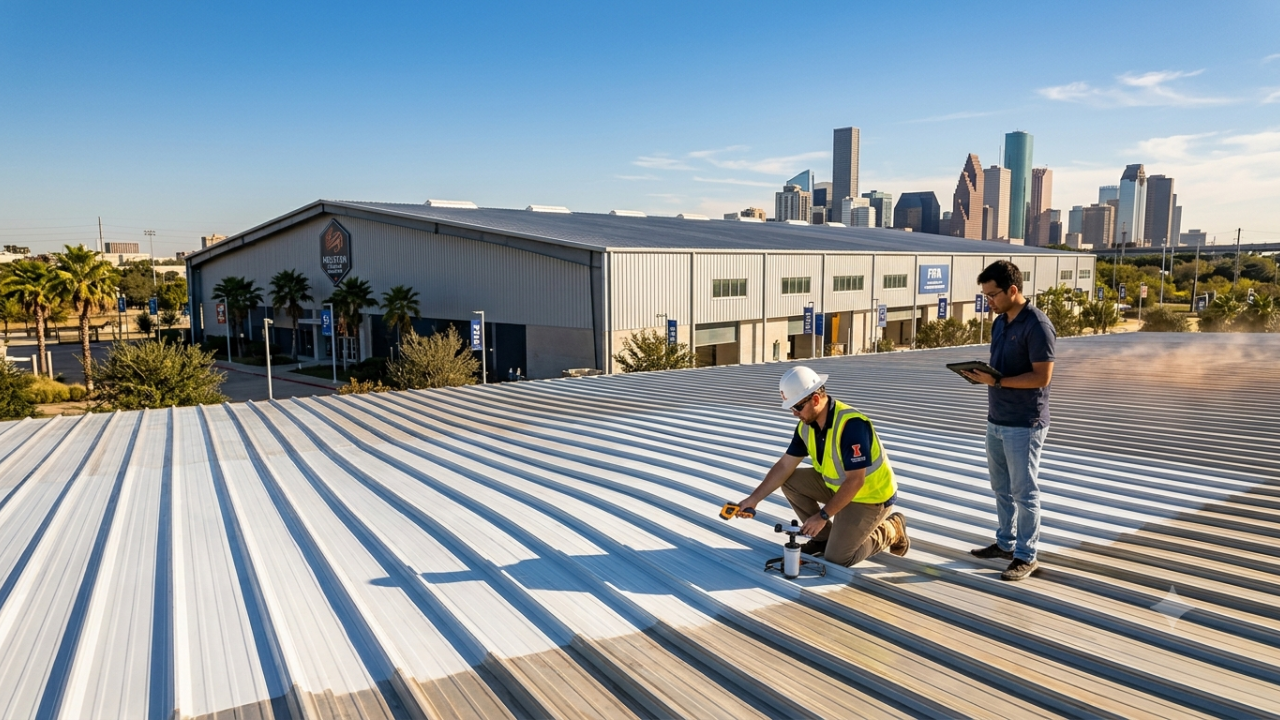
When researchers tested this technology on roofs in places like Houston, the results defied ordinary intuition. Without pulling a single watt from the electrical grid, the film kept test structures up to forty degrees Fahrenheit cooler than traditional roofs.
Forty degrees.
Think about what that means for a house like Elena’s. It means the thermal barrier holding back the Houston summer is no longer a fiberglass cushion bought at a hardware store; it is a fundamental redirection of the sun's energy.
The Invisible Architecture
We tend to look at technological progress through the lens of screens, microchips, and artificial intelligence. We celebrate what fits in our pockets or hums on our desks.
We forget that the most transformative technologies are often the ones we walk on, live under, and never touch at all.
Consider how cities are built. We paved them in asphalt, covered them in dark roofing, and created what urban planners call the urban heat island effect. Cities become self-heating ovens, trapping warmth in concrete canyons long after the sun goes down. Air conditioners pump heat out of indoor spaces and dump it directly onto the street, raising the outdoor temperature even further, which in turn forces air conditioners to work harder. It is a vicious, closed-loop feedback mechanism that drains wallets and destabilizes power grids.
Break that loop at the roofline, and the entire equation shifts.
If a roof can reject solar heat passively, the indoor temperature drops naturally. The attic ceases to be a convection furnace. The air conditioner, instead of running continuously for sixteen hours a day, takes long, restful breaks.
Let us be entirely transparent about the hurdles: this is a nascent technology transitioning from academic cleanrooms to commercial viability. Scaling up production, ensuring long-term durability against UV degradation, and making the material affordable for everyday homeowners requires time, capital, and manufacturing grit.
Yet the economic logic is undeniable. When you lower peak cooling loads by forty degrees, you do not just save a homeowner a few hundred dollars on their monthly electric bill. You alter the peak demand curve of entire municipalities. You prevent rolling blackouts during August heatwaves. You reduce the burning of fossil fuels at power plants miles away.
The stakes are invisible until the power flickers. Then they are blindingly clear.
The Quiet Shift
Back in Spring Branch, the afternoon sun is beginning its slow, orange descent toward the horizon.
The heat does not relent—not yet. The air outside remains thick enough to drink. But inside Elena’s kitchen, the air conditioner is quiet. For the past twenty minutes, it has been resting.
She walks over to the thermostat and checks the digital display. It reads seventy-four degrees. She did not have to crank it down to seventy-two. She did not have to negotiate with her budget.
She looks up toward the ceiling, past the drywall, past the attic joists, past the dark shingles baking in the twilight. She cannot see the microstructures. She cannot see the infrared radiation streaming out into the stratosphere. She cannot see the future arriving quietly on a roll of polymer film.
She only knows that the house feels different.
The weight has lifted. The home is no longer a combat zone fighting a losing battle against the sun. It has become something older, something simpler, something we lost somewhere along the way of building modern cities.
A shelter that actually protects you.