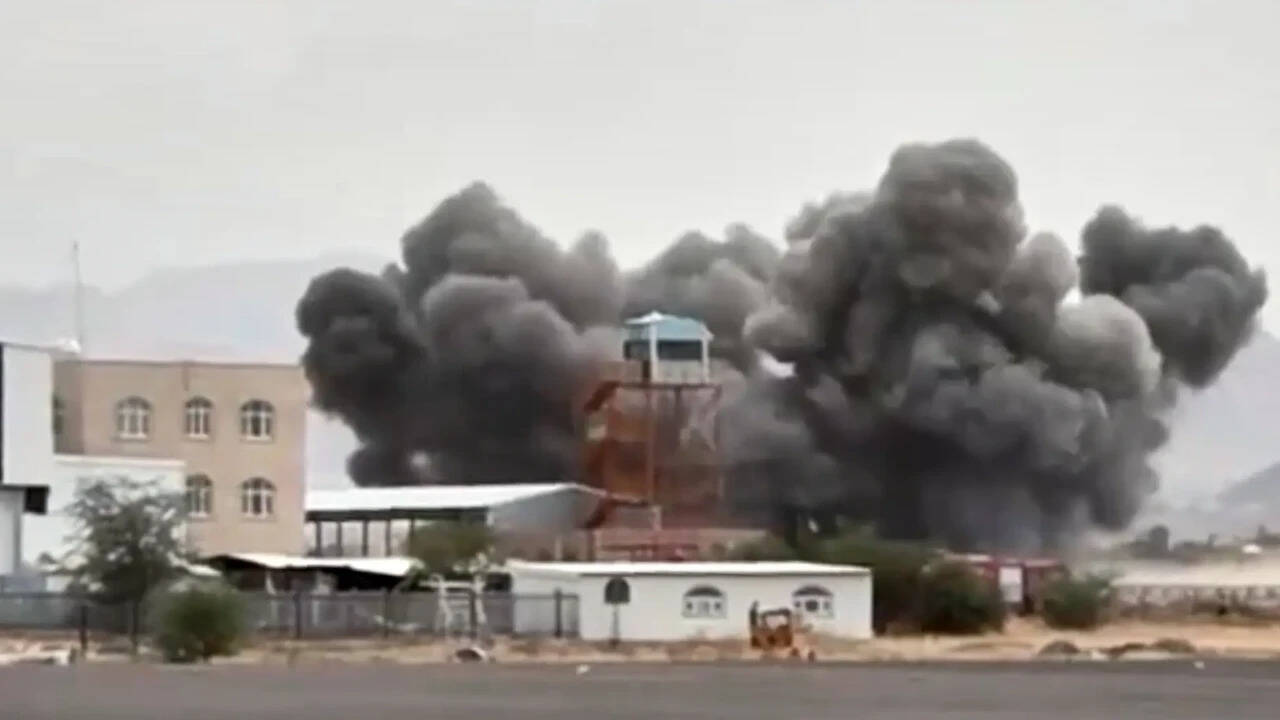
Sirens wailing across a darkened capital city aren't supposed to be routine. Yet, for millions living in Riyadh, the sudden flash of a Patriot missile streaking across the night sky to intercept an incoming projectile became an unsettling reality of modern asymmetric conflict. When Saudi Arabia reports that Houthi forces have targeted its capital with ballistic missiles or explosives-laden drones, the headlines usually focus on the interception statistics.
They talk about clean success rates. They mention Patriot batteries doing their job with clinical precision.
Reality is messier. A falling cluster of shrapnel doesn't care about interception percentages if it lands on a residential street or a busy highway. The psychological toll on a civilian population cannot be measured by military debriefs alone. People want to know why a rebel movement operating out of one of the poorest nations on earth keeps managing to threaten one of the wealthiest capitals in the Middle East.
The Mechanics of Interception Over a Crowded Skyline
Defending a sprawling metropolis like Riyadh is a logistical nightmare. You aren't just protecting a single military base; you're safeguarding millions of residents, sprawling commercial districts, vital water desalination plants, and massive energy infrastructure.
When a ballistic missile or a loitering munition clears Yemeni airspace and heads north, Saudi air defense operators have minutes—sometimes seconds—to make split-second decisions. The primary shield relies heavily on advanced surface-to-air missile systems, most notably the U.S.-made Patriot PAC-3 configuration. These systems track incoming signatures using sophisticated radar arrays and launch interceptors designed to destroy targets through direct kinetic impact.
It works on paper. It often works in practice.
However, math is an unforgiving master in warfare. A single interceptor battery costs millions of dollars per launch. Meanwhile, the Houthi forces can deploy cheap, Iranian-designed drones or modified Scud variants for a fraction of that cost. You don't need a degree in economics to see the long-term strain of an asymmetrical exchange rate where the defender spends a fortune to stop a low-cost nuisance that keeps coming back.
Asymmetric Warfare and the Logic of Cross-Border Strikes
Why do these strikes persist despite years of military intervention by the Saudi-led coalition? The answer lies in the strategic utility of disruption.
Houthi leadership knows they cannot win a conventional military campaign against the Saudi armed forces on the ground in Yemen or across the border. They don't have the heavy armored divisions, the advanced fighter jets, or the massive defense budgets. What they do have is strategic reach.
By launching projectiles toward Riyadh, King Khalid International Airport, or critical oil facilities belonging to Saudi Aramco, the movement achieves multiple objectives simultaneously. First, it boosts domestic morale among their fighters and supporters by projecting power far beyond their immediate front lines. Second, it imposes a constant economic anxiety tax on the Saudi state. Insurance premiums for shipping and aviation spike. Foreign investors pause to reevaluate risk profiles.
Third, and perhaps most importantly, it forces regional and international powers to take them seriously as a political actor. When you can disrupt flights at a major international aviation hub or trigger explosions over a G20 capital, you secure leverage at any negotiating table. You force diplomats from Washington, London, and the United Nations to fly into Muscat or Riyadh to plead for ceasefires.
The Regional Web of Support and Supply Chains
You cannot talk about these attacks without addressing the elephant in the room: external sponsorship. While Houthi engineers and technicians have grown remarkably adept at assembling, modifying, and launching ballistic missiles and drones, the foundational technology doesn't originate in the mountains of Saada.
Intelligence reports from the United Nations and various defense agencies have repeatedly highlighted smuggling routes across the Arabian Sea and the Gulf of Aden. Components arrive in pieces, often disguised in commercial cargo or smuggled through porous coastal regions. Once inside Yemen, underground workshops—sometimes built into caves or hidden beneath civilian infrastructure—reassemble the guidance systems, rocket motors, and carbon-fiber airframes.
This supply chain creates a frustrating dilemma for regional strategists. Bombing a launch site in Yemen might stop tonight's attack, but it does nothing to shut down the pipeline feeding the workshops. It's like mopping up a flooded kitchen while leaving the tap running wide open. Until the international community finds a way to decisively choke off illicit arms transfers at sea, Riyadh will remain within striking distance.
Beyond Kinetic Defense Toward Sustainable Deterrence
Military hardware can buy time, but it cannot buy peace. For years, the official stance relied heavily on a purely kinetic approach—shoot down what comes your way and strike back against launch platforms.
That mindset is shifting. Saudi Arabia's broader foreign policy pivot over recent years reflects a growing recognition that diplomatic engagement, economic diversification under Vision 2030, and regional de-escalation offer better long-term security than endless air defense drills. Direct talks with regional rivals have aimed to lower the temperature across the entire Arabian Peninsula, creating breathing room for localized truces and political settlements within Yemen itself.
At the same time, domestic defense manufacturing is ramping up. Riyadh is pouring resources into indigenous counter-drone technologies, directed-energy weapons, and layered radar networks that reduce reliance on expensive foreign interceptors. Building a more resilient domestic defense ecosystem means the country won't have to sweat every single supply chain bottleneck or diplomatic dispute with Western arms suppliers when tensions flare up again.
The sirens over Riyadh might not vanish overnight. Decades of entrenched conflict, proxy competition, and deep-seated grievances don't disappear because of a signed communiqué in a neutral European hotel. But understanding the mechanics behind these strikes—the economics, the technology, and the geopolitical calculus—reveals why defense is only half the battle. True security for Saudi Arabia requires drying up the motives and the supply lines that keep these missiles flying north in the first place.