The international health community is panicking over a math problem it manufactured out of thin air.
Headlines are sounding the alarm because the whereabouts of nearly 300 people contact-traced for Ebola in the Democratic Republic of the Congo (DRC) are currently listed as unknown. The immediate reaction from Western media and desk-bound bureaucrats is predictable: mobilize the search parties, deploy the tracking tech, and treat these 300 individuals as ticking epidemiological time bombs.
It is a spectacular misreading of how infectious disease outbreaks actually operate on the ground.
As someone who has spent years analyzing surveillance data in under-resourced health systems, I can tell you that trying to track down every single ghost on a contact list during an active outbreak is an expensive exercise in futility. It is a strategy built on bureaucratic vanity, not public health reality.
The Western obsession with perfect ledger data ignores a fundamental truth of the DRC: mobility is a survival mechanism, and a "missing" contact is usually just a normal human being avoiding an intrusive, terrifying system.
The Myth of the Floating Super-Spreader
The entire panic rests on a flawed premise: that 300 missing people equals 300 active chains of transmission wandering into major urban hubs.
Let us dissect the actual mechanics of Ebola transmission. You do not catch Ebola because someone coughed near you on a bus. Transmission requires direct contact with the bodily fluids—blood, vomit, feces—of a symptomatic, severely ill individual.
When a person develops full-blown Ebola, they are not casually backpacking across provinces. They are incapacitated. They are at home, or they are seeking care. The idea that hundreds of highly infectious, symptomatic people are actively evading authorities while smoothly traveling through dense rainforest or navigating complex security zones is an operational fantasy.
The overwhelming majority of these "missing" 300 individuals fall into three distinct, non-dangerous categories:
- Administrative Double-Counting: In the chaos of an outbreak response, names are misspelled, aliases are used, and individuals are registered multiple times across different health zones. A single person can easily become three separate "missing" files.
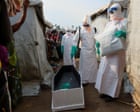
- The Fear Flight: When an outbreak team rolls into a village clad in full-body personal protective equipment (PPE) that resembles an alien invasion, people leave. They go to stay with family two villages over. They are not sick; they are just rational actors avoiding a coercive quarantine system.
- The Baseline Mobile Population: Artisanal miners, traders, and agricultural workers in eastern DRC move constantly for economic survival. They cross porous borders and use unofficial transit routes daily. They are not fleeing the WHO; they are just going to work.
By treating a data gap as an existential crisis, global health agencies divert finite resources away from what actually works: decentralized clinical care and community-led isolation.
The High Cost of Bureaucratic Cleanliness
Every dollar and hour spent trying to play detective in the jungle is a dollar and hour stolen from frontline clinics.
I have watched response teams burn through thousands of dollars in fuel and logistics just to locate a single contact who cleared their 21-day incubation window two weeks prior. Meanwhile, the local clinic down the road is short on basic rehydration fluids and personal protective equipment.
This is the downside of the contrarian reality: if we stop hunting the missing 300, we have to accept that our spreadsheets will look incomplete. It requires abandoning the comfort of the digital dashboard. Western donors love dashboards. They want to see clean metrics, 100% follow-up rates, and neat little charts.
But real public health in a conflict zone is messy. When you force local health workers to prioritize tracking down people who do not want to be found, you destroy the one asset that actually stops an outbreak: community trust.
When armed escorts or aggressive contact tracers hound a community, the entire population goes underground. Traditional healers become the default choice for care, hidden from the view of formal surveillance. That is how an outbreak spirals out of control. The surveillance apparatus itself becomes the vector for driving the disease further into the shadows.
The Flawed Premise of "People Also Ask"
If you look at what people ask during these panics, the questions themselves reveal how deeply the public has been misled by standard health journalism.
Does a missing contact mean the outbreak cannot be contained?
Absolutely not. Outbreaks are contained by isolating the sick and vaccinating the immediate ring of high-risk exposures. Containment does not require finding every casual contact. If a missing person never develops symptoms, their missing status is epidemiologically irrelevant. If they do get sick, the focus must be on making the nearest health center so well-equipped and trusted that they walk in voluntarily.
Why can't we use GPS or cell data to track contacts in the DRC?
This is the favorite suggestion of tech companies looking to secure lucrative government contracts. It fails for two reasons. First, device sharing is incredibly common; tracking a phone does not mean you are tracking the specific contact. Second, enforcing digital surveillance completely breaks the social contract between the health system and the community. The moment healthcare feels like policing, compliance drops to zero.
Shift the Capital from Chase to Care
Stop trying to fix the contact tracing ledger. Do this instead: reallocate every single resource currently dedicated to hunting low-risk missing contacts into decentralized, community-managed isolation units.
People hide because they view the official treatment centers as isolation prisons where people go to die. Flip that incentive. If a community knows that their local clinic has the latest monoclonal antibody treatments, supportive care, and allows family members to safely view and communicate with patients, they will not run away. They will bring the sick to you.
The data gap is not the enemy. The obsession with closing it is.
The next time an international agency screams about hundreds of missing contacts, ignore the panic. The virus does not care about our incomplete spreadsheets, and neither should we. Stop hunting ghosts and start treating the patients right in front of you.


