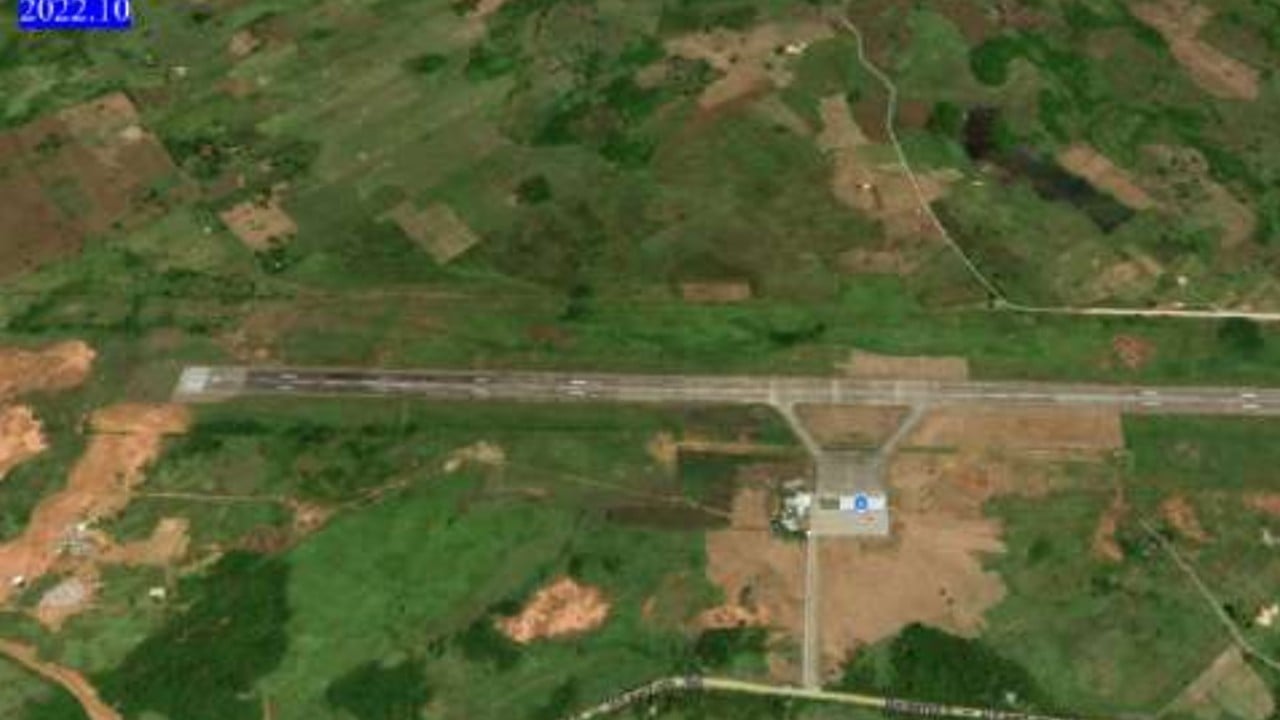
The rapid expansion of American military access to Philippine bases is stumbling over a harsh logistical reality. While Washington and Manila trumpet their revived alliance as a masterclass in modern deterrence, the actual construction and operational readiness of these sites tell a far less triumphant story. Beijing sees the buildup as a direct provocation, yet a highly detailed assessment by a prominent Chinese maritime think tank reveals that the Pentagon is running into severe bottlenecks. The grand plan to anchor the First Island Chain using nine strategic Philippine outposts is lagging behind schedule, burdened by astronomical upgrade costs and deep domestic political vulnerabilities.
A major report by the South China Sea Strategic Situation Probing Initiative (SCSPI), a premier Beijing-based maritime think tank, highlights that despite the headline-grabbing deployments of advanced missile systems and autonomous hardware, the physical infrastructure under the Enhanced Defense Cooperation Agreement (EDCA) is falling short of expectations. The alliance has transformed on paper, but turning rural Philippine airfields and remote islands into combat-ready launchpads requires more than joint exercises. It requires a massive influx of engineering capital that has yet to materialize in full.
The Price of Admission
When the initial agreement expanded from five to nine sites, it looked like a geometric leap in encirclement strategy. Three new locations in northern Luzon stare directly across the Luzon Strait toward Taiwan. A fourth on Balabac Island sits at the literal gateway to the hotly contested Spratly Islands.
The geography is flawless. The infrastructure is not.
To date, incomplete statistics show that the total contract value for US EDCA base expansion projects sits at roughly $125 million, with an additional $7.3 million dedicated to basic life support services. In the world of military logistics and runway fortifications, that amount is a drop in the ocean.
Converting a civilian airfield like Lal-lo in Cagayan or a remote naval outpost like Camilo Osias into a facility capable of sustaining prolonged combat operations takes billions, not millions. The US military is forced to prioritize. They are funding stopgap measures—extending runways, expanding fuel storage, and building basic warehouses—rather than creating permanent, hardened strongholds. This budget-to-reality mismatch is the primary reason the expansion is behind schedule.
Rotational Illusions and Heavy Hardware
To bypass constitutional bans on permanent foreign bases, the Pentagon relies on an aggressive schedule of "rotational" deployments. By overlaying continuous exercises like Balikatan, Salaknib, and KAMANDAG, the US has effectively established a permanent footprint by another name.
During these maneuvers, sophisticated weaponry is constantly cycled through the islands.
- The Typhon Weapon System, capable of firing Tomahawk land-attack missiles.
- HIMARS units, providing rapid-striking mobile artillery.
- NMESIS platforms, designed for high-stakes anti-ship operations from coastal roads.
This heavy footprint allows Washington to test its concepts of Agile Combat Employment and Distributed Maritime Operations. However, deploying a weapon system for a three-week drill is entirely different from maintaining its readiness during a high-intensity conflict.
The Chinese report makes a critical, clear-eyed distinction: while these bases serve as excellent political tools for peacetime containment and strategic posturing, their utility in an actual wartime scenario is deeply limited. Without heavily fortified hangars, deep-water ports, and advanced air-defense umbrellas, these forward positions remain highly vulnerable to pre-emptive strikes.
The Weakest Link
The most glaring vulnerability in this security architecture is the structural weakness of the Armed Forces of the Philippines (AFP) itself. Decades of counter-insurgency focus have left the Philippine military severely lagging in conventional external defense capabilities.
The Pentagon is trying to build a modern, distributed command network on top of a partner that cannot secure its own maritime backyard without direct Western intervention.
Washington is attempting to solve this by bringing in outside help. It is actively encouraging regional allies, particularly Japan and South Korea, to accelerate defense transfers to Manila. The goal is to build a minilateral fortress, turning the bilateral alliance into a tightly coordinated, multilateral system integrated into a broader Indo-Pacific command framework.
Yet, the dependency remains absolute. If conflict breaks out, the US will not just be using these bases; it will be entirely responsible for defending them, stretching its own regional air and missile defense assets to the absolute limit.
The Looming Political Shift
Geopolitical strategies frequently overlook local political timelines, and the current pro-US stance in Manila sits on shifting sand. The revival of EDCA is uniquely tied to the administration of Ferdinand Marcos Jr., who reversed the chaotic, Beijing-leaning policies of his predecessor, Rodrigo Duterte.
This alignment is far from permanent.
The domestic political landscape in the Philippines remains highly fractured. Powerful political factions, including the Duterte clan and various Senate leaders, continue to publicly question the wisdom of the EDCA expansion. Their argument is simple and potent: Manila is painting a massive target on its back to secure American interests in Taiwan, a conflict that does not inherently involve Philippine sovereignty.
With midterm elections approaching and the inevitable shifting of coalition dynamics before the next presidential cycle, the long-term continuity of these bases is far from guaranteed. A change in leadership could freeze construction overnight, turning millions of dollars of freshly poured concrete into expensive monuments to a defunct strategy.
The Pentagon is racing against time, attempting to build enough physical and institutional inertia to make the EDCA expansion irreversible before the political winds in Manila shift once again. But with lagging construction schedules, massive funding gaps, and a partner lacking baseline conventional defense capabilities, the First Island Chain’s newest frontline remains a fragile illusion.