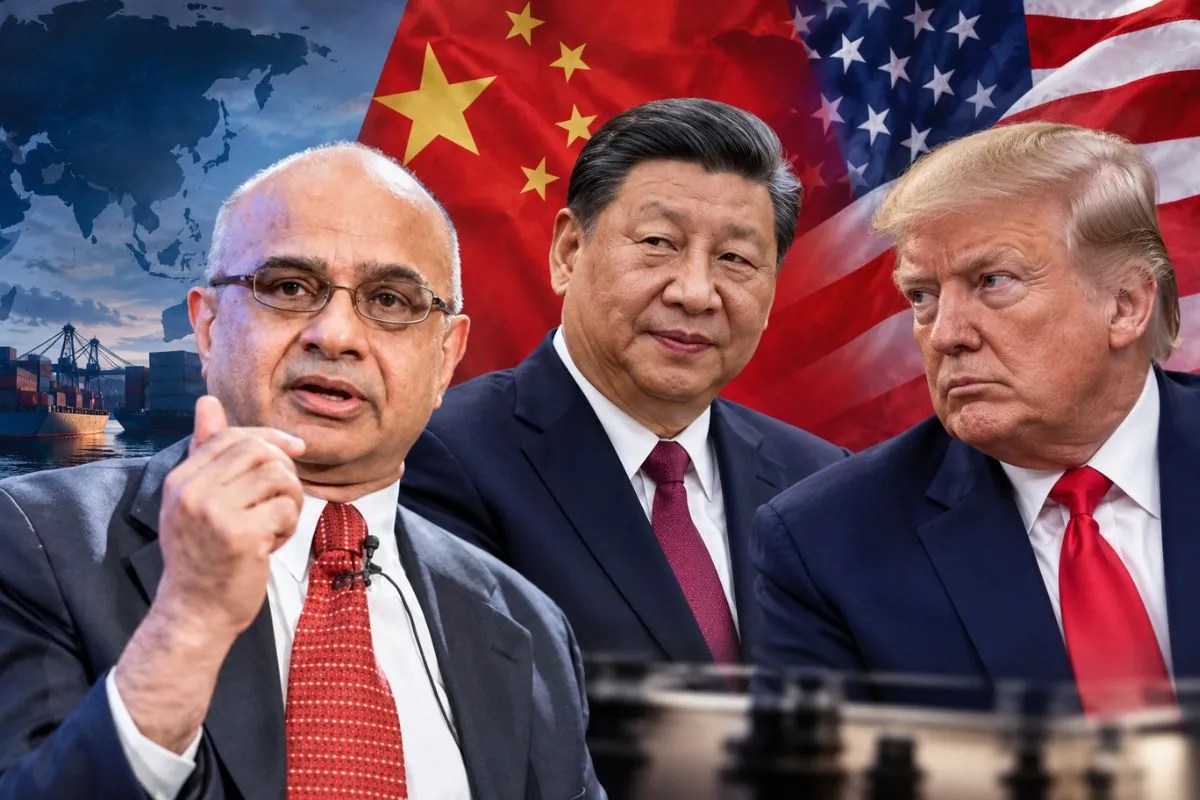
Every strategic analyst in New Delhi is currently hyperventilating over a ghost. The recurring panic centers on a resurrected G2 hypothesis—the whispered fear that Washington and Beijing will cut a backdoor condominium over the global order, carving up Asia while India watches from the sidelines like an uninvited guest at a high-stakes poker game. Brahma Chellaney and a chorus of cautious realists warn that our partners are nervous, that our strategic autonomy is under siege, and that a bilateral superpower pact will relegate India to a permanent second-tier power.
It is a comfortable narrative for pundits who love a good tragedy. It is also completely wrong.
I have spent decades watching foreign policy boardrooms panic over phantom trends while missing the tectonic shifts happening right under their feet. The lazy consensus assumes that Washington and Beijing possess the institutional coherence, mutual trust, and economic leverage to manage a condominium over global affairs. They do not. A G2 is not an emerging reality; it is a structural impossibility.
The Structural Decay of Bipolar Nostalgia
To understand why the G2 concept belongs in the dustbin of bad political science, you have to look at the mechanics of contemporary statecraft. A G2 requires two willing, highly aligned superpowers capable of enforcing order on the periphery. What we actually have is a state of advanced, irreversible systemic decoupling wrapped in mutual economic dependency.
Washington cannot partner with Beijing because the structural drivers of American grand strategy are fundamentally adversarial. Beijing cannot partner with Washington because the Chinese Communist Party’s domestic legitimacy rests on aggressive revisionism and the displacement of American hegemony in the Indo-Pacific. When analysts worry that a bilateral handshake will bypass New Delhi, they are projecting Cold War-era bipolarity onto a multipolar, fractured reality. They assume that great powers can simply sit down in a smoke-filled room and divide spheres of influence as if it were 19th-century Europe.
That world died the day supply chains diversified and technological sovereignty became national security priority number one. You cannot build a condominium with a nation whose entire economic model depends on hollowing out your industrial base.
The Real Threat Is Our Own Paralysis
The danger to India is not a US-China deal. The real danger is that our obsession with being left out of a nonexistent G2 paralyzes our own agency. When we frame our foreign policy around the anxiety of being bypassed, we react instead of dictate. We hedge so cautiously that we end up standing still.
Look at the data. India’s strategic value to the West is not derived from being a junior partner or a buffer state; it is derived from our capacity to anchor a resilient, alternative economic and security architecture in the Indo-Pacific. The Quad, bilateral technology initiatives, and domestic industrial policies like production-linked incentives are not consolation prizes for missing out on a great power club. They are the scaffolding of a new order where New Delhi sets the terms.
When critics argue that neighboring capitals and Western allies are growing anxious about India’s independent posture—particularly regarding our multi-aligned stance on Russia and trade—they misread Western pragmatism. Washington does not need a vassal; Washington needs a heavy counterweight. And counterweights do not coordinate their moves based on whether two rivals are talking to each other. They act because their sovereign interests demand it.
Dismantling the Autonomy Myth
Let us address the sacred cow of Indian strategic thought: strategic autonomy. For decades, this phrase has been used as diplomatic shorthand for non-committal hesitation, wrapped in moral superiority. But autonomy without leverage is just isolation with a press secretary.
If a G2 were actually forming, our best defense would not be issuing anxious op-eds or clinging to outdated non-aligned dogmas. It would be accelerating our manufacturing velocity, scaling our high-tech capabilities, and deepening maritime security integration to a point where no global architecture can function without Indian consent.
Washington and Beijing are locked in a protracted, structural tech-cold war. Semiconductors, artificial intelligence, rare earths, and maritime chokepoints are the battlegrounds. In this arena, India is not a spectator. We are the most critical swing state on the chessboard. The idea that Washington would trade away its long-term partnership with the world's fastest-growing major economy and preeminent democratic counter-weight to China for a transient deal with Beijing is geopolitically illiterate.
Stop fearing the handshake that will never happen. Start building the power that makes everyone else ask for yours.