The global expansion of Artificial Intelligence infrastructure is currently throttled not by silicon scarcity or capital availability, but by a physical localized bottleneck: the social license to operate. As Big Tech firms—primarily Microsoft, Google, and Amazon—scramble to secure the hundreds of gigawatts required for the next generation of LLM training and inference, they have encountered a "not-in-my-backyard" (NIMBY) resistance that threatens to stall hyperscale deployment. To navigate this, the industry is shifting its public relations strategy from a narrative of "digital transformation" to one of "industrial revitalization." By aligning with organized labor and blue-collar unions, tech giants are attempting to reframe data centers from sterile, automated warehouses into the new cathedrals of American manufacturing.
The Tri-Factor Conflict of Data Center Deployment
The friction between hyperscalers and local municipalities stems from three specific structural misalignments. Understanding these variables explains why traditional corporate social responsibility (CSR) initiatives have failed to provide the necessary friction-less expansion.
- The Resource-to-Utility Ratio: Data centers are intensive consumers of localized resources, specifically land, water (for evaporative cooling), and high-voltage electricity. Historically, the utility to the local community was low, characterized by high resource extraction with minimal job creation compared to traditional manufacturing.
- Tax Base Volatility: While data centers provide significant property tax revenue, many jurisdictions find that the depreciation of server hardware occurs so rapidly that the long-term tax yields are less stable than industrial sites with longer-lived equipment.
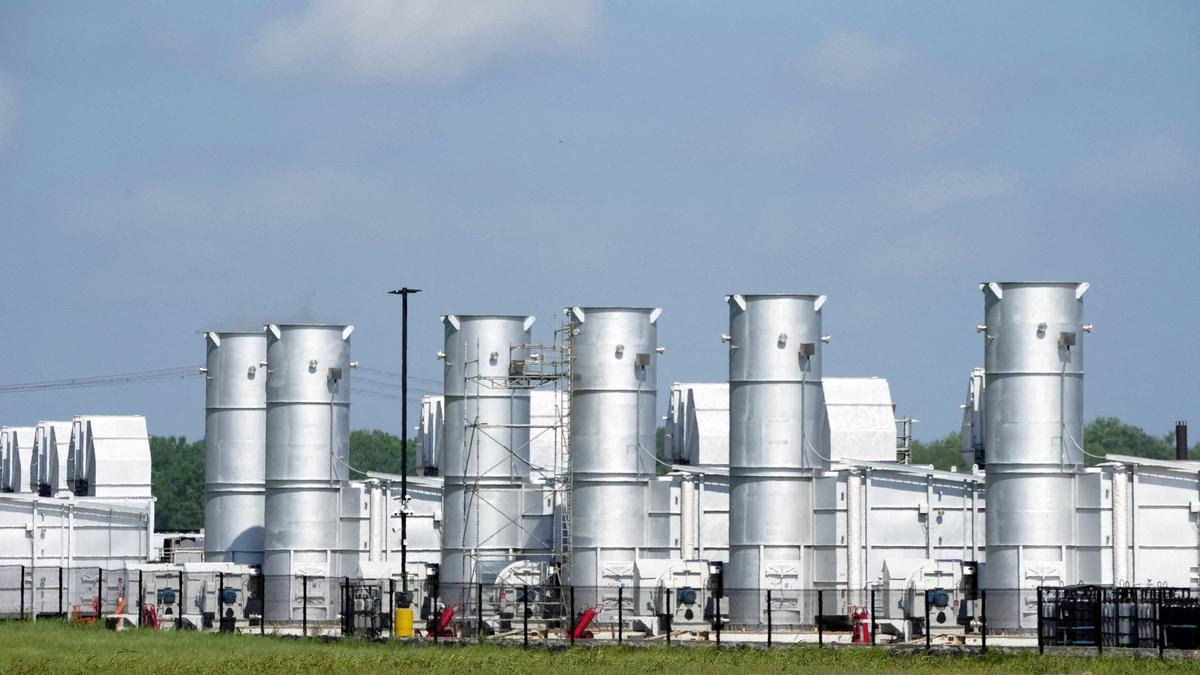
- The Aesthetic-Acoustic Burden: Unlike a distribution center, a data center generates a constant high-frequency acoustic signature from cooling fans and HVAC systems, creating a permanent environmental nuisance for residential zoning adjacent to industrial plots.
The Labor Alignment Strategy: A Structural Pivot
The tech industry's "blue-collar ally" is not a philanthropic partnership but a calculated strategic hedge. By signing Project Labor Agreements (PLAs) with building trades unions, tech giants convert a potential source of political opposition into a formidable lobbying force. This strategy operates on a logic of concentrated benefits and diffused costs.
The Construction-Operations Paradox
The primary criticism of data centers is that they "create no jobs." This is a misunderstanding of the job lifecycle. While a 100MW data center may only require 30 to 50 full-time operational staff (mostly security and site reliability engineers), the construction phase requires thousands of high-wage, specialized trade workers.
- Electricians: The power density of AI clusters (moving from 10kW per rack to 100kW+) requires an unprecedented level of complex electrical infrastructure.
- Pipefitters and HVAC Technicians: The transition to liquid-to-chip cooling necessitates industrial-grade plumbing that exceeds the requirements of standard commercial real estate.
- Civil Engineers: The load-bearing requirements for high-density GPU racks demand reinforced concrete foundations and specialized structural steel.
By guaranteeing that these roles are filled by union labor, hyperscalers secure a political proxy. When a local zoning board debates a new campus, the most vocal advocates are no longer "out-of-town tech bros," but local union leaders representing thousands of residents who see the project as a multi-year wage guarantee.
Quantifying the Economic Flywheel of Infrastructure
The economic impact of a data center must be measured through a "Multi-Phase Value Chain" rather than a snapshot of permanent employees.
Phase 1: The Capital Expenditure (CapEx) Injection
This phase represents the highest density of local economic activity. For a $1 billion data center, approximately 30-40% of the cost is attributed to labor and local materials. This creates an immediate, albeit temporary, surge in local tax revenue and secondary service spending (housing, food, transport for workers).
Phase 2: The Grid Modernization Subsidy
To support a 500MW site, the hyperscaler often pays for significant upgrades to the local electrical substation and transmission lines. In many regulatory environments, these "behind-the-meter" investments improve grid reliability for the broader community, effectively acting as a private subsidy for public infrastructure.
Phase 3: The Sustained Property Tax Floor
Even with accelerated depreciation, the sheer scale of the buildings ensures a high baseline of property tax. For rural counties, a single data center can represent 20% or more of the total tax base, enabling the lowering of residential property taxes or the funding of school districts without increasing the burden on citizens.
The Physics of Resistance: Power and Water
Despite the labor alliance, two physical constraints remain that no amount of PR can fully mitigate: the heat rejection limit and the grid's thermal ceiling.
The transition to AI-specific hardware (GPUs and TPUs) has shifted the power density profile. Traditional "air-cooled" data centers are becoming obsolete because air is a poor medium for heat transfer at high densities. The industry is forced toward liquid cooling. This creates a new friction point: consumptive water use. In water-stressed regions like Arizona or parts of the Netherlands, the "jobs" argument loses weight against the "drought" argument.
Hyperscalers are attempting to solve this via "Water Positive" pledges—investing in local watershed restoration—but the engineering reality is that heat must go somewhere. If it does not go into the water, it goes into the air, increasing the local ambient temperature (the urban heat island effect), which further irritates local residents.
The Geopolitical Imperative as a PR Shield
The most sophisticated layer of the current strategy is the framing of data center expansion as a matter of National Security. By linking local planning permissions to the "AI Arms Race" against China, tech giants are elevating their projects from commercial ventures to patriotic necessities.
This creates a high-pressure environment for local regulators. To deny a data center permit is no longer just a local zoning decision; it is framed as a setback for national technological sovereignty. This "Sovereign AI" narrative is particularly effective in the United States and Europe, where there is a bipartisan appetite for re-shoring critical infrastructure and reducing dependence on foreign supply chains.
The Regulatory Fragility of the Status Quo
The current strategy of using labor unions as a vanguard has limitations. The primary risk is the "Project Labor Agreement" itself. While PLAs secure union support, they also increase construction costs by 10% to 20%. In a high-interest-rate environment, the cost of capital may eventually make these "social license" premiums unsustainable.
Furthermore, the "job creation" narrative has an expiration date. Once the construction is complete, the community is left with a massive, windowless monolith that employs fewer people than a medium-sized grocery store. If the promised "downstream tech ecosystem" (startups and secondary businesses moving to the area) fails to materialize, the community sentiment can sour rapidly, leading to "post-occupancy" taxes or stricter environmental regulations that target operational sites.
Strategic Execution: The Industrial Realignment Playbook
To ensure the long-term viability of AI infrastructure, the industry must move beyond the "temporary construction jobs" argument and integrate the data center into the local industrial fabric.
- District Heating Integration: Instead of rejecting heat into the atmosphere, data centers must be designed to pipe waste heat into local municipal heating systems or agricultural greenhouses. This turns a "nuisance" (heat) into a "utility."
- Dual-Use Infrastructure: Hyperscalers should co-locate data centers with renewable energy generation (on-site solar or wind) and battery storage. This allows the data center to act as a "virtual power plant," stabilizing the grid during peak demand rather than just draining it.
- The Vocational Pivot: Instead of promising "high-tech" jobs that require Ivy League degrees, the focus should be on training local community college students in high-voltage electrical maintenance and industrial HVAC operations. These are the "blue-collar" roles that are actually required to keep a data center running.
The winners of the AI era will not be the companies with the best algorithms, but the companies that can build the most physical capacity. Achieving that capacity requires a move away from "Digital Exceptionalism" and a return to the principles of heavy industrial development. The path to the AGI future is paved by the heavy machinery of the present, and the tech giants who realize they are actually industrial utility companies will be the ones who successfully scale.