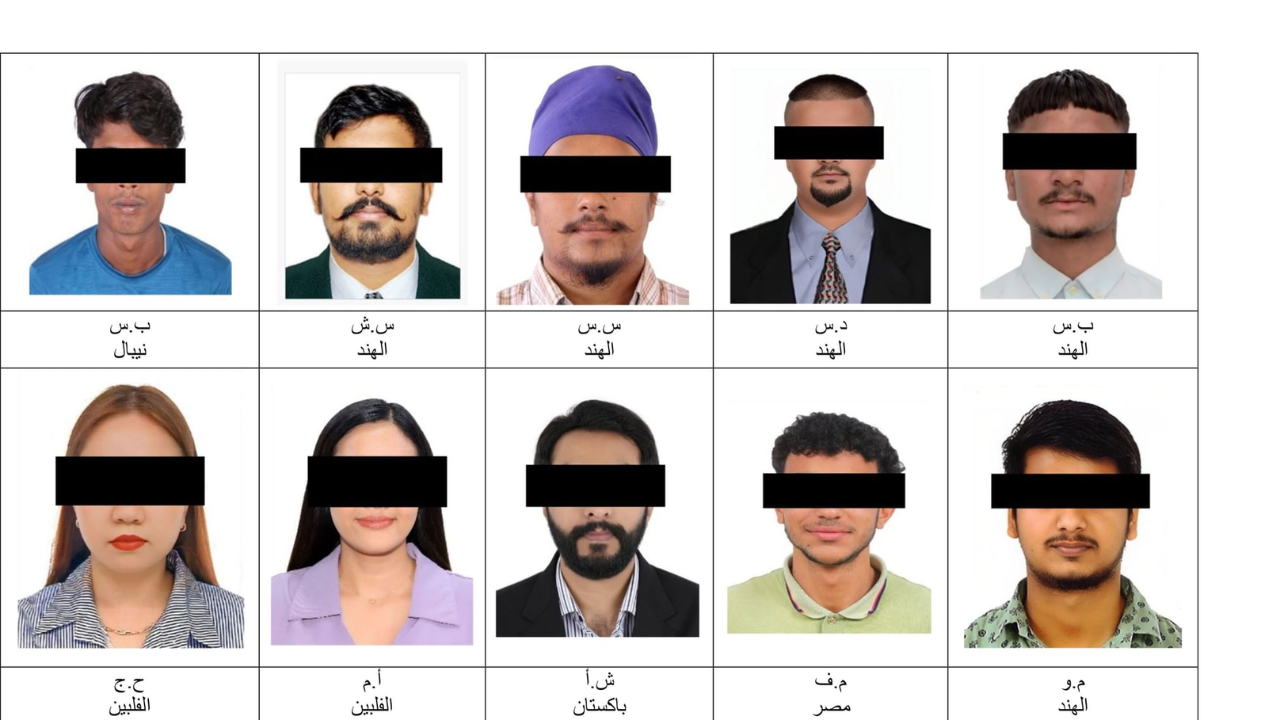
The arrest of 25 individuals by UAE authorities for the dissemination of misleading content and the glorification of military aggression is not an isolated law enforcement action but a targeted application of Information Deterrence. In a geopolitical environment characterized by hybrid threats, the state treats digital discourse as a theater of national security. This intervention demonstrates a shift from reactive policing to a proactive containment strategy designed to mitigate the "Contagion Effect" of unauthorized narratives. To understand the logic behind these arrests, one must analyze the intersection of the UAE’s Federal Decree-Law No. 34 of 2021 on Combatting Rumors and Cybercrimes with the broader strategic objective of social cohesion.
The Triad of Digital Subversion
The state’s crackdown targets three specific vectors of information risk. These are categorized by their potential to destabilize the internal security equilibrium:
- Narrative Distortion: The intentional fabrication or manipulation of facts to create a false perception of state policy or external events.
- Militaristic Incitement: Content that praises or encourages unauthorized military action, which compromises the state’s monopoly on the use of force and its diplomatic neutrality.
- Institutional Erosion: Media that targets the credibility of national symbols or security apparatuses, thereby weakening the social contract.
The recent arrests specifically addressed the second vector. In the context of regional volatility, "glorifying military aggression" is viewed through a risk-assessment lens: it invites retaliatory cyber-attacks, triggers diplomatic friction, and can radicalize domestic populations. By enforcing strict boundaries, the UAE signaling that its digital space is a regulated utility, not a public square of absolute privilege.
The Mechanics of Federal Decree-Law No. 34
The legal architecture supporting these arrests is built on the principle of Proportional Liability. Under Article 43 and Article 44 of the 2021 Cybercrime Law, the threshold for criminality is not the intent of the user, but the potential or actual impact on public order.
Structural Definitions of Offenses
- Misleading Content: This is defined as any data, news, or reports that contradict officially released information from government sources. The law removes the "subjectivity defense" by establishing the state as the sole arbiter of factual truth regarding national interests.
- Public Incitement: This involves any digital communication that encourages acts that would jeopardize the interests of the state. The arrests of these 25 individuals suggest that "glorification" is being interpreted legally as a form of incitement, as it validates illegal violence as a social or moral good.
The cost function for these violations is significant. Penalties involve a combination of incarceration and fines ranging from AED 100,000 to AED 500,000. For the state, these fines serve as a friction mechanism, increasing the "cost of entry" for those considering the dissemination of inflammatory content.
The Cognitive Security Framework
The UAE’s strategy rests on the concept of Cognitive Security—the protection of the collective mental space of a population from manipulation. When 25 individuals are removed from the digital ecosystem simultaneously, the state is performing a "network pruning" operation.
The Feedback Loop of Digital Unrest
Information instability follows a predictable feedback loop that the UAE legal system seeks to interrupt:
- Trigger Event: A regional conflict or a controversial policy change occurs.
- Amplification: Individual users or "influence nodes" post content that simplifies complex geopolitics into binary, aggressive narratives.
- Validation: Algorithm-driven echo chambers reinforce these narratives, creating a false sense of consensus.
- Mobilization: The digital sentiment translates into physical-world risks, such as protests, vigilantism, or unauthorized recruitment for foreign causes.
By intervening at the Amplification stage, the Public Prosecution prevents the cycle from reaching the Mobilization phase. This is a cold, mathematical approach to social stability: if the "R" value (reproduction rate) of a misleading narrative stays below 1.0, the narrative dies out naturally.
Algorithmic Sovereignty and Surveillance Capabilities
The speed of these arrests highlights the UAE’s investment in Signal Intelligence (SIGINT) and automated monitoring. The state does not rely on manual reporting alone; it utilizes natural language processing (NLP) to scan for keywords and sentiment patterns that correlate with known subversion profiles.
The technical bottleneck for many nations is the inability to distinguish between "organic dissent" and "coordinated inauthentic behavior." The UAE bypasses this distinction by making the content itself the violation, regardless of whether it was posted by a bot or a citizen. This creates a high-certainty legal environment where the evidence is immutable (the digital trail) and the interpretation is fixed by the Decree-Law.
Strategic Constraints and Systemic Risks
While the strategy of aggressive information deterrence is effective in maintaining immediate order, it carries inherent systemic risks that analysts must quantify:
- The Transparency Paradox: By strictly controlling the narrative, the state may inadvertently create a vacuum that is filled by encrypted, dark-web channels. If users feel the "clearnet" is too heavily monitored, they migrate to platforms where the state has less visibility.
- International Perception Costs: High-profile arrests for "content" often clash with Western-aligned indices on press freedom. The UAE accepts this trade-off, prioritizing internal stability and Foreign Direct Investment (FDI) over abstract liberty metrics.
- Narrative Fragility: If the official state narrative is ever proven factually incorrect, the lack of a "buffer zone" of independent media can lead to a more rapid collapse of public trust than in a system where diverse viewpoints are tolerated.
The Economic Dimension of Information Control
There is a direct correlation between information stability and the UAE's status as a global hub for finance and tourism. Capital is allergic to volatility. By treating "misleading content" as a criminal offense, the UAE is essentially de-risking its brand.
A digital environment characterized by glorification of military aggression suggests a country on the brink of conflict. By suppressing these signals, the government maintains a perception of a "Safe Haven" (The Switzerland of the Middle East). The 25 arrests are, in this sense, a regulatory maintenance cost for the nation’s credit rating.
Operational Directives for Residents and Entities
To navigate this landscape, individuals and corporate entities must adopt a policy of Information Neutrality. This involves several tactical steps:
- Source Verification: Only disseminating data that originates from the Emirates News Agency (WAM) or specific Ministry portals.
- Audit of Engagement: Reviewing past social media activity for any content that could be interpreted as "glorifying" non-state actors or foreign military operations.
- Algorithmic Awareness: Understanding that "liking" or "sharing" carries the same legal weight as "authoring" under the current interpretation of the Cybercrime Law.
The state’s move signals an end to the era of digital ambiguity. In the UAE, your digital footprint is an extension of your legal personhood, subject to the same rigors as physical conduct.
The strategic play for the UAE is the institutionalization of this deterrence. Expect an increase in public awareness campaigns that frame these arrests not as "censorship," but as "digital hygiene." The government will likely expand its definition of misleading content to include economic speculation that threatens the Dirham or the real estate market.
The final move for any observer is to recognize that the UAE has redefined the boundary of the state. It no longer ends at the border; it extends to every byte of data generated within its jurisdiction. Stability is not a passive state; it is an actively managed output of a high-resolution surveillance and legal engine.