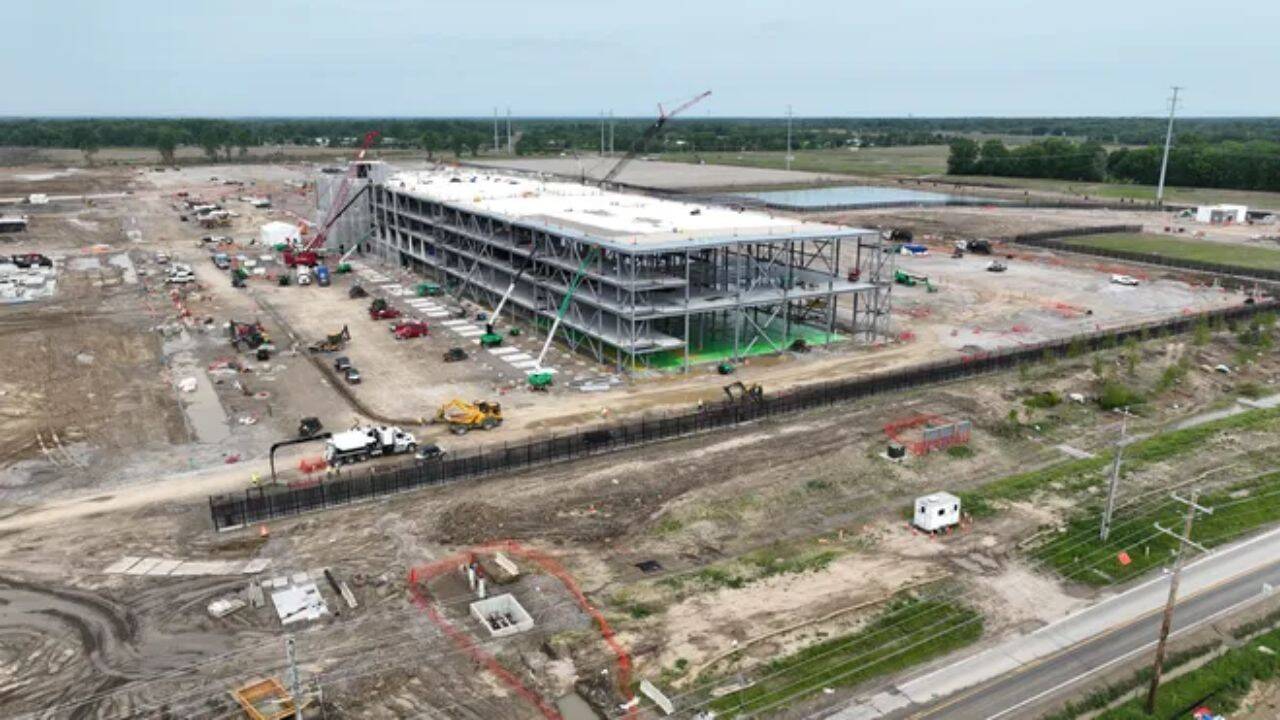
Municipal resistance to hyperscale data center development in Ohio represents a predictable market friction between localized physical resource limits and centralized digital capital allocation. When residents organize to block multi-billion-dollar projects—such as the $5 billion Amazon Web Services expansion facing zoning and regulatory hearings—they are reacting to an asymmetric distribution of costs and benefits. Cloud infrastructure providers capture global revenue from compute capacity, while local municipalities absorb concentrated impacts on electrical grid stability, municipal water tables, and land-use density. Understanding this conflict requires breaking down the thermodynamic, economic, and regulatory mechanics governing modern data center siting.
The Thermodynamic and Grid Reality of Hyperscale Expansion
Standard reporting frames municipal opposition around vague environmental concerns or general neighborhood disruption. In reality, local pushback is anchored in the physical physics of power distribution and thermal management. A single hyperscale campus does not operate like a traditional commercial warehouse; it functions as an industrial-scale thermodynamic engine that converts massive amounts of electrical energy into low-grade waste heat.
To understand why a $5 billion project triggers immediate regulatory friction, one must examine the three primary physical resource constraints at the municipal level:
Baseload Power Absorption and Substation Saturation
Hyperscale facilities require continuous, uninterrupted baseload power measured in hundreds of megawatts—frequently exceeding the residential load of the entire host municipality. When a developer proposes a project of this scale, the regional transmission organization and local utility must allocate existing substation capacity or construct new high-voltage transmission corridors. For residents, this manifests in two ways: the visual and spatial disruption of new transmission lines crossing residential or agricultural zoning, and the upward pressure on retail electricity rates when grid upgrade costs are socialized across the broader ratepayer base rather than ring-fenced to the industrial consumer.Consumptive Water Use in Evaporative Cooling
Server racks generate dense thermal loads that air cooling alone cannot dissipate efficiently in humid continental climates like Ohio. To maintain optimal Power Usage Effectiveness ratios, operators rely on evaporative cooling towers. Unlike residential water usage, where roughly 90 percent of drawn water returns to the municipal wastewater system for treatment and reuse, evaporative cooling is consumptive. The water is vented into the atmosphere as vapor. During summer peak-load months—when ambient temperatures rise and server cooling demands spike—a hyperscale campus draws millions of gallons per day from local aquifers or surface reservoirs, directly competing with agricultural irrigation and municipal residential supply.Acoustic Profile and Low-Frequency Resonance
Industrial chillers, rooftop HVAC arrays, and backup diesel generator testing produce continuous broadband and low-frequency noise. While standard municipal zoning codes measure sound in A-weighted decibels, low-frequency hum propagates further through structural materials and atmospheric inversions than high-frequency noise. Residents living adjacent to newly rezoned industrial parcels experience chronic acoustic intrusion that standard sound-attenuation berms fail to block.
The Municipal Fiscal Asymmetry
The core economic tension in Ohio’s data center corridor stems from a structural mismatch between state-level tax incentives and local infrastructure liabilities. State economic development agencies routinely deploy aggressive tax abatements—specifically exemptions on sales and use taxes for server hardware and enterprise software—to attract capital investment. From a macroeconomic perspective, the state views a $5 billion capital commitment as a validation of its business climate.
At the county and township level, the fiscal math operates differently. Data centers exhibit an exceptionally low employment-to-capital ratio compared to traditional manufacturing. Once the 18-to-24-month construction phase concludes, a multi-billion-dollar server campus requires a relatively small permanent workforce of facility engineers, security personnel, and technicians.
Because personal property taxes on business equipment were largely phased out in Ohio, local taxing districts rely heavily on real property assessments and municipal income taxes. When developers negotiate Payment in Lieu of Taxes agreements or Community Reinvestment Area abatements to reduce their real estate tax obligations, local school districts and townships forfeit the primary revenue stream meant to offset infrastructure wear. Residents observe massive industrial footprints consuming local land and grid capacity while generating minimal payroll tax revenue for municipal services.
Regulatory Friction and the Zoning Hearing Mechanism
Public hearings, such as the November 10 review facing the Amazon proposal, serve as the primary legal bottleneck where macroeconomic strategy collides with hyper-local land-use law. In Ohio, zoning authority is heavily decentralized, resting with township trustees, municipal planning commissions, and county commissioners.
When residents push for a data center ban or moratorium, they are exploiting a vulnerability in municipal zoning codes. Most township zoning resolutions were drafted decades ago and lack specific classifications for hyperscale compute facilities. Developers typically seek to build under legacy "light industrial" or "warehouse and distribution" designations, or they petition for Planned Unit Development rezonings on agricultural land.
Resident coalitions challenge these applications through three distinct procedural vectors:
- Comprehensive Plan Inconsistency: Opponents argue that converting prime agricultural land or buffer zones into high-density utility infrastructure violates the municipality’s long-term comprehensive land-use plan, creating legal grounds for judicial review if the zoning board approves the variance.
- Infrastructure Adequacy Mandates: Zoning codes routinely require applicants to prove that existing public utilities—water, sewer, and roads—can support the proposed use without degrading service for current residents. By demanding independent hydrological and grid-impact studies prior to zoning approval, opponents force multi-month delays that disrupt hyperscale deployment schedules.
- Ballot Referendum Threats: Under Ohio law, township zoning amendments approved by trustees are subject to citizen referendum if opponents gather a sufficient threshold of valid signatures within 30 days. The credible threat of a ballot referendum transforms a technical land-use decision into a direct political liability for elected local officials, incentivizing them to impose temporary moratoriums to study the issue rather than risk immediate electoral backlash.
Operationalizing Community Resistance: Why Standard PR Fails
Hyperscale developers consistently misdiagnose municipal resistance as a public relations deficit rather than a structural cost-allocation problem. Standard corporate playbooks rely on highlighting headline capital expenditure figures, temporary construction job counts, and charitable grants to local schools. This messaging fails because it does not address the physical externalities experienced by adjacent property owners.
Telling a township resident that a project represents a $5 billion investment does not mitigate the loss of aquifer pressure, the hum of cooling towers, or the construction of high-voltage transmission lines across their property line. In fact, emphasizing the massive scale of capital investment often reinforces the perception that a trillion-dollar enterprise is extracting local physical resources without paying full market rate for the disruption.
Furthermore, Non-Disclosure Agreements frequently shield the exact identity of the end-user and the precise water and power consumption metrics during early zoning phases. When municipal officials and residents are asked to approve massive rezoning requests without transparent disclosures regarding peak megawatt draw or daily water consumption, trust collapses. Secrecy in the pre-application phase guarantees organized opposition by the time the mandatory public hearing occurs.
Limitations of Municipal Bans and Moratoriums
While citizen-led moratoriums successfully halt immediate site development, they carry distinct economic and legal limitations as a long-term policy instrument.
First, outright bans invite constitutional challenges under substantive due process and regulatory takings doctrines if a municipality cannot demonstrate a rigorous, science-backed nexus between the prohibition and public health or safety. Courts routinely strike down indefinite moratoriums that function as disguised exclusionary zoning rather than genuine planning pauses.
Second, a localized ban does not eliminate regional grid strain. Because Ohio sits within the PJM Interconnection footprint, electrical transmission capacity is managed regionally. If Township A bans a data center, the developer simply moves five miles down the transmission corridor to Township B, which may accept the tax revenue. Township A still shares the regional transmission upgrade costs through its utility tariff structure, and it still draws from the same regional watershed, yet it forfeits all direct local tax revenue or negotiated community benefit payments.
Strategic Framework for Infrastructure Siting and Governance
Resolving the conflict between hyperscale compute demand and municipal resource protection requires moving away from ad-hoc zoning battles toward standardized engineering and fiscal guardrails. Both municipal authorities and infrastructure developers must alter their operational frameworks to align incentives.
For municipal governments and zoning boards evaluating hyperscale proposals, the immediate priority is replacing blanket moratoriums with rigorous, codified performance standards:
- Mandate Closed-Loop Thermal Architectures: Zoning codes for data centers must prohibit open-loop evaporative cooling in water-stressed watersheds. Require developers to utilize closed-loop liquid cooling, air-cooled chillers, or reclaimed municipal wastewater, reducing consumptive water draw to near zero after initial system fill.
- Enforce Strict Acoustic Boundary Limits: Establish clear, measurable decibel caps at the residential property line that explicitly regulate low-frequency C-weighted sound pressure levels alongside standard A-weighted metrics, backed by mandatory post-construction acoustic testing and enforceable remediation penalties.
- Require Ring-Fenced Utility Tariffs: Condition local zoning approvals on binding agreements with the serving electric utility confirming that all substation upgrades, dedicated transmission lines, and grid reinforcement costs are fully funded by the facility operator under a dedicated industrial tariff, insulating residential ratepayers from cross-subsidization.
- Restructure Fiscal Offsets Around Land Area: Because data centers generate minimal income tax, replace standard property tax abatements with predictable, inflation-adjusted per-acre or per-megawatt infrastructure impact fees paid directly to the host township and school district to fund permanent capital improvements.
For hyperscale developers and site-selection teams, avoiding the November 10 hearing bottleneck requires abandoning stealth acquisition tactics in favor of early engineering transparency. Site selection must prioritize brownfield industrial parcels with existing heavy transmission infrastructure and non-potable industrial water supplies over greenfield agricultural land. Disclosing exact peak power and water metrics prior to the first public filing, paired with legally binding commitments to closed-loop cooling and dedicated grid funding, removes the primary technical arguments driving resident mobilization. When the physical externalities are engineered out of the project design before the zoning application is filed, municipal opposition loses its empirical foundation.


