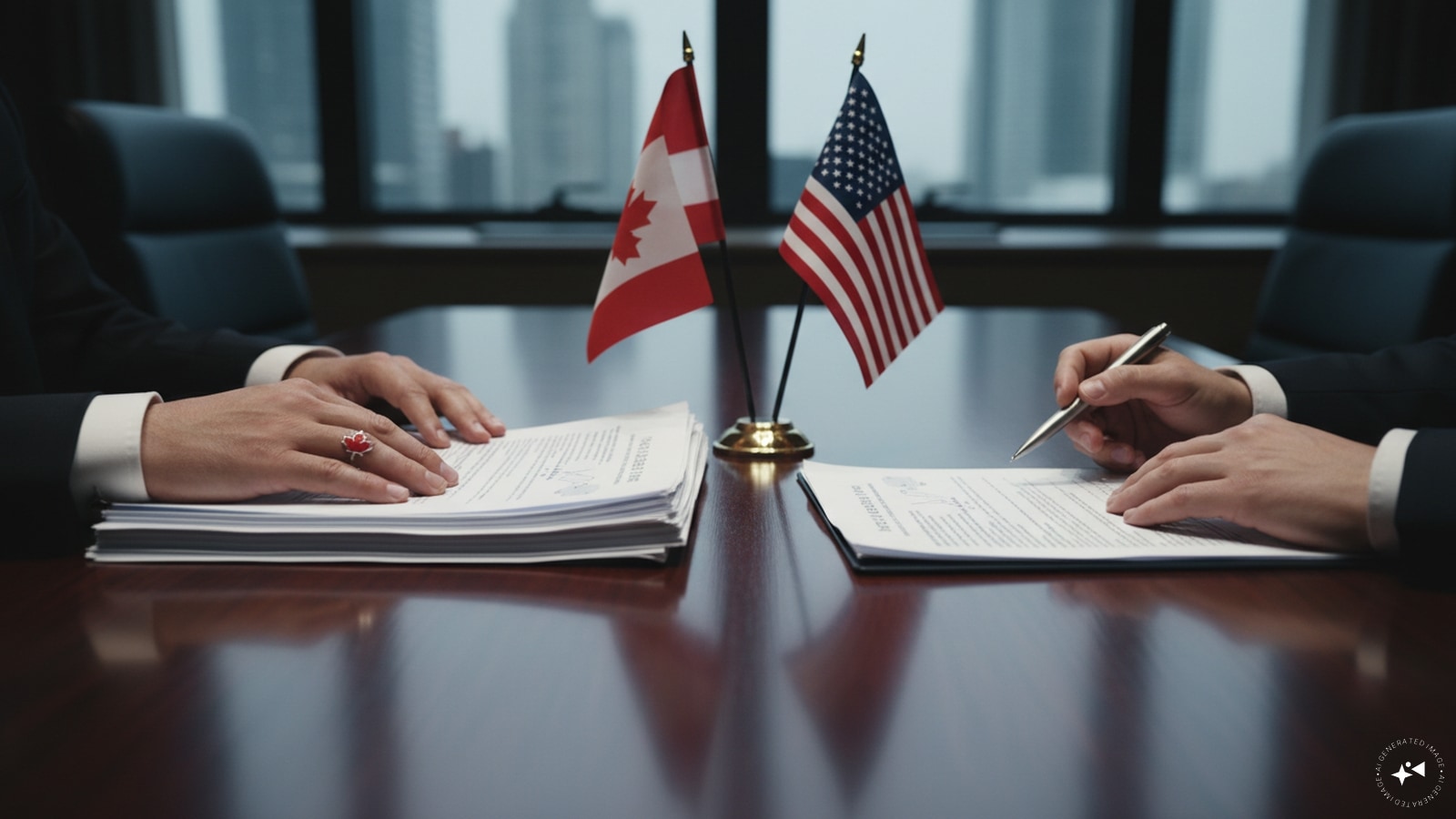
The boundary line between the United States and Canada has long been celebrated as the longest undefended border on earth, an administrative abstraction separating two closely integrated economies. That boundary now feels like a permanent trench line. Following the catastrophic collapse of last-ditch negotiations in Washington, the White House slapped a staggering 50 percent tariff on roughly $20 billion worth of Canadian goods. Prime Minister Mark Carney pulled his negotiating team off the table and announced that Canada will enact dollar-for-dollar retaliatory measures targeting American steel, dairy, appliances, agricultural equipment, pulp and paper, and electronics.
The old consensus is dead. For decades, policymakers in Ottawa operated under the comforting assumption that institutional momentum, shared geography, and deep supply chain integration would always pull both nations back from the brink of economic self-destruction. That assumption ignored how political incentives shift when a superpower decides to weaponize its market access. Carney did not mince words when addressing the nation from Parliament Hill, characterizing the American levies as a direct, unprovoked assault. When an ally treats integration as a vulnerability rather than an asset, the rules of the game change permanently.
To understand how this trade war escalated so rapidly, one has to examine the mechanics of the failed eleventh-hour deal. Canadian negotiators went to Washington prepared to swallow bitter pills, willing to accept some level of ongoing friction if it preserved predictable market access. They offered concessions on provincial alcohol restrictions and discussed compromises on longstanding disputes over steel and aluminum. According to senior Canadian officials, the breakdown occurred because American principals introduced late-stage demands that crossed foundational red lines.
Those late-stage demands included provisions that would have effectively restricted Canada from pursuing independent trade agreements with other global partners, alongside attempts to secure exclusive rights to Canadian critical minerals. For an administration in Ottawa trying to project sovereignty in a fractured global order, accepting those terms would have meant subordinating national economic policy to foreign oversight. Carney recognized that signing a flawed document under duress would only invite further coercion down the line. Walking away was politically mandatory, even if the economic fallout will sting millions of workers on both sides of the border.
The asymmetry of the conflict presents a severe structural challenge for Canadian policymakers. The United States economy is roughly ten times larger than that of its northern neighbor, meaning a literal dollar-for-dollar retaliation strategy packs different political and economic consequences in Washington than it does in Ottawa. Roughly three-quarters of all Canadian goods exports flow south. Targeting American electronics, agricultural machinery, and steel will inflict localized pain on specific congressional districts, but the broader U.S. economy absorbs the shock far more easily than a mid-sized export-driven economy absorbs a 50 percent penalty on key industrial inputs.
Economists at major Canadian financial institutions estimate that the initial wave of U.S. tariffs directly impacts a fraction of overall trade, but the secondary psychological and investment chill threatens to freeze capital expenditure across the board. Small and medium-sized exporters who rely entirely on cross-border logistics are already scrambling to find alternative markets or restructuring their workforces. The human cost is immediate. Factories that spent forty years optimizing just-in-time delivery systems across the Detroit-Windsor corridor now face a high-cost environment where every cross-border shipment requires a complex cost-benefit analysis.
This rupture validates a warning Carney issued months prior at international economic forums, where he argued that the post-Cold War era of frictionless globalization had expired. Nations that fail to diversify their supply chains leave themselves entirely at the mercy of shifting political winds in Washington. Yet diversification is a multi-year project, not a weekend fix. Shifting export destinations away from the American market requires massive capital investments in port infrastructure, trans-oceanic logistics, and alternative trade agreements that simply do not materialize overnight.
The political alignment within Canada throughout this crisis has been striking. Provincial leaders who normally clash with the federal government on every conceivable issue have rallied behind the resistance strategy. Ontario Premier Doug Ford praised the decision to reject the American terms, noting that the proposed concessions would have hollowed out the manufacturing and automotive core of his province. This unity reflects a profound sense of public betrayal. For generations, average citizens viewed the United States not just as an economic partner, but as a trusted cultural and security guarantor. Travel statistics demonstrate a sharp, sustained drop in cross-border leisure trips as Canadians consciously redirect their spending inward or toward other international destinations.
The Trump administration's trade team remains unbowed, signaling that no new talks are scheduled and pointing out that retaliation invites further countermeasures. U.S. trade representatives maintain that Canada had an exceptionally favorable arrangement under previous continental frameworks and brought the current escalation upon itself by refusing to meet modern alignment standards. This framing treats trade agreements not as permanent rules-based architectures, but as transactional instruments subject to renegotiation whenever political utility dictates.
As the September 8 effective date for Canada's retaliatory tariffs approaches, supply chain managers and corporate strategists are bracing for a prolonged period of volatility. The friction at the border is no longer a temporary negotiation tactic. It has hardened into structural economic policy, transforming a historic partnership into a cold, transactional standoff with no clear exit strategy in sight.