When Director of National Intelligence Jay Clayton went on Sunday morning television to defend President Donald Trump calling Vladimir Putin his "friend," the intelligence community watched a quiet institutional boundary collapse in real time. Clayton declared the label "entirely appropriate" within the context of the trilateral summit in Shenzhen, China, while simultaneously conceding that the Russian president is "not America's friend in Ukraine."
That split-screen answer reveals more than standard Washington spin. For decades, the role of the nation's top intelligence officer was built on a strict firewall between raw threat assessment and diplomatic theater. By validating a president's personal affection for an adversarial autocrat while admitting that same leader is actively waging war against a U.S. ally, Clayton signaled a fundamental reordering of how American espionage agencies operate under the second Trump administration. For a deeper dive into this area, we recommend: this related article.
The Wall Street Lawyer Running the Spy Agencies
To understand why Clayton’s remarks on ABC’s This Week and CNN’s State of the Union landed with such force, you have to look at who is sitting in the director's chair. Jay Clayton is not a career intelligence officer. He is a veteran Wall Street mergers-and-acquisitions attorney from Sullivan & Cromwell, a former Securities and Exchange Commission chair, and until July 2026, the U.S. Attorney for the Southern District of New York.
Confirmed along strict party lines in late July 2026 to replace Tulsi Gabbard, Clayton brings a transactional dealmaker’s worldview to the Office of the Director of National Intelligence (ODNI). By November 2026, his portfolio had expanded to include serving as White House AI Czar and Acting National Cyber Director. To get more context on this development, in-depth analysis can be read on The Washington Post.
In corporate boardrooms, calling a rival CEO a "friend" across a negotiating table is standard lubricant for a merger. You flatter the counterparty. You create a warm room so the terms get signed.
Intelligence work operates on the opposite premise. Analysts are trained to strip away personal warmth and focus entirely on capability and intent. When the head of all 18 U.S. intelligence agencies adopts the vocabulary of deal-making to excuse a president’s praise for a geopolitical adversary, the distinction between objective intelligence analysis and White House communications begins to blur.
What Actually Happened in Shenzhen
The controversy did not happen in a vacuum. On November 19, 2026, Donald Trump, Vladimir Putin, and Chinese President Xi Jinping sat down in Shenzhen for an unprecedented trilateral summit on the sidelines of the APEC meetings.
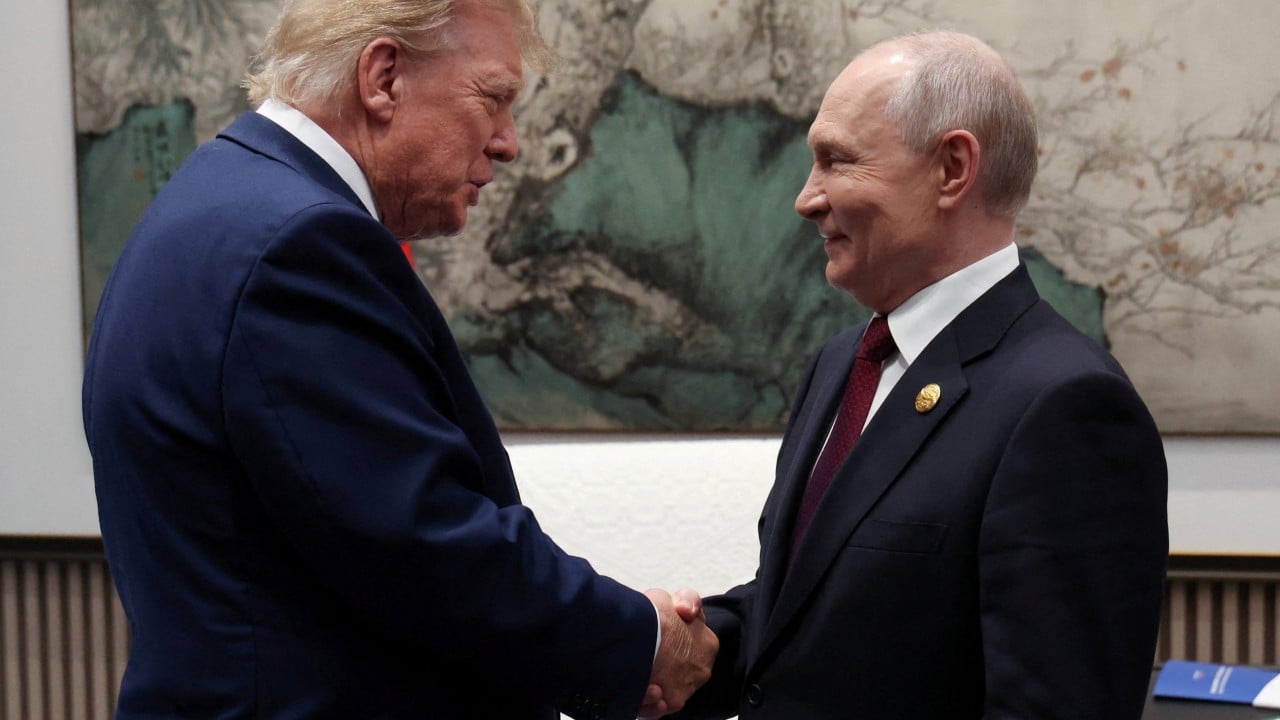
The optics were jarring. Trump beamed as he greeted Putin, referring to him as his "friend" and boasting to reporters about their "fantastic" relationship. When pressed on whether Putin was a friend to the United States, Trump sidestepped the question entirely, stating that he could not speak for America, only for his own personal rapport with the Russian leader.
Three days later, Clayton was tasked with cleaning up the fallout on the Sunday shows. Pressed by anchors Dana Bash and Jonathan Karl, Clayton drew a sharp line between the room in Shenzhen and the battlefield in Eastern Europe.
"In that circle of that conversation, using the term 'friend' is entirely appropriate," Clayton said. "In that context, whatever language the president wants to use, I trust him completely."
Yet in the very next breath, when asked directly if Putin is a friend to the United States, Clayton flatly rejected the premise. "He is not America's friend in Ukraine. Not at all. Not at all," he said.
The Shenzhen Declaration and the ICC
The substance of the Shenzhen meeting explains why the administration was so eager to project personal harmony. The three leaders issued a joint "Heads of State Declaration toward Peace" that touched on nuclear risk reduction, global energy supply, and United Nations reform.
Buried inside that document was a striking diplomatic concession. The United States, Russia, and China jointly declared that the International Criminal Court (ICC) and similar bodies "must not abuse their jurisdiction," emphasizing the immunity of state officials. Putin remains the subject of an active ICC arrest warrant for war crimes in Ukraine. By standing beside Putin in China and validating language that undermines the court pursuing him, Trump handed Moscow a major diplomatic victory before a single shot stopped firing in Ukraine.
The Strategic Logic vs. The Intelligence Reality
Defenders of the administration argue that critics are willfully misreading basic diplomatic tradecraft. In high-stakes nuclear diplomacy, cornering an adversary leaves them with no exit ramp.
From this perspective, Trump’s personal flattery is a deliberate tool. If calling Putin a friend lowers the temperature in a room containing the leaders of the world's three largest nuclear arsenals, the argument goes, the semantics are irrelevant. Personal rapport becomes a pressure valve.
Proponents point out that previous presidents have used warm personal rhetoric with brutal autocrats to extract strategic concessions, from Richard Nixon in Beijing to Franklin Roosevelt in Yalta. In their view, Clayton was simply acknowledging reality: a president needs room to maneuver in private negotiations without his own intelligence chief publicly undercutting his negotiating posture on national television.
Where the Dealmaker Argument Breaks Down
That defense misses how intelligence agencies actually function—and how foreign adversaries exploit daylight between a president’s personal feelings and his country’s security apparatus.
First, Vladimir Putin is a former KGB foreign intelligence officer. He does not view the word "friend" as casual American small talk. In Russian statecraft, personal flattery from an American president is treated as a exploitable vulnerability and a propaganda triumph. Russian state media immediately broadcast Trump’s remarks and Clayton’s subsequent validation as proof that Western unity has fractured and that Washington now views Moscow as an equal partner rather than a rogue aggressor.
Second, the "two-track" theory—where the president plays the warm friend while the intelligence community tracks the hostile threat—creates severe friction inside the building. Analysts at the CIA, NSA, and Defense Intelligence Agency produce the President's Daily Brief (PDB). Their job is to tell the commander-in-chief hard truths about Russian cyberattacks, sabotage operations in Europe, and battlefield intentions in Ukraine.
When the Director of National Intelligence publicly states that he trusts the president "completely" to characterize a hostile foreign leader as a friend, it sends an unmistakable signal down the chain of command. Career analysts start asking a dangerous question: Will intelligence assessments that contradict the president's personal affinity for Putin be welcomed, or will they be buried?
Allied Blowback and the Trust Deficit
The damage from the Shenzhen remarks and Clayton’s defense was immediate across allied capitals. Intelligence sharing relies entirely on trust. The United States sits at the center of the Five Eyes alliance and NATO intelligence networks because partners believe their most sensitive secrets will not be compromised by political whims in Washington.
European leaders did not mince words. Polish Prime Minister Donald Tusk, whose country sits directly on the front line of Russian aggression and serves as the primary logistics hub for Ukraine, issued a blunt rebuke. "Mr. Putin is not our friend and will never be," Tusk stated.
Even figures on the European right broke ranks. Richard Tice, deputy leader of the right-wing Reform UK party, called the characterization "a grave mistake" and "wrong at every level," reminding viewers that Putin is a "murderous dictator". In Washington, Senate Democratic Leader Chuck Schumer labeled the Shenzhen summit a "historic embarrassment," arguing that America would have been better off if Trump had stayed home.
When frontline allies hear the U.S. Director of National Intelligence validate the "friend" label—even with caveats about Ukraine—they recalculate their risk. European intelligence services become far more hesitant to share raw human intelligence on Russian operations if they fear the top levels of the U.S. government are prioritizing personal rapport with the Kremlin over collective security.
The Structural Shift at ODNI
The Office of the Director of National Intelligence was created in the wake of the September 11 attacks for one specific purpose: to ensure that intelligence was coordinated across agencies and delivered to the White House without political distortion.
Historically, DNIs have guarded their nonpartisan posture fiercely, often refusing to comment on the president's diplomatic rhetoric altogether. Standard protocol for an intelligence chief pressed on a president’s choice of words is a polite refusal: "I leave diplomatic characterizations to the president and the Secretary of State; my job is to assess the threat."
Clayton chose not to take that off-ramp. By stepping onto the political stage to validate Trump’s language, he effectively merged the roles of chief intelligence officer and administration surrogate.
This shift coincides with major operational changes inside the U.S. cyber and intelligence apparatus. During the same Sunday appearance on CNN, Clayton acknowledged that ongoing structural overhauls within federal cyber defense would result in "glitches, gaps, interruptions in service". Coming just one day before he was tapped to serve as Acting National Cyber Director, the admission underscored a massive consolidation of power. One man now oversees the entire intelligence community, federal cyber defense, and White House artificial intelligence policy.
Why Words Matter in Intelligence
In corporate mergers, ambiguity is an asset. You keep the language soft until the ink is dry. In national security, ambiguity is a liability.
Vladimir Putin’s strategic objective has remained unchanged for over two decades: to dismantle the post-Cold War security architecture in Europe, weaken NATO, and secure a sphere of influence over neighboring states. Calling him a friend does not alter Russian missile production, pause Russian disinformation campaigns targeting American elections, or stop Russian troops from advancing in eastern Ukraine.
Jay Clayton tried to thread an impossible needle on Sunday morning. He attempted to validate his boss’s personal diplomacy while preserving a shred of analytical credibility regarding Russian aggression. Instead, he exposed a widening fault line at the heart of American statecraft, where the nation's top spy is now expected to validate the president's personal friendships even while tracking the friend's weapons aimed at American allies.