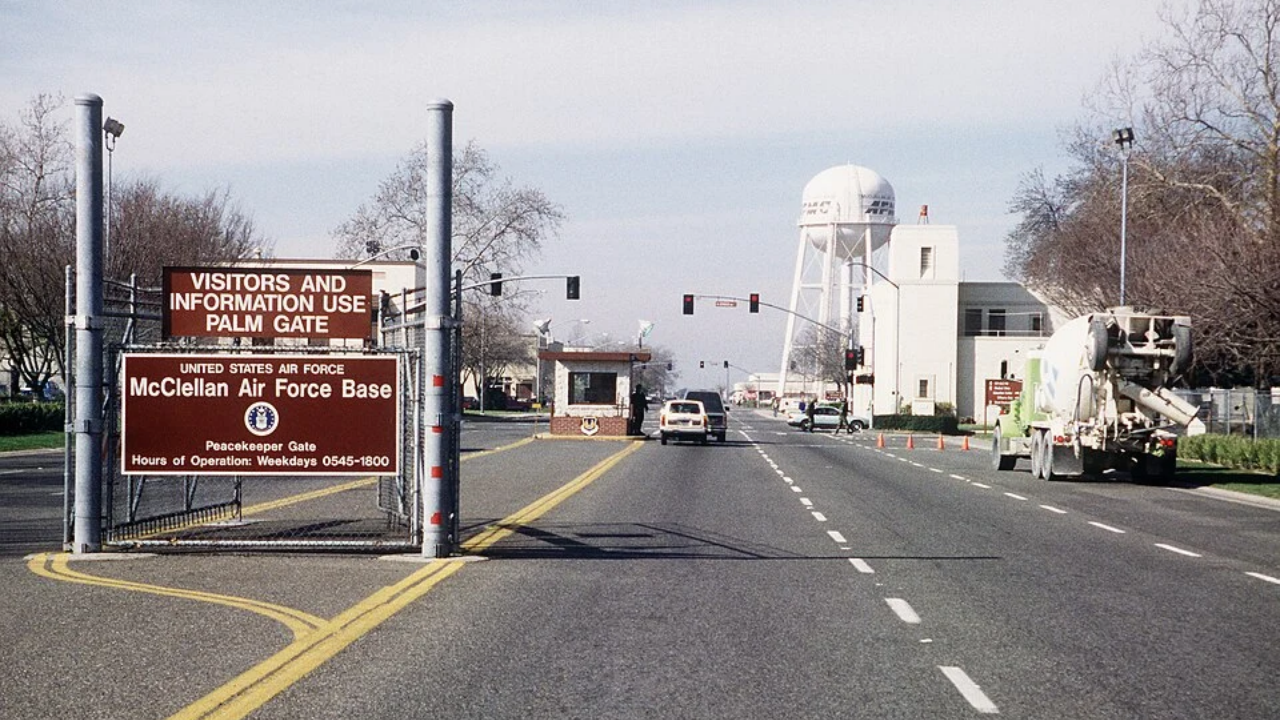
Twenty-five years after McClellan Air Force Base shut down in 2001, the sprawling 3,000-acre Sacramento installation has drawn roughly $600 million in investment, turning a shuttered Cold War industrial hub into a commercial complex with about 10 million square feet of buildings and a public-use airport.
Look closer at that headline number, though, and the neat comeback story starts to fray. Six hundred million dollars spread across 3,000 acres over a quarter-century equals just $200,000 an acre—barely enough to pave roads, patch roofs, and keep aging concrete from crumbling into rubble. A multi-decade tally of McClellan Park is not a triumph of effortless real estate magic. It is a grinding lesson in how toxic liabilities, public subsidies, and stubborn industrial inertia collide on former military land.
For decades, I have watched industrial sites and municipal redevelopment pledges get dressed up in glossy brochures. Usually, the ribbon-cutting gets all the ink while the balance sheet sits quietly in the dark. At McClellan, the story is far more complicated than a simple "from military base to business park" makeover.
Why a Cold War Workhorse Had to Close
McClellan was no minor outpost. For more than six decades, it operated as a massive logistical, maintenance, and electronics depot supporting conflicts from World War II through the Gulf War, employing up to 26,000 civilians and military personnel at its peak. When the Base Realignment and Closure process in 1995 put the base on the chopping block and aircraft overhaul work shifted elsewhere—most notably losing out in competition with Hill Air Force Base in Utah—Sacramento absorbed a gut punch.
Closing a major industrial facility does not just erase paychecks. It hollows out supplier networks, freezes surrounding neighborhoods in North Highlands, and leaves behind specialized infrastructure built for defense rather than modern commercial tenants. When the gates formally closed in 2001, employment had already fallen to a fraction of its wartime and Cold War highs.
A closed military base is rarely a blank slate. More often, it is a giant, expensive puzzle where every piece carries a legal, environmental, or zoning catch.
Turning those acres into a functioning civilian economy required more than optimism. It required moving tenants into empty hangars and warehouses even before the military fully exited, a mechanism known as a hot transfer that helped keep activity alive during the transition. Without early momentum, large industrial campuses can rot from the inside out while bureaucrats argue over title deeds.
How Toxic Soil and Federal Rules Shape Every Deal
If you want to understand why rebuilding McClellan took a quarter-century instead of five years, start underground. McClellan was placed on the Environmental Protection Agency Superfund list in 1987. Decades of aircraft maintenance, chemical handling, radiological laboratory work, and firefighting foam left behind a heavy legacy of soil and groundwater contamination—including solvents, metals, radiological materials, and PFAS compounds.
Let us use a hypothetical example to show how environmental risk slows commercial real estate. Suppose a logistics operator wants to build a modern distribution center on a parcel next to an old maintenance apron. Even if the surface looks clean, groundwater plumes, vapor intrusion rules, or agency review sign-offs can delay financing or force costly engineering controls. Suddenly, a straightforward lease turns into a multi-agency negotiation involving federal regulators, state environmental boards, and local planners.
That reality exposes an uncomfortable truth about base reuse. Private developers do not step into Superfund sites out of civic charity. They step in when risk is ring-fenced, public grants or tax mechanisms help carry early infrastructure costs, and long-term land value justifies the headache. Over the years, McClellan Park has relied on a patchwork of private capital, tenant build-outs, and public funding streams to keep buildings occupied and active.
The Real Ledger Behind the Numbers
Headline investment figures can flatter a project while masking what still needs work. Reaching roughly $600 million over 25 years sounds impressive until you weigh it against 10 million square feet of structures, heavy utility demands, and the sheer scale of a 3,000-acre footprint.
| Metric or Factor | What the Headline Suggests | What It Means on the Ground |
|---|---|---|
| Total Investment | A massive wave of money pouring into the site | Roughly $600 million across 25 years and 3,000 acres is steady, incremental rebuilding rather than a sudden boom |
| Building Stock | Ready-to-use commercial space | Around 10 million square feet includes older military structures needing adaptation alongside newer space |
| Airfield & Rail | Built-in transport advantage | A major runway and rail access help industrial users, but maintaining heavy infrastructure is costly |
| Environmental Legacy | Past history from a closed base | Superfund oversight and PFAS groundwater issues remain long-term realities that shape land use |
| Community Reuse | Purely corporate offices and factories | Charter schools, nonprofits, government agencies, and converted facilities mix with private business |
Adaptive reuse at McClellan has produced genuine, practical wins. Converting an old bowling alley into charter school classrooms or turning former military spaces over to nonprofits, public agencies, and aviation or industrial operators shows how flexible reuse keeps land productive. Daily visitor counts in the tens of thousands prove the campus is alive, not a ghost town.
Still, there is a catch that boosters rarely highlight loudly enough. Having commercial tenants inside a former defense depot does not erase the original industrial footprint, nor does it guarantee high-wage job growth equal to the base's mid-century heyday. Surrounding neighborhoods like North Highlands still measure success by tangible local opportunity, safe infrastructure, and steady tax base support—not just square footage leased.
What Other Cities Get Wrong About Base Reuse
Too many cities treat a military closure like a lottery ticket. Local leaders assume a big runway, cheap land, and federal grants will automatically summon high-tech headquarters and booming suburbs.
In reality, large-scale base conversions are slow industrial turnarounds. They reward patience, clear environmental boundaries, and realistic expectations about which industries actually need heavy land, air access, or warehouse capacity. Anyone evaluating McClellan Park after 25 years should judge it not as a finished miracle, but as an ongoing test of whether legacy industrial land can pay its own way without hiding its scars.
Audit the real balance sheet of any major redevelopment—count the cleanup obligations, public subsidies, and infrastructure repair bills right alongside the headline investment number before calling the turnaround complete.