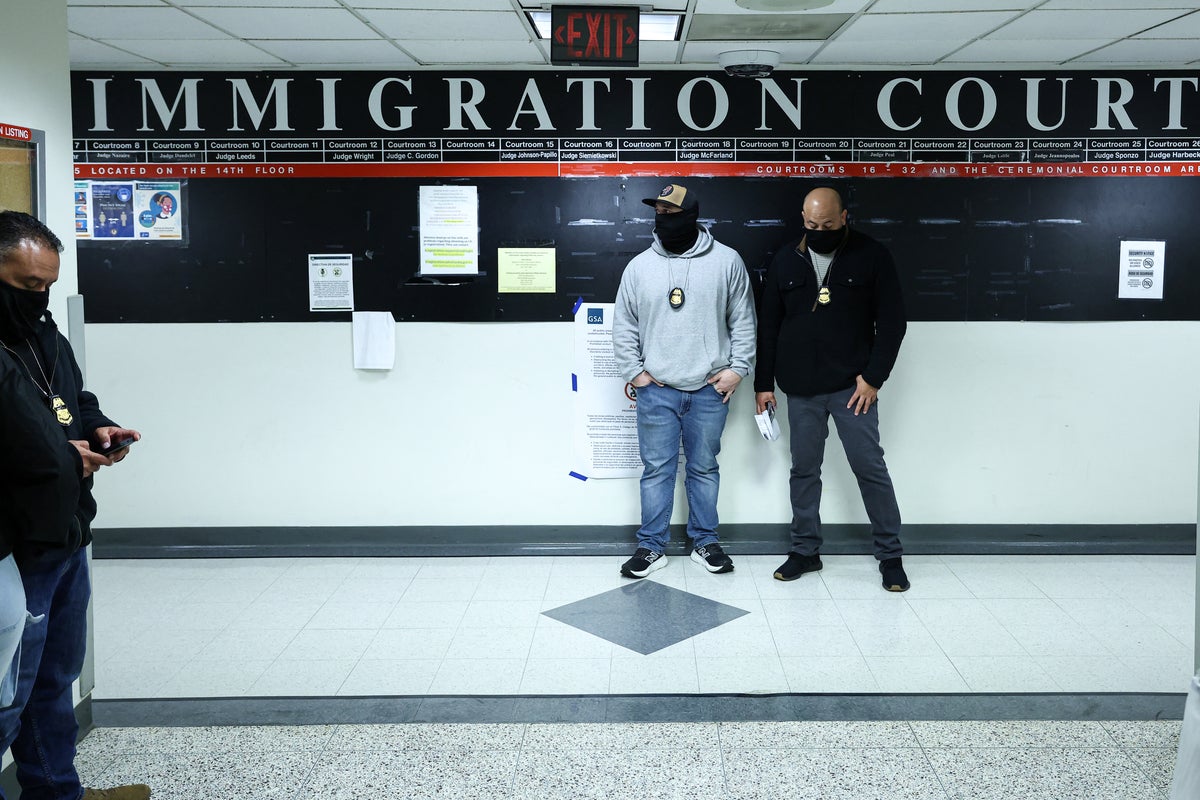
The Executive Office for Immigration Review is quietly shifting from individual adjudication to industrial-scale processing. By consolidating hundreds of unrepresented migrants into single-room, hyper-accelerated "mega master" calendar hearings, the Department of Justice is rapidly clearing its multi-million-case backlog. The primary mechanism driving this shift is not sudden efficiency, but the predictable math of default deportations. When a single hearing contains more than 100 individuals who cannot fit into the room, find legal counsel, or receive updated notice of their abruptly advanced court dates, the result is an assembly line of in absentia removal orders.
This strategy changes the administrative objective from resolving claims to manufacturing final orders.
The Mechanics of the Mega Master Docket
For decades, an initial master calendar hearing in an immigration court resembled a crowded but manageable docket. A judge would call twenty to thirty individuals, review their identifying information, advise them of their rights, and grant extensions to find legal representation.
The new operational model completely alters this scale. Under directives rolling through jurisdictions like Chicago, Boston, Chelmsford, and Dallas, the numbers have quadrupled. A single judge is now assigned dockets exceeding 100 individuals in a single session.
The physical infrastructure of federal immigration courts is entirely unequipped for this volume. A standard federal plaza courtroom cannot hold 100 respondents, their families, interpreters, and security personnel. The immediate result is logistical gridlock in the hallways. When a respondent cannot physically enter the room or clear building security before their name is called, the legal consequence is swift and absolute.
┌─────────────────────────────────────────────────────────┐
│              TRADITIONAL VS. MEGA MASTER                │
├───────────────────────────┬─────────────────────────────┤
│ Standard Docket Volume    │ 20 - 30 Respondents         │
├───────────────────────────┼─────────────────────────────┤
│ Mega Master Docket Volume │ 100+ Respondents            │
├───────────────────────────┼─────────────────────────────┤
│ Primary Legal Outcome     │ Continuance / Counsel Search│
├───────────────────────────┼─────────────────────────────┤
│ Mega Master Outcome       │ High-Volume In Absentia Orders│
└───────────────────────────┴─────────────────────────────┘
The Strategy of the Accelerated Calendar
To understand the sudden emergence of these massive dockets, one must look at how the dates are being manipulated behind the scenes. Court administrators are actively pulling cases that were originally scheduled for initial appearances in 2027, 2028, or 2029, and moving them up to the current calendar.
This creates an immediate notice crisis. The vast majority of individuals caught in these expedited blocks do not have legal counsel to monitor the electronic portal. They rely on physical mail. If a notice of a rescheduled hearing is sent to an outdated address, or if it arrives mere days before the new date, the respondent remains entirely unaware that their multi-year wait has been compressed into next Tuesday.
The system relies on this breakdown. If a respondent fails to appear at a master calendar hearing, the immigration judge is legally empowered to issue an in absentia order of removal. The government does not need to debate the merits of an asylum claim or analyze cross-border family ties. It simply logs a non-appearance and closes the file with a deportation stamp.
"They are anticipating that the majority will not show up," noted one Texas-based immigration attorney, who requested anonymity to protect their ongoing practice before the court. "They can then claim they completed thousands of cases, but it's being driven by structural failure, not actual adjudication."
Judicial Onboarding and Executive Targets
The introduction of mass dockets aligns directly with an aggressive executive push to scale up deportations to a targeted one million individuals per year. This marks a steep escalation from the 600,000 deportations executed in 2025.
To handle this operational friction, the Department of Justice recently onboarded its largest single class of new personnel, adding 77 immigration judges alongside five temporary military lawyers detailed to serve on the administrative bench. Yet, adding more judges to a broken assembly line does not fix the core distortion of justice. Instead, it expands the capacity to process the flawed dockets.
The executive branches are also implementing targeted nationality dockets alongside the mass calendar approach. Cases involving individuals from specific countries, such as Somalia, Syria, and Iran, are being systematically advanced alongside juvenile dockets. This selective acceleration creates a two-tiered system where the complexity of a legal defense is secondary to the geopolitical designation of the respondent.
The Illusion of Efficiency
There is a flawed argument suggesting that moving court dates forward is fundamentally beneficial for migrants seeking a resolution to their status. In a vacuum, reducing a four-year wait for a legal hearing sounds positive.
For the sliver of immigrants who possess private, retained counsel and a clear path to status, an advanced date can indeed shorten their time in legal limbo. It forces the government to lay its cards on the table.
But for the unrepresented majority, this speed is catastrophic. Finding an immigration attorney who will take a complex asylum case or a cancellation of removal matter requires months of consultations, financial savings, and document gathering from home countries. Compressing that timeline down to a few weeks effectively strips the respondent of the ability to mount any defense at all.
When a judge faces a room of 100 people, the time allocated per individual shrinks to mere minutes or seconds. The court ceases to function as a deliberative legal body. It turns into a processing facility where the objective is statistical output rather than individual justice.
The long-term consequence of the mega master docket will not be a permanently cleared backlog. It will be an influx of emergency motions to reopen cases, filed by people who were ordered deported simply because they were stuck in an elevator, lost in a mailroom delay, or buried under the sheer weight of a numbers game.