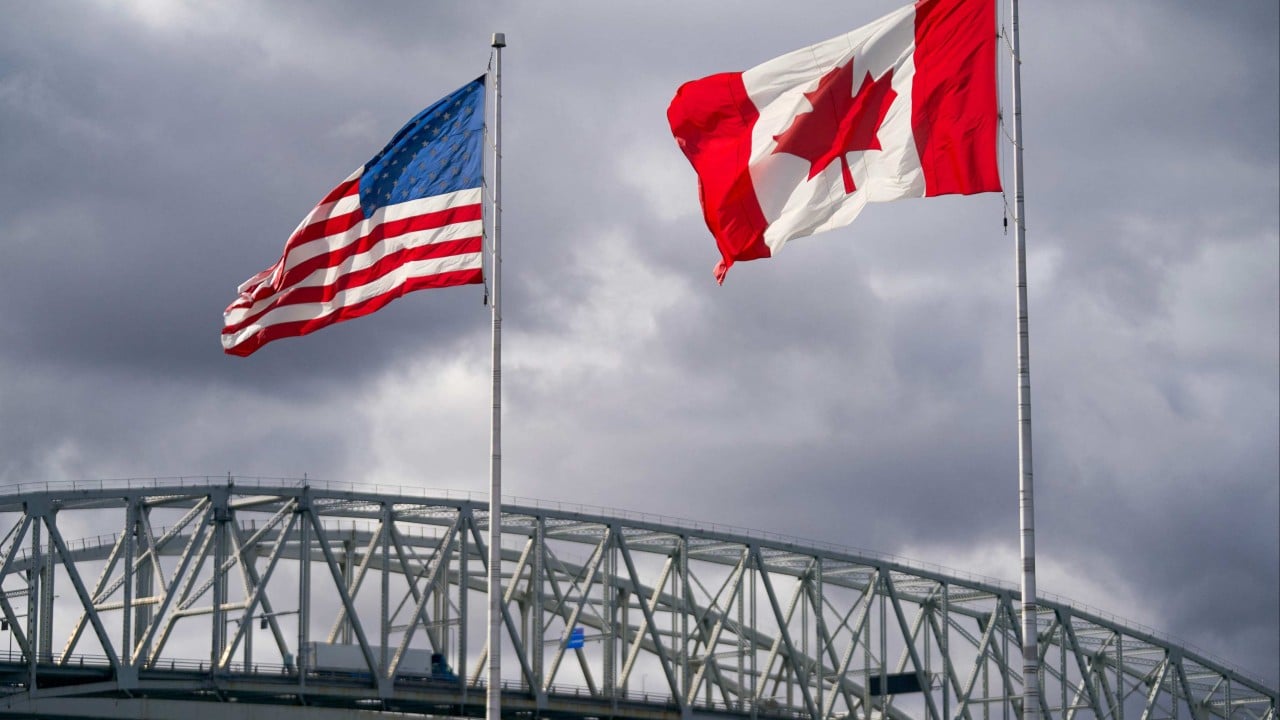
The border between the United States and Canada is no longer just a line on a map separating old allies; it has transformed into a high-stakes economic battleground. Following the sudden collapse of bilateral trade negotiations, the White House has pushed forward with 50 percent punitive tariffs on roughly twenty billion dollars worth of Canadian goods. Washington insists that Ottawa cannot survive a prolonged economic confrontation, casting the dispute as a stark lesson in absolute asymmetrical power. Prime Minister Mark Carney’s administration has fired back, vowing dollar-for-dollar retaliation and framing the demands coming out of Washington as an existential threat to national sovereignty.
For decades, the commercial relationship between these two nations was defined by institutional predictability and deep supply chain integration. That architecture has fractured. What began as friction over dairy access, steel levies, and automotive components has escalated into a structural collision between an economic superpower and its primary trading partner.
The Anatomy of the Breakdown
Trade negotiations do not typically implode over weekend deadlines without profound underlying venom. According to officials close to the talks, the final hours in Washington hit an impassable wall when American negotiators introduced clauses designed to restrict Canada from pursuing independent trade agreements with other global economies. For Ottawa, accepting such terms would mean surrendering independent foreign policy control.
Prime Minister Carney walked away from the table, labeling the final terms unacceptable. Within hours, the White House triggered sweeping fifty percent duties on five and a half percent of total Canadian exports.
The speed of the escalation caught domestic industries off guard. Consider a hypothetical mid-sized manufacturing firm in Ontario that exports precision automotive parts across the Detroit River. Under the new tariff regime, the cost of crossing that border doubles overnight. Margins evaporate instantly. Management faces an impossible choice between absorbing unsustainable losses or passing the price hike onto American buyers who can easily source alternatives elsewhere.
Administration officials in Washington have adopted a hardline stance, arguing that Canada depends far too heavily on the American consumer market to sustain any meaningful resistance. Nearly seventy percent of all Canadian exports head south. From the perspective of the White House economic team, this structural imbalance leaves Ottawa with zero leverage.
Sovereignty Versus Survival
The ideological core of this conflict traces back to warnings issued months ago. When Prime Minister Carney addressed international leaders at Davos, he argued that middle powers negotiating alone against economic superpowers find themselves structurally disadvantaged. He warned that the international trade order was undergoing a permanent rupture rather than a cyclical transition.
Now, Canada serves as the primary test case for that theory.
The Trump administration has made little secret of its contempt for traditional diplomatic norms. Statements from the White House have openly mocked Canadian economic posture, with rhetoric suggesting that Canada benefits immensely from its proximity to the United States without offering adequate reciprocity.
This rhetoric strikes a raw nerve in Ottawa. Canadian trade officials point out that past compromises on dairy quotas and lumber were hammered out through legal frameworks like the United States-Mexico-Canada Agreement. Discarding those legal frameworks in favor of sudden executive decrees signals that previous treaties are worth little more than the paper they are printed on.
Yet, bravado in Ottawa cannot entirely mask the structural vulnerability of the domestic economy. Entire sectors—from forestry and manufacturing to agriculture—rely on frictionless access to American ports and distribution networks. When retaliatory tariffs take effect, American goods will face matching duties, but the secondary shock waves will hit Canadian logistics providers, rail networks, and warehouse operators just as hard.
The Domestic Fallout on Both Sides
Economic policy rarely stays confined to macroeconomic boardrooms. The fallout from this fracture is already rippling through American politics and commerce.
Governors from northern border states, including Michigan and Maine, have expressed deep alarm. Manufacturing hubs in the American Midwest rely heavily on components that cross the border multiple times during production. Disrupting that loop drives up assembly costs, threatens local jobs, and stokes inflation just as the Federal Reserve attempts to stabilize price pressures.
Federal Reserve officials have noted that prolonged friction between the two economies will keep inflationary impulses alive. When customs duties act as a hidden tax on everyday goods, consumers foot the bill. A school district in Minnesota suddenly facing thousands of dollars in unexpected cost spikes for basic imported supplies offers a small window into a much larger systemic problem.
Despite growing warnings from business coalitions, agricultural lobbies, and lawmakers from both political parties, the White House remains defiant. President Trump has doubled down on social media, accusing Canada of harboring long-standing protectionist barriers against American farmers and demanding an end to what he terms unfair commercial advantages.
A Permanent Divergence
The most significant casualty of this trade war is not any single category of goods, but the illusion of permanence. For generations, businesses operated under the assumption that North American economic integration was irreversible. Corporate supply chains were built to treat the international boundary as an administrative inconvenience rather than a hard barrier.
That mindset is dead.
Even if a temporary truce is eventually brokered, political leaders across the Canadian political spectrum acknowledge that returning to the old status quo is no longer viable. Prime Minister Carney’s administration is accelerating efforts to diversify trade relationships away from the United States, targeting new pacts in Europe and the Indo-Pacific.
Diversification, however, is a long-term remedy for an immediate trauma. Building alternative shipping routes, port infrastructure, and logistics networks takes years. In the interim, Canadian businesses must navigate an unpredictable regulatory environment where a single executive post or sudden policy shift can erase profitability overnight.
The White House is betting that the pain will force Ottawa to capitulate entirely. Canada is betting that the political cost to American consumers and the disruption to integrated supply chains will force a retreat from Washington. As September approaches and retaliatory levies prepare to lock into place, both nations are marching deeper into uncharted economic territory with no clear exit strategy in sight.