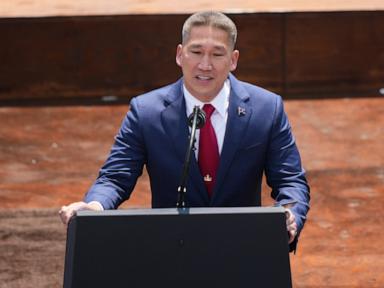
President Donald Trump has announced his intent to nominate acting Navy Secretary Hung Cao to permanently lead the Department of the Navy. The decision follows a high-stakes internal shakeup at the Pentagon that abruptly removed John Phelan from the position. Cao, a retired Navy captain and former explosive ordnance disposal officer, steps into the permanent role carrying the explicit backing of Defense Secretary Pete Hegseth and an unorthodox political resume.
This promotion is not merely a routine administrative elevation. It represents a calculated realignment of civilian military leadership, driven by intense bureaucratic friction, competing visions for fleet modernization, and an administration determined to install loyal operational hardliners across every branch of the armed services.
The Anatomy of an Ouster
Bureaucratic inertia inside the Pentagon rarely breaks cleanly. When John Phelan exited the administration abruptly, defense analysts scrambled to decode the sudden shift. Phelan, a financial executive without a traditional military background, had spent his brief tenure attempting to balance corporate efficiency metrics with the sprawling demands of naval procurement. Yet, friction accumulated rapidly behind closed doors.
Sources familiar with the transition point to a breakdown in chain-of-command protocols. Phelan’s direct lines of communication to the White House frequently bypassed Defense Secretary Pete Hegseth, creating an untenable command structure. Hegseth, pushing a muscular internal reform agenda, wanted a department head who understood special operations mechanics from firsthand experience rather than corporate balance sheets.
Enter Hung Cao. Having served previously as the under secretary of the navy, Cao had spent months operating largely on the periphery of Phelan’s inner circle. Reports from defense insiders indicate that Cao was frequently excluded from core decision-making meetings. Rather than sidelining him permanently, this internal exile preserved Cao’s outsider status within an embattled bureaucracy. When the top post emptied, Cao stood as the ready-made alternative: a decorated combat veteran possessing absolute ideological alignment with the administration's core objectives.
From Saigon to Special Operations
To understand how Cao approaches the secretary's office, one must examine a trajectory forged in extreme dislocation. Born in Saigon in 1971, Cao fled Vietnam as a four-year-old refugee during the collapse of the South Vietnamese government in 1975. That early trauma left an indelible imprint on his worldview regarding national security and institutional survival.
After moving through various international postings due to his father's work with USAID, Cao settled in Northern Virginia, graduated from the elite Thomas Jefferson High School, and enlisted as a seaman recruit in 1989 before earning an appointment to the United States Naval Academy. His three decades in uniform defined a brutal operational path. As an Explosive Ordnance Disposal (EOD) and deep-sea diving officer, Cao deployed to hazardous environments across Iraq, Afghanistan, and Somalia.
Unlike many civilian service secretaries whose primary expertise lies in congressional budgeting or defense contracting, Cao spent his career dealing with immediate, high-consequence physical threats. He led operations ranging from deep-sea salvage missions—including rigging the wreckage during the 1999 search for John F. Kennedy Jr.'s aircraft—to counter-improvised threat missions for special forces. That background explains the intense urgency in his public posture. When political allies demand immediate structural transformation, Cao speaks the language of tactical execution.
The Political Crucible and Industry Ties
Military retirement in 2021 did not mark the end of Cao’s public life; it served as a springboard into high-stakes electoral politics. Motivated heavily by the chaotic 2021 U.S. military withdrawal from Afghanistan, Cao launched aggressive Republican campaigns in Virginia, first running for the House of Representatives in 2022 and subsequently mounting a high-profile bid for the U.S. Senate against incumbent Democrat Tim Kaine in 2024.
Though he lost the Senate race, the campaigns cemented his status as a firebrand populist within the conservative movement. He utilized platforms like the Republican National Convention to critique what he characterized as a softening of military culture, earning national visibility and the explicit endorsement of Donald Trump.
Between his political campaigns and his entry into the Pentagon administration, Cao worked as a vice president and client executive at CACI International, a major defense contractor. In that capacity, he focused on fielding electronic warfare packages, optical communications, counter-drone technology, and enterprise IT optimization for the Navy. This stint gave him a pragmatic, unvarnished look at the defense industrial base's systemic delays and supply chain vulnerabilities. He knows firsthand why naval shipbuilding programs run years behind schedule and billions over budget, having sat on the corporate vendor side of the equation.
Navigating a Stretched Fleet
Nomination is merely the opening salvo. Confirmation by a polarized Senate will test the administration's political capital, but the true challenge awaits inside the Pentagon's river entrance. Cao assumes permanent command of a sea service facing historic operational strain.
The Navy is currently managing simultaneous pressure points across multiple global theaters. In the Middle East, naval assets maintain a constant, high-tempo posture monitoring hostile actors and protecting shipping lanes in the Strait of Hormuz. In the Caribbean and South American approaches, the service has sustained aggressive counter-narcotics and interdiction campaigns. Simultaneously, the looming strategic competition with China in the Indo-Pacific requires an accelerated shift toward distributed maritime operations, unmanned systems, and resilient shipyard infrastructure.
These operational realities collide directly with chronic maintenance backlogs and acute manpower shortages. Shipyards are choked by skilled labor deficits and antiquated dry-dock facilities. While previous civilian leaders attempted to solve these bottlenecks through corporate restructuring consultants and efficiency paradigms, Cao’s instinct leans toward direct accountability and cutting through regulatory red tape.
The upcoming confirmation hearings will serve as a referendum not just on Cao’s career, but on the administration's entire philosophy of civilian defense oversight. Traditionalists will scrutinize his partisan background and vocal opposition to progressive military initiatives. Supporters will point to his combat credentials, refugee story, and technical mastery of special operations as the exact antidotes required for an institution losing its competitive edge.
The uniform is back at the helm of the Department of the Navy, and the directives coming out of the secretary's office will brook little dissent.
This video provides additional context regarding Hung Cao's background, his path from Vietnamese refugee to military leadership, and the political dynamics surrounding his rise within the administration.
http://googleusercontent.com/youtube_content/1


