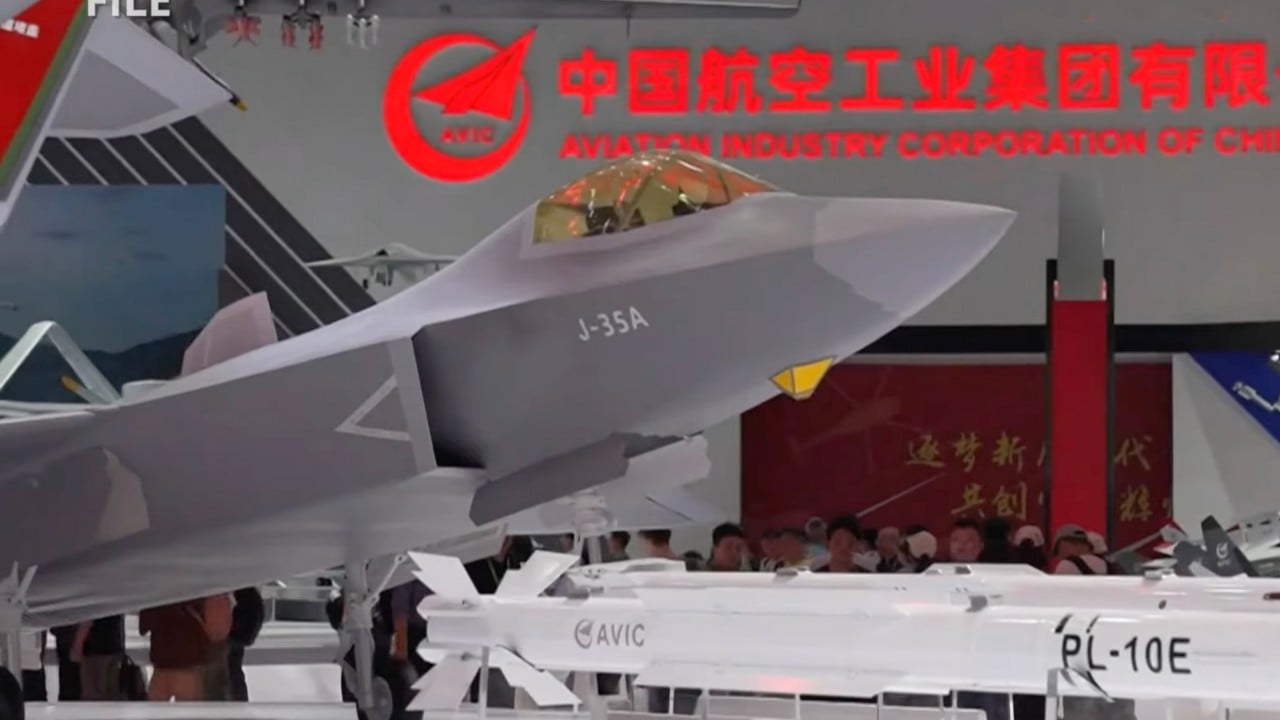
China’s J-35A stealth fighter is not merely an incremental upgrade or an export curiosity. It represents a fundamental shift in how the People’s Liberation Army Air Force intends to fight a high-end air war, moving away from bespoke, expensive heavyweights toward mass-producible, multi-role fifth-generation airpower. While early Western assessments dismissed the jet as a derivative copy of the American F-35, the airframe that debuted at Zhuhai and entered active service milestones tells a far more complicated story about propulsion breakthroughs, internal payload compromises, and industrial scale.
For decades, aviation analysts watched Shenyang Aircraft Corporation struggle to turn its private-venture FC-31 demonstrator into a viable military aircraft. The early prototypes smoked heavily, lacked internal weapons capacity, and suffered from anemic thrust. That era is over. The J-35A is a heavily redesigned, land-based fighter optimized for networked warfare, extended range, and rapid factory output.
Solving the Propulsion Bottleneck
Engines make or break modern fighter programs. For thirty years, Chinese aerospace engineers could build sophisticated airframes and advanced radars, yet they remained reliant on Russian turbofans that suffered from short service lives and sluggish throttle response. The J-35A changes that calculus by pairing a sleek, low-observable fuselage with domestic medium-thrust engines that finally deliver competitive power-to-weight ratios.
Early FC-31 testbeds flew on Russian RD-93 engines, the same powerplants used on the MiG-29. Those engines left heavy soot trails, ruining any hope of low infrared observability, and lacked the electrical generation capacity required to run modern active electronically scanned array radars. The transition to the domestic WS-13E and subsequently the WS-21 (often referred to in industry circles as an advanced derivative of the WS-13 family) cured the smoke problem and boosted dry thrust.
More importantly, Shenyang engineers are preparing the airframe for the WS-19, a clean-sheet medium-thrust turbofan designed specifically for fifth-generation kinematics. Let us be clear about what that means in combat. A twin-engine fighter with two WS-19 powerplants generates enough excess specific power to sustain high-G turns at transonic speeds without bleeding energy, something single-engine stealth fighters routinely struggle to achieve.
Propulsion is not just about top speed. Modern electronic warfare suites, infrared search-and-track sensors, and high-power gallium nitride radar modules demand massive amounts of electrical power and thermal cooling. Without an engine capable of driving high-output generators and absorbing heat loads via fuel-cooled heat exchangers, a stealth fighter's avionics remain blinded or throttled back. The J-35A’s engine bays and dorsal spine have been visibly reshaped to accommodate these thermal management systems, proving that Chinese engineers learned hard lessons from their earlier prototypes.
The Physics of Internal Weapons Bays
Stealth is useless if you have to bolt missiles onto your wings. External pylons scatter radar waves like a disco ball, forcing a fifth-generation fighter to carry its primary ordnance inside the fuselage. Here, the J-35A faces the exact same unforgiving geometry that plagued the F-35 Joint Strike Fighter during its development.
To preserve a low radar cross-section, the J-35A features a ventral weapons bay nestled between its twin intake trunks. Because the fuselage is narrower than that of the heavy J-20 Mighty Dragon, every millimeter inside that bay is contested real estate. Standard Chinese air-to-air missiles like the PL-15 were originally designed with wide-span fins that limited how many could fit inside a cramped internal bay.
Chinese weapons designers solved this by developing folding-fin variants and compressed-carriage munitions. By clipping the control surfaces and redesigning the missile bodies, the J-35A can comfortably carry four to six beyond-visual-range missiles internally. If you add the capability to carry miniature, high-density air-to-air interceptors—a concept both Washington and Beijing have aggressively pursued—that internal loadout jumps significantly for defensive counter-air missions.
The Strike Compromise
Air-to-ground capability presents a much thornier engineering problem. Unlike the F-35A, which was built around a deep belly specifically sized to swallow 2,000-pound Joint Direct Attack Munitions, the J-35A prioritizes aerodynamic fineness and supersonic drag reduction over cavernous internal volume.
If you look closely at the underside of the J-35A, the fuselage is flatter and sleeker than its American counterpart. That shape lowers wave drag, allowing the jet to cruise efficiently at high speeds without burning through its internal fuel reserves. The trade-off is simple: you cannot easily fit heavy bunker-busting bombs inside that bay. Instead, the J-35A relies on smaller, precision-guided glide munitions, anti-radiation missiles, and miniature standoff weapons. For heavy strike missions, the aircraft must revert to "beast mode," mounting heavy ordnance on underwing hardpoints after enemy air defenses have been degraded.
Sensor Fusion and the Kill Web
Hardware only gets you halfway to air dominance. In modern aerial combat, the pilot who sees first and shares targeting data fastest wins, regardless of who pulls tighter turns. The J-35A was built from the cockpit outward as a node in a broader military network rather than a lone wolf.
Mounted beneath the nose is an electro-optical targeting system housed inside a faceted sapphire window, virtually identical in concept to the F-35’s EOTS. This sensor allows the pilot to passively detect, track, and laser-designate surface targets or low-flying aircraft without turning on the main radar, which would otherwise broadcast the jet's position to enemy electronic intelligence receivers.
Around the airframe, distributed aperture cameras provide a 360-degree spherical view of the battlespace, feeding imagery directly into the pilot’s helmet-mounted display. When paired with a nose-mounted AESA radar built using gallium nitride semiconductor technology, the J-35A can simultaneously track multiple stealthy targets while jamming enemy frequencies.
Consider a hypothetical scenario over the Taiwan Strait or the South China Sea. A flight of J-35As operates forward at high altitude with their radars completely silent, relying on passive infrared sensors and data links fed by distant KJ-500 airborne early warning aircraft. Because the J-35As emit zero radio frequency energy, opposing air defenses struggle to triangulate their positions. The J-35As receive targeting coordinates from the rear, launch PL-15 missiles from inside their weapons bays, and hand off mid-course guidance to a drone or a heavier J-20 operating miles away before turning cold. That is not science fiction; it is standard doctrine for networked fifth-generation warfare.
Why Shenyang Matters More Than Chengdu
Western media obsess over the J-20, built by Chengdu Aircraft Corporation. That focus misses the larger industrial picture. The J-20 is a large, complex, resource-intensive twin-engine heavy fighter designed to hunt high-value assets like tankers and surveillance planes at extreme ranges. You do not build thousands of J-20s easily, nor do you risk them in routine attrition battles.
Shenyang Aircraft Corporation built the J-35A to solve the volume problem. Historically, Shenyang served as China's primary producer of Flanker derivatives—the J-11, J-15, and J-16. Those jets are massive, heavy-metal airframes that require extensive titanium forgings and thousands of labor hours per unit. Transitioning Shenyang to the J-35A introduces modern, automated composite manufacturing and pulsed assembly lines into China’s northern aviation hub.
By splitting fifth-generation production between Chengdu in the southwest and Shenyang in the northeast, Beijing has created a two-track industrial base that mirrors the American F-22 and F-35 split, but with one critical difference. While the United States shut down the F-22 line after building fewer than two hundred airframes, China is keeping both lines hot simultaneously.
Furthermore, the J-35A shares immense structural and avionics commonality with the carrier-based J-35 destined for the People’s Liberation Army Navy. Building both a land-based Air Force variant and a catapult-launched naval variant from the same foundational design slashes unit costs, streamlines spare parts logistics, and accelerates pilot training pipelines across both branches of the military.
The Export Wildcard and Geopolitical Friction
No analysis of the J-35A is complete without addressing the export market. For years, the United States held an absolute monopoly on fifth-generation fighter exports through the F-35 program. If a nation wanted stealth, it had to align itself with Washington, submit to strict end-user monitoring, and accept American diplomatic conditions.
The J-35A shatters that monopoly. Beijing has openly marketed the export variant—still tied to the FC-31 lineage—to nations locked out of the F-35 club. Countries in the Middle East, Southeast Asia, and South America that cannot meet Washington’s political prerequisites, or simply cannot afford the steep lifecycle maintenance costs of an American stealth fleet, now have a credible alternative.
Pakistan has already signaled deep interest in acquiring the platform to counter India’s growing airpower, a move that would fundamentally alter the tactical balance across South Asia. Even traditional American partners in the Persian Gulf have used the specter of Chinese stealth acquisitions as diplomatic leverage during arms negotiations with Washington.
Yet buyers face stark realities. Purchasing a Chinese stealth fighter means plugging into a Chinese command-and-control ecosystem. Data links, maintenance diagnostics, and munitions integration do not play nicely with Western NATO-standard hardware. Any nation buying the J-35A is making a generational commitment to Beijing’s defense supply chain, trading Western interoperability for sovereign access to low-observable technology.
Unresolved Vulnerabilities
Despite rapid progress, the J-35A is not invincible, and treating it as an unstoppable wonder weapon is just as foolish as dismissing it as a cheap knockoff. Several stubborn engineering challenges remain unresolved.
First is the persistent question of radar-absorbent material durability. Maintaining a stealth coating in harsh operational environments—high humidity, salt spray, and rapid thermal cycling—is a logistical nightmare. Even the United States Air Force and Navy spend millions of maintenance hours patching seams, replacing degraded tape, and reapplying coatings on the F-22 and F-35. How well Shenyang’s surface coatings hold up during high-tempo, sustained combat operations away from climate-controlled hangars remains an open question.
Second is engine longevity. While the WS-21 and upcoming WS-19 engines solve the immediate thrust and smoke deficits, mean time between overhauls remains a critical metric. Western turbofans routinely operate for thousands of hours before requiring major depot-level rebuilds. Historically, Chinese jet engines required replacement at a fraction of those intervals. If a squadron of J-35As must pull engines every few hundred flight hours during a protracted conflict, sortie generation rates will collapse regardless of how stealthy the airframe is on paper.
Third is pilot culture. Fifth-generation warfare demands decentralized decision-making. Junior flight leads must be empowered to improvise when communications are jammed and command networks fracture. The People’s Liberation Army Air Force has spent the last decade overhauling its rigid, ground-controlled training syllabus to foster independent tactical initiative, yet institutional habits built over seventy years do not vanish overnight.
The J-35A has moved past the prototype stage and into the harsh reality of operational deployment, leaving Western defense planners with a shrinking window to adapt before hundreds of these jets roll off Shenyang's assembly lines.