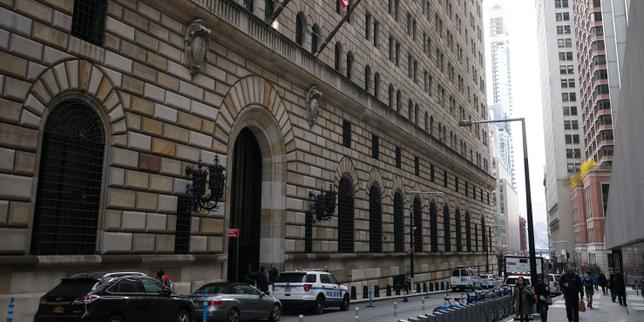
European central banks are quietly dismantling decades-old custody arrangements, pulling billions of dollars in sovereign gold out of Manhattan as confidence in the transatlantic alliance fractures. De Nederlandsche Bank recently finalized a massive reallocation, shifting over 78 tons of bullion out of the Federal Reserve Bank of New York and relocating its operational weight to London and domestic vaults. This move follows a quiet complete withdrawal by the Bank of France, leaving the New York Fed with a rapidly shrinking portfolio of foreign sovereign wealth. For decades, parking gold reserves in the subterranean vaults beneath Liberty Street was treated as a bureaucratic non-decision. Today, that arrangement represents an unacceptable geopolitical vulnerability.
The Mechanics of the Great Retreat
Logistics in modern central banking rarely involve Hollywood-style armored trucks rumbling down cobblestone streets. When De Nederlandsche Bank restructured its holdings, physical transport accounted for only a fraction of the operation. Out of more than 86 tons moved from New York and Ottawa, administrators physically shipped a modest 27 tons to a high-security cash center in Zeist, while executing sophisticated financial swaps for the remainder. Recently making news recently: The Economics of Domestic Film Subsidies and Labor Alignment.
The institution liquidated roughly 59 tons directly on the New York market while simultaneously purchasing equivalent "London Good Delivery" bars anchored in the United Kingdom. This hybrid approach bypassed the astronomical security costs and insurance risks of transatlantic freight while achieving the primary objective: geographical diversification away from American soil.
France executed a similar playbook on a larger scale, liquidating 129 tons of non-standard bullion held in New York to fund local European acquisitions, banking an extraordinary multi-billion-euro book profit amid soaring bullion valuations. Central bank governors frame these maneuvers around crisis readiness and tradeability. Gold sitting in the vaults of the Bank of England can be mobilized, monetized, or pledged as collateral in a matter of hours within the world's deepest physical liquidity pool. Gold buried beneath lower Manhattan, by contrast, sits behind layers of institutional friction just as political friction between Washington and European capitals intensifies. More details on this are explored by CNBC.
The Shadow of Sanctions and Sovereign Risk
The motivation driving these institutional shifts goes far beyond portfolio optimization or liquidity metrics. When foreign exchange reserves can be frozen overnight—as central bank watchers witnessed with billions in Russian sovereign assets following the invasion of Ukraine—the definition of a safe haven changes entirely.
European policymakers and fiscal watchdogs have grown increasingly vocal about asset concentration risk. If a foreign administration decides to weaponize financial plumbing or dispute the legal status of foreign-held reserves during a trade war, the distance between ownership and physical control becomes a chasm.
The Federal Reserve maintains that foreign gold enjoys absolute legal immunity under specialized custodial statutes. Yet legal protections matter only as long as the governing authority respects the framework. When domestic political discourse in the United States veers toward treating international agreements as transactional leverage, prudent risk managers in Frankfurt, Amsterdam, and Paris stop trusting institutional inertia. They look at the map, calculate the exposure, and realize that keeping a third of a nation's ultimate financial backing across an unpredictable ocean is an outdated luxury.
Fractured Consensus Across the Continent
Not every European capital shares the same appetite for disruption. The Deutsche Bundesbank, guardian of the world's second-largest national gold hoard, continues to resist internal political pressure for a total withdrawal from New York. Having completed a grueling multi-year repatriation of 674 tons from Paris and New York back to Frankfurt years prior, German leadership insists its remaining American-held stash is secure.
Bundesbank officials argue that destabilizing long-standing custodial ties unnecessarily undermines market confidence. Yet critics within the German parliament point out that leaving more than a thousand tons of sovereign metal in a foreign jurisdiction exposes the country to direct political coercion.
This divergence exposes a deeper fracture within the eurozone. Smaller and mid-sized central banks are moving rapidly to insulate themselves from systemic shocks, while legacy institutions move with agonizing caution to avoid signaling a lack of faith in the global financial architecture.
The New Reality of Sovereign Vaults
Global gold dynamics have fundamentally shifted. Central banks have extended a historic buying streak, making bullion the ultimate tier-one reserve asset as confidence in sovereign debt wanes. When nations accumulate hard assets at this scale, where those assets rest matters just as much as how much they weigh.
The quiet emptying of American vaults by European central banks marks the end of an era of blind trust. It signals an international monetary system returning to hard-nosed realism, where geography, physical access, and political independence dictate every ton of metal stored away for the next crisis.