The political architecture of post-war Europe rests on a fragile foundation of open borders and shared currency, a design now facing its most aggressive domestic challenge from Germany's rising political force.
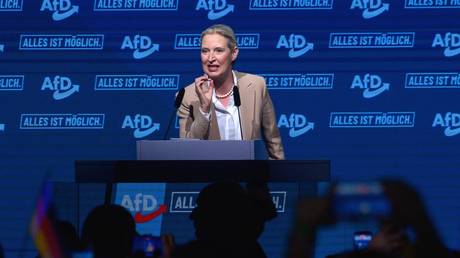
Alternative for Germany (AfD) co-leader Alice Weidel recently laid out a hardline platform that includes pulling Berlin out of the Schengen Area and abandoning the euro. This proposal strikes directly at the economic and social arteries of the European Union. For decades, the conventional wisdom in Brussels held that integration was a one-way street. Once nations dismantled their border posts and synchronized their economies, turning back the clock was treated as an administrative impossibility. Today, that assumption looks less like an immutable law and more like wishful thinking.
When a major party climbs to the top of national opinion polls on a platform of re-erecting continental checkpoints, the shockwaves travel far beyond the Bundestag.
To understand why this rhetoric resonates so deeply with millions of German voters, one must look past the standard political shouting matches and examine the friction points of modern European logistics. The Schengen Agreement, signed in 1985, removed internal border checks across participating states. It transformed the European heartland into a frictionless economic zone where goods, services, and labor moved as easily as cargo crossing state lines in America. Factories in Bavaria relied on workers commuting daily from neighboring countries. Supply chains for German automotive giants operated on strict just-in-time delivery models that depended on zero delays at international crossings.
That frictionless ideal has collided with public anxiety over irregular migration, security threats, and economic stagnation.
As support for the AfD surges past traditional conservative blocks in key polls, the mainstream parties have found themselves scrambling to catch up. Even center-left and center-right administrations have instituted rolling border checks with their neighbors, transforming temporary security measures into an awkward, semi-permanent reality. Yet, where mainstream leaders treat border checks as an unfortunate exception to the rule, the AfD treats them as a starting point. Their policy prescription is absolute: total withdrawal from the visa-free zone and the re-establishment of sovereign national boundaries enforced by federal police.
The logistical nightmare of such a proposal is rarely discussed by its proponents. Germany sits at the geographic center of the continent, sharing land borders with nine different nations. Reintroducing permanent customs posts and passport controls along every highway, rural lane, and rail line would require billions of euros in infrastructure and thousands of new federal personnel.
Consider a hypothetical example involving the Rhine-Main logistics corridor. Thousands of freight trucks cross multiple international frontiers daily to deliver components to manufacturing hubs. If each truck faces systematic administrative inspection at the German border, the resulting bottlenecks would stretch for dozens of kilometers within hours. The economic cost to export-driven industries would compound rapidly, turning minor administrative delays into severe supply chain contractions.
Yet, voters drawn to the nationalist message are often willing to trade economic efficiency for a perceived recovery of national sovereignty.
The economic critique extends to the single currency as well. Weidel’s assertion that Germany fared better before the introduction of the euro taps into a persistent undercurrent of financial discontent. Savers in Germany have long viewed European Central Bank monetary policies with deep suspicion, arguing that low-interest-rate environments penalize prudent domestic savings to bail out heavily indebted southern member states. While mainstream economists warn that abandoning the euro would trigger an unprecedented revaluation crisis and devastate German export competitiveness, the populist appeal lies in the narrative of national self-reliance.
This political pivot exposes a fundamental vulnerability in the European project. Integration was engineered by elites who assumed that continuous institutional binding would eventually erase national friction. They underestimated how quickly public sentiment could turn when citizens begin to associate open borders with unmanaged security risks and economic vulnerability.
The strategy of the established parties has been defensive isolation—trying to out-maneuver the populist right by adopting tougher rhetoric while maintaining the underlying European treaties. That balancing act is growing more precarious by the month. As regional elections approach and national polling numbers continue to shift, the debate over Europe's open borders has moved from the fringes of political theory into the center of government strategy.
The architecture of continental unity was built for fair weather. Now that the political climate has turned severe, the walls are starting to go back up.
AfD co-leader calls for Germany to leave euro, Schengen covers the recent statements by party leadership regarding the withdrawal from European integration agreements.