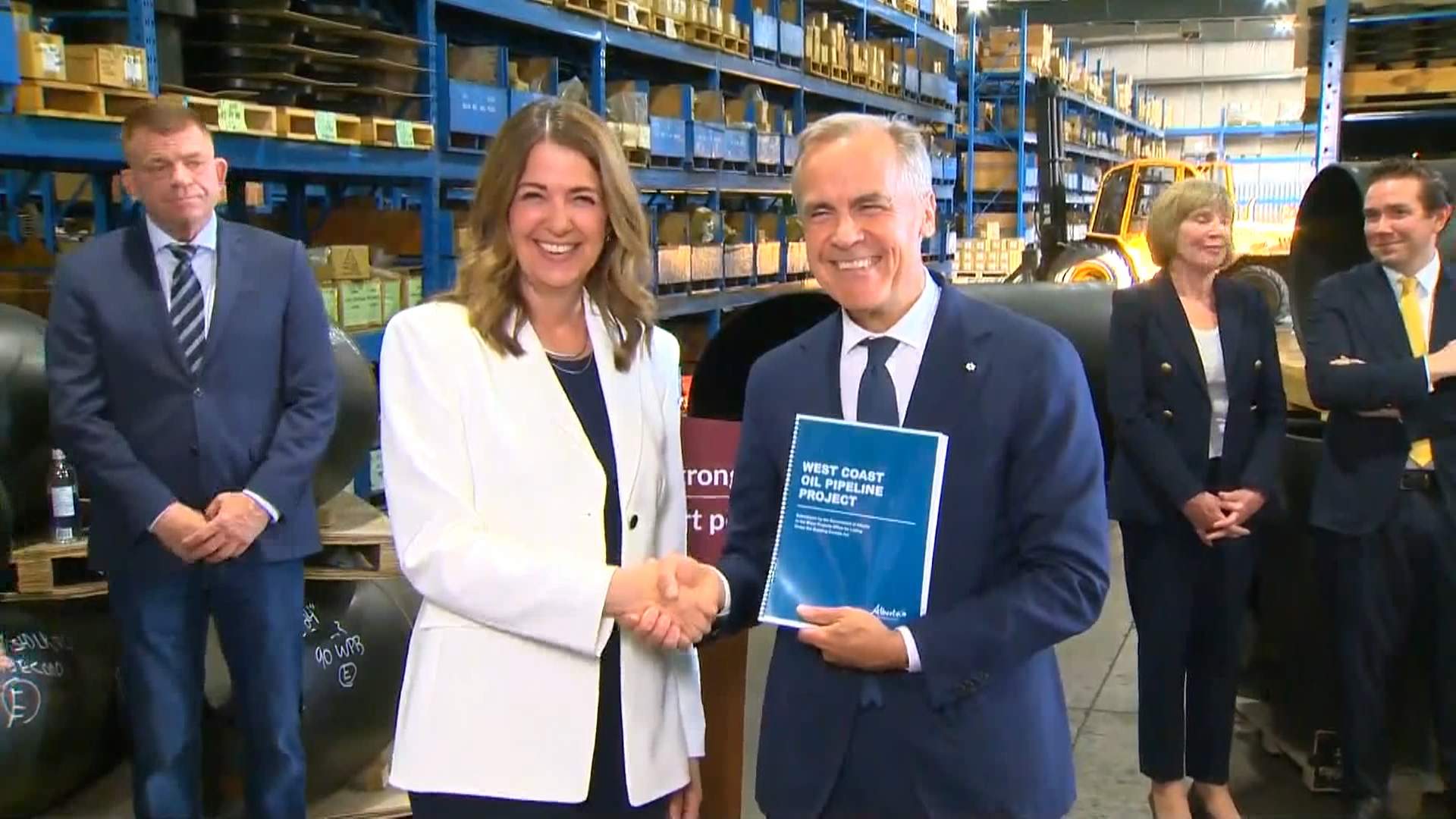
The proposed one-million-barrel-per-day West Coast oil pipeline announced by Canadian Prime Minister Mark Carney and Alberta Premier Danielle Smith represents a historic shift in North American energy logistics, but its corporate blueprint reveals an uncomfortable truth. The partnership behind this project consists of the Canadian federal government through Trans Mountain Corporation, the Alberta provincial government via the Alberta Petroleum Marketing Commission, and Calgary-based Pembina Pipeline Corporation as a minority private stakeholder. Together, they intend to construct a 1,200-kilometer conduit following the existing Trans Mountain corridor to the southwest coast of British Columbia, targeted at breaking Canada's near-total dependency on the United States energy market.
While political rhetoric frames the massive project as a balanced public-private partnership, the financial architecture tells a completely different story.
The public owns this project. Out of the estimated $35.2 billion to $43.7 billion required just to get the pipeline built, ninety percent of the initial equity and risk will be carried directly by the state. Trans Mountain Corporation and the Alberta Petroleum Marketing Commission will hold equal shares of the remaining ninety percent balance once a carved-out portion is reserved for future Indigenous equity partners. Pembina Pipeline Corporation, the sole private sector firm involved at this stage, is contributing its technical and operational expertise in exchange for a conservative ten percent economic interest during the construction phase, with an option to increase its share to twenty percent once commercial operations begin in the mid-2030s.
The Public Power Players and One Private Backer
To understand why this infrastructure project is structured like a state utility rather than a corporate venture, one must look closely at the specific mandates of the entities involved. Trans Mountain Corporation is a federal Crown corporation, functioning as a subsidiary of the Canada Development Investment Corporation. It answers directly to the parliament in Ottawa. This is the same entity that took over the original Trans Mountain expansion project after its previous private owner walked away due to runaway regulatory delays and soaring costs. That expansion eventually reached completion in May 2024 at a staggering final price tag of $34.2 billion, but it proved that state-backed execution could push heavy infrastructure through intense regional opposition.
On the provincial side sits the Alberta Petroleum Marketing Commission. This agency operates as the commercial arm of the Alberta ministry of energy, responsible for marketing the province’s conventional oil and bitumen royalties. By entering this partnership as an equal partner to the federal government, the province ensures that its internal goal of doubling oil production to eight million barrels per day over the next fifteen years has a guaranteed outlet. The province is effectively using its own balance sheet to build a highway for its primary export product.
Pembina Pipeline Corporation provides the necessary corporate veneer for the operation. As a major player in Western Canadian natural gas processing and transportation, Pembina brings deep technical execution capabilities without exposing its public shareholders to catastrophic capital risk. Pembina's non-binding heads of agreement ensures it will help manage engineering, procurement, and contracting strategies. Their participation can scale up to one-fifth of the project only after the pipeline is safely built, fully operational, and generating predictable toll revenues.
Why Private Capital Refuses to Take the Risk
The stark absence of dominant private equity in this pipeline group is not an accident. Capital markets have grown deeply allergic to funding major greenfield oil pipelines across Canada and the United States. The reasons are entirely economic. Over the past decade, regulatory bottlenecks, protracted legal challenges from environmental coalitions, and unpredictable construction delays have turned linear infrastructure into a financial minefield.
When private entities attempt these projects, the delays eat through interest during construction and destroy project economics. The original Trans Mountain expansion was initially projected to cost just $7.4 billion. It ended up costing more than four times that amount. No corporate board or public equity fund can survive that level of volatility without destroying its stock price.
By stepping in as the primary financiers, the federal and provincial governments are absorbing the early-stage construction risk that the private sector refuses to touch. If the project faces intense regulatory scrutiny in British Columbia, or if regional court challenges halt work crews in the early 2030s, the state treasury bears the carrying costs. The government can afford to wait out a three-year court delay. A private corporation cannot.
Breaking the American Monopoly Amid Tariff Threats
The broader strategic motive driving Prime Minister Mark Carney’s sudden alignment with Alberta’s oil sector is deeply rooted in international trade vulnerabilities. Canada currently exports roughly four million barrels of oil per day to the United States, representing nearly sixty percent of all American crude imports. This single-buyer relationship gives American refineries massive leverage over Canadian pricing, forcing Alberta producers to accept a persistent discount known as the Western Canada Select differential.
Political shifts in Washington have made this dependence an existential threat to the Canadian economy. With threats of universal import tariffs and shifting trade frameworks casting a shadow over cross-border commerce, Ottawa views a direct pipeline to the Pacific coast as a matter of economic sovereignty. Diversifying the customer base to include major Asian industrial economies like Japan, South Korea, India, and China is designed to narrow the price gap by an estimated $3 per barrel.
The math is straightforward. Giving Canadian producers an alternative destination deprives American Gulf Coast and Midwest refiners of their monopsony power. Even if a significant portion of the oil never actually crosses the Pacific, simply having the physical capacity to ship one million barrels per day to Asia alters the structural pricing dynamics across the entire North American continent.
The High Stakes Political Truce
The alignment between a Liberal prime minister focused on fiscal discipline and an Alberta premier championing provincial sovereignty represents a highly tactical political trade-off. Alberta has been gripped by intensifying regional friction, with a provincial vote scheduled for mid-October regarding its constitutional relationship with the federal government. By delivering a firm commitment to a $35 billion infrastructure project that promises to generate up to 140,000 jobs during its peak construction phase, Ottawa is attempting to neutralize separatist momentum by demonstrating the tangible economic value of federation.
However, this support came with an explicit condition. The federal backing of the West Coast oil pipeline is legally tied to the finalization of a tripartite agreement to construct the Pathways carbon capture and storage network. The Pathways project, supported by Canada's largest oil sands producers, aims to deploy carbon capture infrastructure across northern Alberta to drastically curb the emissions intensity of heavy crude production.
This creates a delicate policy balance. The federal government can justify supporting a massive fossil fuel pipeline to international climate observers by pointing to the simultaneous mandate for large-scale carbon abatement at the source. Alberta gets its market access, and Ottawa secures enforceable corporate commitments toward national emission targets.
Technical Realities and the Southern Corridor Decision
Choosing the correct route for a project of this scale involves balancing environmental impact against political survival. While early policy discussions frequently focused on a northern route through British Columbia to access deep-water ports closer to Asian shipping lanes, the partnership ultimately selected a southern path. The proposed line will run from Bruderheim, Alberta, and run parallel to the existing Trans Mountain corridor, terminating at the Roberts Bank Terminal in Delta, British Columbia.
This decision was dictated by existing legislation. The federal Oil Tanker Moratorium Act strictly prohibits crude oil tankers from loading or navigating off the coast of northern British Columbia to protect sensitive marine ecosystems. By utilizing the southern corridor, the project complies with the law while minimizing the amount of new land disturbance.
Building alongside an existing right-of-way dramatically reduces the need to clear undisturbed wilderness, limits impacts on wildlife habitats, and simplifies the technical engineering process. The crews will be working along a path that has already been surveyed, cleared, and stabilized during previous pipeline expansions.
| Project Metric | Detail / Target |
|---|---|
| Proposed Capacity | 1,000,000 barrels per day |
| Estimated Cost | $35.2 billion to $43.7 billion |
| Target Construction Start | September 1, 2027 |
| Projected Completion Window | 2032 to 2034 |
| Primary Route Corridor | Bruderheim, Alberta to Delta, British Columbia |
| Public Ownership Stake | 90% (Split between TMC and APMC) |
| Private Ownership Stake | 10% during construction (Pembina Pipeline) |
The Upcoming Battle for Coastal Approvals
Despite the immense political capital backing the proposal, the project faces immediate logistical hurdles on the West Coast. The corridor is projected to pass through the traditional territories of more than ninety First Nations communities and cross at least nine established reserves in British Columbia. While the partnership framework explicitly includes an Indigenous equity purchase right backed by federal and provincial loan guarantee programs, securing consent across dozens of distinct nations remains a complex task.
Some coastal communities have already expressed strong satisfaction that the northern tanker ban remains intact, insulating their traditional waters from increased industrial traffic. However, the southern terminus at Roberts Bank will see a substantial increase in maritime traffic. Environmental organizations and local municipal authorities in the lower mainland of British Columbia are already organizing opposition, citing the risk of localized marine spills and the broader global impact of facilitating increased fossil fuel production.
The Major Projects Office has until October 1 to officially register the pipeline as a project of national interest under the Building Canada Act. Once that designation occurs, the regulatory clock begins ticking toward the proposed September 2027 ground-breaking date. The success of this massive public investment will ultimately depend on whether the state's deep pockets can overcome the regional friction that broke the private sector years ago.
You can learn more about the strategic choice behind the pipeline path by watching this report on the southern route proposal, which explains the logistical and legislative factors shaping the current expansion corridor.