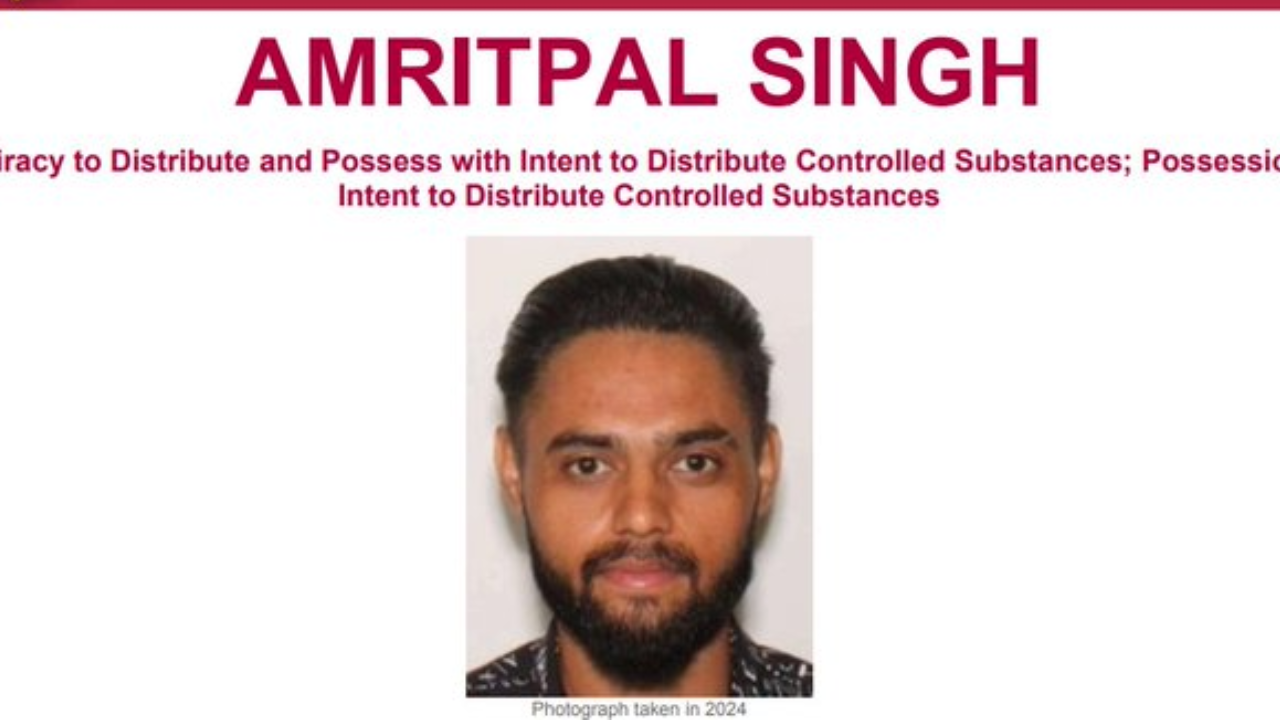
Indian national Amritpal Singh has been officially added to the United States Federal Bureau of Investigation's Most Wanted list, thrusting a secretive cross-border narcotics pipeline into the global spotlight. Federal prosecutors in the Central District of California secured an arrest warrant for Singh on June 23, charging him with conspiracy to distribute and possess with intent to distribute controlled substances alongside conspiracy to export them.
The indictment ties Singh directly to the Ravinder Dhanda Organized Crime Group, a Vancouver-based transnational criminal syndicate. According to federal investigators, this network operated as a primary logistics hub, smuggling bulk quantities of cocaine and methamphetamine across the porous corridors connecting Mexico, the United States, and Canada.
The Mechanics of North American Logistics
Transnational drug cartels no longer rely on single-point smuggling routes or isolated couriers. Modern operations mimic multinational supply chain logistics, utilizing legitimate commercial infrastructure to mask illicit cargo. The Ravinder Dhanda organization exploited the vast, heavily trafficked trade routes spanning the Pacific Northwest down through California and deep into Mexican cartel territory.
Investigators note that syndicates operating out of British Columbia have increasingly established operational linkages with South American source suppliers and North American distribution cells. By embedding operatives within legitimate transportation networks, these groups move hundreds of kilograms of narcotics past border checkpoints with minimal friction.
Singh's specific role within this architecture involved coordinating the mechanics of distribution and export. While public attention often fixes on high-profile cartel bosses, federal anti-narcotics efforts increasingly target the operational facilitators—individuals who manage the complex web of stash houses, transit schedules, and cross-border couriers necessary to keep multi-ton shipments moving.
The Geopolitical and Jurisdictional Maze
Chasing cartel nodes across international borders presents a permanent headache for law enforcement agencies. Canada remains an attractive operational base for transnational criminal groups due to geographic proximity to the United States market and complex jurisdictional boundaries between federal, provincial, and municipal police forces.
When criminal syndicates span India, Canada, the United States, and Mexico, intelligence sharing often slows down bureaucratic pipelines. The FBI's decision to elevate Singh to the Most Wanted list signals a strategic shift toward public pressure and international cooperation. When traditional extradition pathways bog down or suspects scatter across the globe, a public federal warrant acts as an international flare, compelling foreign partner agencies and local police forces to prioritize the target.
This public designation also disrupts the financial and social anonymity that mid-level transnational figures rely on. Bank accounts, encrypted communication channels, and safe houses become liabilities the moment an agency broadcasts an individual's facial photograph and physical description globally.
The Expanding Scope of Federal Enforcement
The case against Singh sits inside a broader federal initiative targeting North American drug supply chains. Over recent years, U.S. law enforcement has intensified its focus on the convergence of Canadian-based organized crime groups and traditional Mexican cartels. These alliances have weaponized the northern border for drug transit, turning quiet suburban logistics hubs into critical nodes for global narcotics distribution.
Federal arrest warrants filed in Los Angeles highlight how domestic drug enforcement has transformed into an overseas intelligence operation. Investigators must map out financial ledgers, encrypted messaging applications, and shipping manifests that cross multiple time zones before a single indictment can be handed down.
Law enforcement agencies maintain active channels for tips regarding Singh's whereabouts, urging anyone with actionable intelligence to contact local FBI offices or American embassies. As international task forces tighten the net around the remaining members of the Dhanda network, the primary objective remains dismantling the transport infrastructure that allows multi-state drug pipelines to operate with impunity.