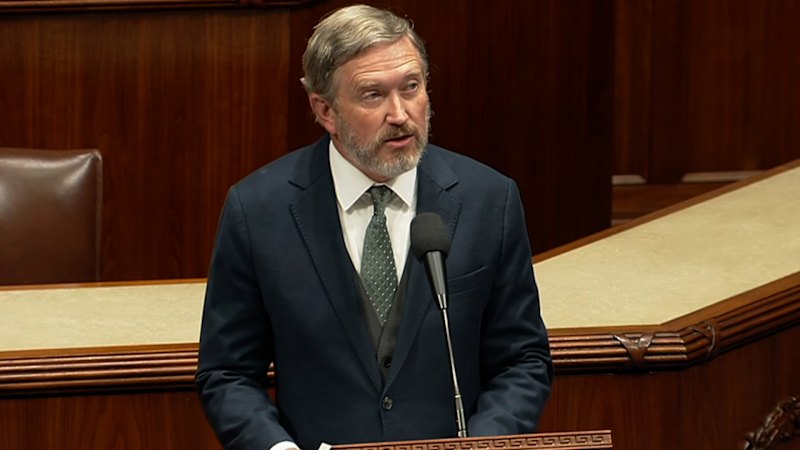
When a member of the president's own party introduces articles of impeachment against a sitting Cabinet secretary, Washington stops and takes notice. That is precisely what unfolded on Capitol Hill when a Republican congressman formally filed an impeachment resolution targeting Defense Secretary Pete Hegseth.
Intra-party impeachment efforts are extraordinarily rare in modern American politics. Normally, impeachment is a weapon wielded by the opposition party to inflict political damage, force oversight, or rally a base ahead of midterm elections. When the call comes from inside the house, the calculus shifts entirely. It signals deep fractures within the governing coalition, intense disagreements over national security doctrine, or acute friction between the executive branch and congressional oversight committees.
To understand why a Republican lawmaker would take such a drastic step against a Trump administration defense chief, you have to look beyond the cable news shouting matches. You have to examine the constitutional mechanics of impeachment, the historical rarity of Cabinet removals, and the specific fault lines currently dividing conservatives over the future of the Pentagon.
The Anatomy of an Intra-Party Revolt
Impeachment resolutions filed by lone lawmakers are often dismissed by seasoned Capitol Hill observers as political theater. In most cases, they are referred to the House Judiciary Committee, where leadership quietly lets them die without a hearing or a floor vote.
Yet filing a formal resolution against a sitting Defense Secretary carries a different weight than targeting a lower-profile official. The Department of Defense commands the largest discretionary budget in the federal government and oversees the global posture of the United States military. Any formal challenge to the legitimacy of its civilian leader immediately reverberates through the Pentagon's E-Ring, allied capitals, and defense industry boardrooms.
According to congressional records and statements surrounding the filing, the core friction stems from fundamental disputes over Pentagon management, accountability, and adherence to congressional mandates. While the broader Republican conference has largely rallied behind the administration's push to overhaul military culture and strip away diversity initiatives, pockets of the party remain fiercely protective of traditional institutional norms, alliance structures, and statutory oversight rules.
When those two visions collide, the result is legislative warfare. A member of Congress frustrated by unanswered oversight requests, disputed policy shifts, or controversies surrounding senior Pentagon leadership has few tools that command instant attention. Subpoenas can be tied up in court for years. Appropriations riders get stripped out in conference committees. An impeachment resolution, by contrast, forces the issue onto the public record immediately.
Why Cabinet Impeachments Almost Never Happen
To appreciate the gravity of this filing, consider the sheer rarity of Cabinet-level impeachments in American history. Since the founding of the republic, the House of Representatives has impeached only one Cabinet secretary.
That occurred in 1876, when the House voted to impeach Secretary of War William Belknap over his involvement in a kickback scheme involving trading post contracts at Fort Sill. Belknap actually resigned minutes before the House voted, hoping to avoid the proceedings. The House impeached him anyway, and the Senate held a trial, though Belknap was ultimately acquitted because several senators believed they lacked jurisdiction over a private citizen.
Since Belknap, numerous Cabinet officials have faced intense calls for impeachment, formal resolutions, and relentless congressional investigations. None have been impeached by the full House.
- Andrew Mellon (1932): Rep. Wright Patman introduced impeachment articles against the Treasury Secretary over alleged conflicts of interest involving his vast business holdings. President Herbert Hoover appointed Mellon as Ambassador to the United Kingdom before the Judiciary Committee could act, effectively ending the inquiry.
- Eric Holder (2013): Conservative lawmakers filed articles of impeachment against President Barack Obama's Attorney General following the "Fast and Furious" gun-walking controversy and his subsequent contempt of Congress citation. The resolution never reached the House floor.
- Alejandro Mayorkas (2024): Homeland Security Secretary Alejandro Mayorkas became the first sitting Cabinet member since Belknap to be formally impeached by the House of Representatives, following a narrow party-line vote driven by Republicans over border enforcement policies. The Senate subsequently dismissed the articles without holding a full trial.
The historical record demonstrates a clear rule of congressional survival. Cabinet secretaries rarely survive when they lose the confidence of the president, and they almost never face successful impeachment when they retain it. Because the president can fire a Cabinet member at will, impeachment is generally viewed by constitutional scholars as a redundant mechanism unless the executive branch actively shields an official from accountability.
The Constitutional Hurdle
Article II, Section 4 of the U.S. Constitution stipulates that the President, Vice President, and all civil officers of the United States shall be removed from office on impeachment for, and conviction of, treason, bribery, or other high crimes and misdemeanors.
Cabinet secretaries clearly fall under the definition of "civil officers." However, the phrase "high crimes and misdemeanors" has been the subject of fierce legal and political debate for over two centuries.
Constitutional scholars generally agree that an impeachable offense does not necessarily require a violation of the criminal code. Alexander Hamilton, writing in Federalist No. 65, described impeachable offenses as those arising from the misconduct of public men, or the abuse or violation of some public trust. They are, in Hamilton's words, of a nature which may with peculiar propriety be denominated political, as they relate chiefly to injuries done immediately to the society itself.
Despite that broad theoretical standard, modern lawmakers face an uphill battle convincing their colleagues that policy disputes, management failures, or controversial rhetoric rise to the level of high crimes and misdemeanors. Critics of the resolution against Hegseth argue that using impeachment to settle intra-party policy grievances or administrative disputes cheapens the constitutional remedy and sets a dangerous precedent for future administrations.
Supporters of aggressive oversight counter that when an agency head stonewalls Congress or operates outside statutory boundaries, impeachment is the ultimate constitutional check available to the legislative branch.
The Fault Lines Inside the Republican Conference
The filing against Hegseth exposes a broader ideological and strategic divide within the modern Republican Party regarding national defense. For decades, the GOP operated under a unified Reaganite consensus emphasizing forward military presence, robust support for international alliances like NATO, and deference to uniformed military leadership.
That consensus has fractured. One wing of the party favors an "America First" approach characterized by deep skepticism of foreign entanglements, aggressive purging of what it views as ideological bloat within the officer corps, and a willingness to disrupt entrenched Pentagon bureaucracies. Hegseth, a former Fox News host and Army National Guard veteran who campaigned heavily on reforming military culture and rooting out "wokeness" at the Defense Department, embodies this disruptive mandate.
Another wing of the Republican conference—composed largely of defense hawks, members representing districts heavily reliant on military installations, and institutionalists on the Armed Services Committee—views rapid, top-down disruption with alarm. Their concerns typically center on three core areas:
1. Readiness and Retention
Military readiness is notoriously fragile. Critics within the defense establishment worry that sweeping personnel changes, abrupt policy reversals, and high-profile political battles distract senior commanders from primary warfighting preparation. When a congressman represents a district home to thousands of active-duty troops and defense contractors, administrative turbulence at the Pentagon translates directly into local economic and security anxiety.
2. Congressional Oversight and Transparency
Members of the House Armed Services and Appropriations committees guard their constitutional prerogatives jealously. Under Article I, Congress raises and supports armies and makes rules for the government and regulation of the land and naval forces. When Pentagon leadership is perceived as bypassing statutory reporting requirements, withholding information, or sidelining congressional input on major force posture decisions, even loyal party members push back.
3. Alliance Stability
The global security environment leaves little margin for error. With ongoing conflicts in Eastern Europe and the Middle East, alongside escalating strategic competition in the Indo-Pacific, traditional defense hawks argue that steady, predictable leadership at the Pentagon is essential to maintaining deterrence. Any sign of internal chaos or fractured command authority invites adversaries to test American resolve.
How the Legislative Mechanism Plays Out
Filing an impeachment resolution is only the first step in a complex procedural journey. Understanding the mechanics of the House floor reveals why this resolution faces steep odds, regardless of the merits argued by its sponsor.
When a member introduces an impeachment resolution through the normal legislative hopper, it is routinely referred to the House Judiciary Committee. Unlike privileged resolutions—which must be brought to the floor for a vote within two legislative days—a standard resolution sits in committee until the chair decides to schedule a markup.
If the Republican leadership opposes the effort, the Judiciary Committee chair simply takes no action. The bill gathers dust until the end of the two-year congressional term, at which point it expires automatically.
There is, however, a procedural nuclear option. Under Rule IX of the House of Representatives, a member can raise a "question of the privileges of the House" to force an immediate floor vote on an impeachment resolution. If a lawmaker takes that route, House leadership cannot simply bury the measure in committee. They must either allow a vote on the resolution itself, move to table (kill) it, or vote to refer it back to committee.
Forcing a floor vote via a privileged resolution puts every single Republican member on the record. Moderate Republicans in swing districts would have to choose between alienating the administration's core base or voting to protect a Defense Secretary facing intense scrutiny. Defense hawks would have to weigh their institutional concerns against party loyalty.
Because House leadership knows how damaging such a vote can be to party unity, they work furiously behind the scenes to prevent privileged motions. Typically, this involves offering the aggrieved lawmaker concessions—such as dedicated committee hearings, promised document disclosures from the Pentagon, or direct meetings with senior administration officials—in exchange for holding off on a floor confrontation.
The White House and Pentagon Calculus
From the perspective of the White House and the Pentagon, an impeachment resolution from an opposition lawmaker is a badge of honor. It rallies the base and reinforces a narrative of battling an entrenched political establishment.
An impeachment resolution from a Republican is a headache. It cannot be easily dismissed as partisan harassment by Democrats. It creates a media cycle focused entirely on internal division rather than administration achievements, and it hands opposition lawmakers a ready-made talking point to amplify during committee hearings and television appearances.
Historically, when a Cabinet official becomes a persistent political liability, the White House conducts a cold calculation. Does the official's value to the president's agenda outweigh the political capital required to defend them?
In the first Trump administration, turnover among senior national security officials—including Defense Secretaries James Mattis and Mark Esper—was notably high. Yet the administration has also demonstrated fierce loyalty toward nominees and officials who align closely with its core cultural and political battles. Removing a Defense Secretary under fire from Congress risks signaling weakness and inviting further rebellions from dissatisfied lawmakers.
Consequently, the Pentagon's standard response to such legislative pressure is to project business as usual while quietly dispatching legislative affairs teams to Capitol Hill to contain the fallout and shore up support among key committee chairs.
What Actually Happens Next
Without overwhelming support from the Republican conference—and a near-total collapse of confidence from the White House—a lone congressman's impeachment resolution will not remove Pete Hegseth from office. Even in the unlikely event that the resolution gained enough traction to pass the House, convicting a civil officer in the Senate requires a two-thirds supermajority vote, an insurmountable threshold in a closely divided chamber.
Yet measuring the impact of this resolution solely by whether it results in a Senate trial misses the point of how power operates in Washington.
Impeachment resolutions serve as warning flares. They establish a formal baseline of grievances that can be expanded upon if new controversies emerge. They force Pentagon officials to spend valuable hours preparing legal defenses and briefing lawmakers rather than executing policy. Most importantly, they signal to the administration that the margin for error on Capitol Hill is razor-thin.
In a House of Representatives governed by narrow majorities, a handful of dissatisfied lawmakers holds immense leverage over the legislative agenda. Every defense authorization bill, every supplemental spending package, and every confirmation battle becomes a potential hostage to unresolved grievances. The resolution may never reach the floor, and Pete Hegseth may remain firmly behind his desk at the Pentagon, but the political price of keeping him there just went up.


