The lock clicked. It is a specific, metallic sound familiar to anyone who has ever traveled internationally for work, a sound that usually signals the moment a weary traveler can finally drop their bags, exhale, and stop performing.
I stood in the center of a newly renovated hotel room in Shanghai three years ago, staring at the brass door handle. The room smelled of fresh paint and institutional carpet cleaner. Outside the window, a gray drizzle fell over an expressway choked with quiet, electric traffic. On the desk sat a welcome basket of fruit wrapped in cellophane.
Everything looked normal. Everything felt completely mundane.
It took me three days to realize I was sharing that room with an uninvited guest who never slept, never blinked, and cataloged every breath I took.
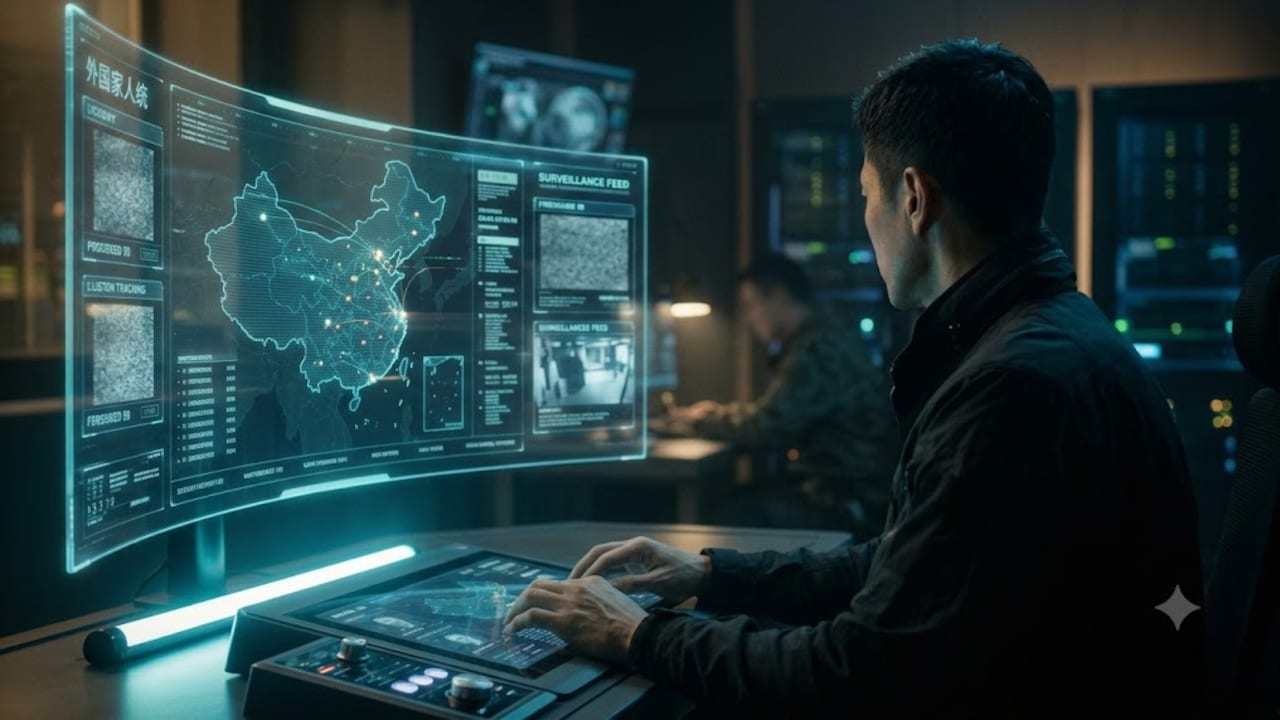
When we talk about modern mass surveillance, our imaginations default to cinematic tropes. We picture dark rooms filled with blue-lit monitors, analysts wearing oversized headphones, and grainy satellite feeds tracking movements down empty midnight alleys. We imagine men in trench coats standing under flickering streetlamps.
That is not how it happens. It is much quieter than that. And it is much closer.
Consider what happens when a foreign journalist, a corporate executive, or a diplomat crosses an international border into a jurisdiction governed by omnipresent digital oversight. The physical passport is scanned at customs, a face is mapped by high-definition optical sensors, and a digital footprint is instantly generated. But the tracking does not stop at the airport exit. It follows the traveler into the taxi, onto the subway, and straight through the hotel lobby doors.
In many major metropolitan areas across China, hospitality infrastructure is deeply integrated with local municipal security apparatuses. This is not a conspiracy theory whispered in dark corners; it is a matter of administrative law. Hotels are required by local regulations to transmit guest registration data directly to public security networks in real time. Every passport scan, every visa entry date, and every expected departure time feeds a localized database designed to monitor population movement down to the individual room number.
(Note: When I describe this direct data pipeline, I am referring to the standardized municipal reporting requirements enforced across commercial lodging establishments in major urban centers.)
The hardware itself is often hiding in plain sight.
Walk into any modern business-class hotel room. Look up at the smoke detector mounted on the ceiling. Look at the smart television mounted on the wall, pre-programmed with interactive welcome menus. Look at the digital door locks operated by radio-frequency identification. Each of these endpoints is a potential node in a wider network of telemetry.
During my stay, I noticed something odd about the television interface. It lacked a standard remote control; instead, guests were encouraged to scan a local quick-response code with their personal smartphones to control room climate, order room service, and access streaming options. To use the room, you had to bridge the gap between your personal device and the local hotel network.
Think about the implications of that simple convenience.
To order a bottle of water, you hand over your digital handshake. Your phone connects to a local router. That router is tied to the hotel infrastructure. That infrastructure communicates with regional servers. The line between your private digital life and the host environment blurs until it vanishes entirely.
People often ask me if my laptop was physically searched while I was out. Did someone pick the lock? Did an agent sift through my papers?
The answer is almost certainly no. Physical intrusion is crude. It leaves fingerprints, scuff marks, and unease. Why bother picking a lock when you can simply clone a digital certificate? Why rifle through a briefcase when you can monitor the encrypted data packets leaving a laptop connecting to the hotel Wi-Fi network?
When a foreign traveler logs onto a local network, they enter a digital Panopticon. Standard virtual private networks, the digital armor that millions of remote workers rely on every day, face aggressive countermeasures. Deep packet inspection algorithms actively hunt for encrypted tunneling protocols, throttling speeds, dropping connections, or forcing re-authentications that expose the underlying device metadata.
I remember sitting on the edge of that hotel bed at two in the morning, trying to send a routine email back to an editor. The progress bar crept forward at a crawl, stuttering, freezing, then resetting entirely.
It was a visceral experience of digital suffocation.
You feel exposed, even when the room is dead silent. You start editing your own thoughts before you type them. You wonder if the casual joke you are sending to a colleague will be flagged by an automated sentiment-analysis script looking for anomalous phrasing. You wonder if your webcam indicator light flickered for a microsecond because of a software update, or something else entirely.
That psychological shift is the true objective of pervasive surveillance networks. They do not need to read every single word you write or listen to every whispered phone call. The mere awareness that they could is enough to alter human behavior. It breeds self-censorship. It induces a low-grade, persistent anxiety that wears down your stamina over weeks and months.
Statistics from various international travel advisories note a steady rise in digital security incidents reported by foreign nationals abroad, ranging from targeted malware deployments during captive-portal logins to unexplained account lockouts. Yet, these numbers fail to capture the human cost. They do not measure the journalist who decides not to make a phone call to a sensitive source because the hotel connection feels too hot. They do not quantify the executive who scraps an entire research initiative because the digital friction is simply too high to bear.
We have built a world where convenience is the Trojan horse of privacy.
Every smart amenity, every frictionless check-in app, and every integrated municipal database represents a trade-off. We exchange our personal telemetry for speed, comfort, and safety. But when that infrastructure is weaponized by a state apparatus with totalizing ambitions, the trade-off ceases to be a choice. It becomes a condition of entry.
As I packed my bags on the final morning of my trip, I unplugged my laptop and slipped it into its sleeve. The room was just as I had found it: clean, quiet, and seemingly empty.
I walked down to the lobby, handed my key card to the front desk clerk, and stepped out into the morning sunlight. The air outside tasted sharp and cold. But as I hailed a cab and watched the hotel fade into the concrete horizon, I could still feel the phantom weight of that brass door handle, and the quiet, watching eye of the room I had left behind.