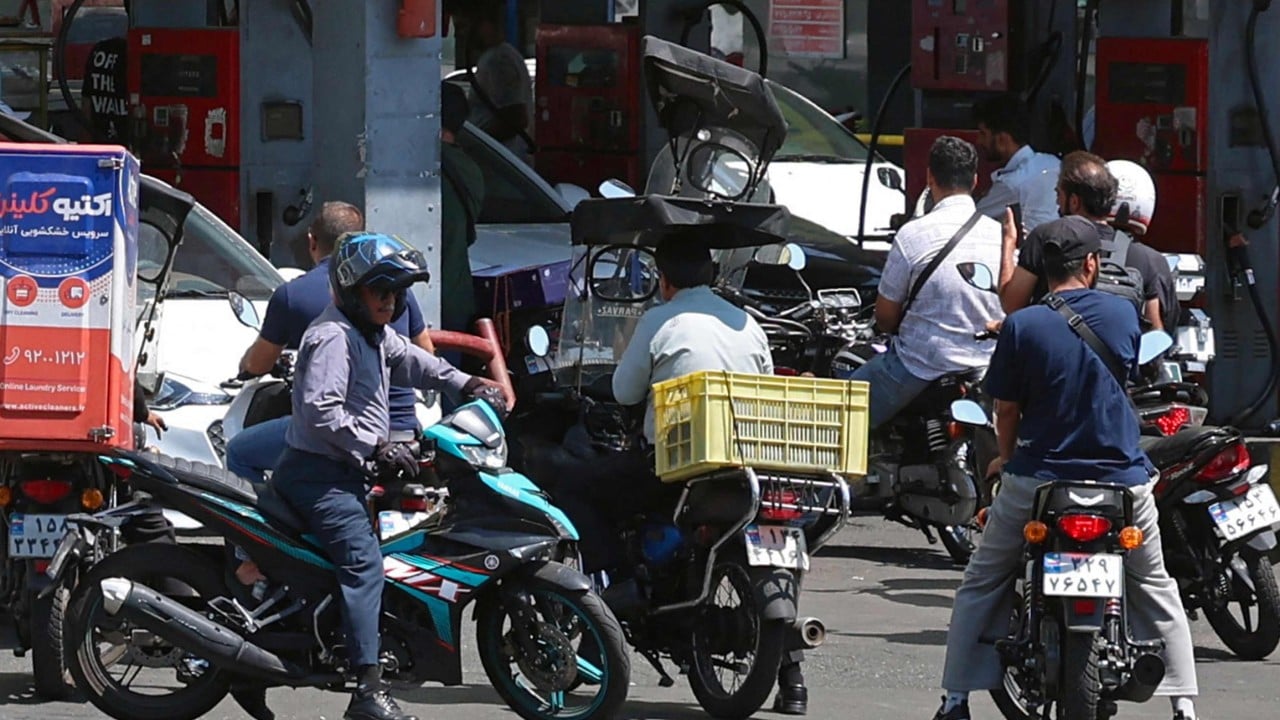
Everyone in Washington thinks sanctions work like a slow-acting poison. They look at the snaking queues at Tehran gas stations, the creeping inflation figures, and the daily depreciation of the rial, and they nod in self-satisfied agreement. The lazy consensus is simple: turn the economic screw another half-turn, and the regime eventually cracks, bows, or folds under public pressure.
It is a comforting bedtime story for foreign policy wonks who prefer spreadsheets over ground-level reality. It is also entirely wrong.
Iran's gas lines are not a sign that the leadership is about to surrender to American pressure. They are a symptom of a completely different pathology—one that has nothing to do with sanctions compliance and everything to do with structural rot, administrative incompetence, and a regime that long ago mastered the art of weaponizing its own dysfunction. If you think the Islamic Republic is going to cave because people are waiting three hours for regular unleaded, you do not understand how authoritarian survival actually works.
The Sanctions Fallacy
Let us dispense with the primary myth: that comprehensive economic pressure creates revolutionary momentum.
History shows the exact opposite. When you isolate an autocracy from the global financial grid, you do not empower the middle class to overthrow the tyrants. You do the precise opposite. You crush the independent private sector, bankrupt civil society, and force every single citizen into a state-dependent survival loop.
I have watched foreign investors pour millions into frontier markets thinking economic pain equals political change. It is a rookie mistake. In Iran, the state controls the distribution channels, the subsidized commodities, and the black-market arteries that keep the economy on life support. When fuel becomes scarce, who gets priority? Not the dissenters standing in those viral gas lines. The Islamic Revolutionary Guard Corps controls the logistics, the smuggling rings, and the alternative supply chains.
Every new restriction passed in Washington simply hands another monopoly to the hardliners. They do not view sanctions as a deterrent; they view them as an exclusive franchise license.
The Real Crisis Hiding Inside the Pumping Stations
Why are the gas lines actually growing? The superficial narrative blames crude export caps and foreign exchange shortages. That misses the mechanics on the ground.
Iran is a hydrocarbon superpower sitting on top of some of the largest oil and gas reserves on Earth. The physical inability to supply refined fuel to its own domestic market is not a failure of extraction. It is a failure of basic engineering, maintenance, and fiscal suicide born from populist price controls.
The government prices domestic gasoline at roughly three cents a liter. At that price, consumption is completely detached from reality. Smuggling subsidized fuel across the borders into Pakistan, Afghanistan, and Turkey is the most lucrative trade in the region. Entire border provinces survive entirely on moving state-subsidized petroleum out of the country for hard currency.
The gas lines are not caused by a lack of oil. They are caused by systemic bleeding. The regime cannot raise prices because the last time they tried, in November 2019, nationwide protests erupted that terrified the security apparatus to its core. They chose long queues and logistical friction over the immediate political threat of urban riots.
Understand that trade-off. Autocrats do not fear angry citizens waiting for fuel as much as they fear angry citizens charging police stations.
Why Washington Keeps Missing the Target
The policy establishment in Western capitals operates on a fundamental misconception of how the Iranian state absorbs shocks.
For decades, analysts have treated Tehran as a rational economic actor that responds to cost-benefit analyses. If inflation hits fifty percent, the leadership must reconsider its regional proxy strategy to appease the domestic population, right? Wrong.
Survival for the ruling elite does not depend on GDP growth or consumer satisfaction. It depends on internal security cohesion, loyalty within the military hierarchy, and the brutal suppression of alternative power centers.
Imagine a scenario where Washington drops every single sanction tomorrow, unfreezes billions in foreign assets, and invites Tehran back into the global banking system. Do you think the regime redirects those windfalls toward public infrastructure, modernizing refineries, or easing the burden on the working poor?
Of course not. The money flows straight into the security apparatus, missile development, and regional proxy networks. The clerical elite treats the civilian economy as a tax farm, not a stakeholder community. Economic normalization without internal structural reform only deepens the entrenchment of the security state.
The Anatomy of State-Sponsored Monopoly
To grasp how this system endures, you have to look at the economic footprint of the bonyads—the massive, tax-exempt semi-public foundations that control vast swathes of the Iranian economy.
These organizations answer to no elected body, pay zero taxes, and operate outside the standard regulatory framework. When sanctions bite, independent private businesses vanish. They cannot secure letters of credit, they cannot clear international wire transfers, and they cannot compete with state-backed conglomerates.
The bonyads and the military-industrial complex step into the vacuum, buying up distressed assets for pennies on the dollar. The state becomes the sole employer, the sole importer, and the sole arbiter of who eats and who starves.
When you make your entire population dependent on state-issued rations and subsidized bread, you eliminate the economic independence required for rebellion. People fighting for daily caloric and logistical survival rarely have the bandwidth to stage a sustained political revolution.
Dismantling the Popular Narratives
Let us address the frequent queries circulating in policy circles.
Are the protests driven by economic desperation?
Yes, but desperation is not direction. Economic misery produces bread riots, not institutional reform. Without a unified leadership, a coherent alternative platform, and access to communications infrastructure that cannot be instantly throttled by the state, spontaneous outbursts of anger are routinely managed, absorbed, and crushed by a security apparatus designed specifically for that purpose.
Will diplomatic engagement change the trajectory?
Engagement without leverage is appeasement; pressure without a viable endgame is noise. The current diplomatic stalemate persists because both sides are trapped in outdated playbooks. Washington thinks it can starve the regime into submission, while Tehran thinks it can outlast Western electoral cycles. Both assumptions are dangerously flawed.
The Unspoken Reality of Regime Longevity
The uncomfortable truth that nobody in Washington wants to admit is that authoritarian regimes do not typically fall from external economic coercion. They collapse from internal elite fragmentation, succession crises, or catastrophic military defeat.
As long as the security forces remain unified, well-fed, and convinced that their survival is inextricably linked to the preservation of the regime, those gas lines can stretch clear across the country without threatening the supreme leader's grip on power.
The queues are long, the currency is weak, and the population is exhausted. None of that spells the imminent demise of the Islamic Republic. It merely signals the continuation of a slow-motion managed decline—one where the ruling class eats first, the proxies get paid second, and the ordinary citizen bears the cost until something inside the machinery finally breaks under its own internal weight.
Stop waiting for sanctions to do the job of a revolution. They never have, and they never will.