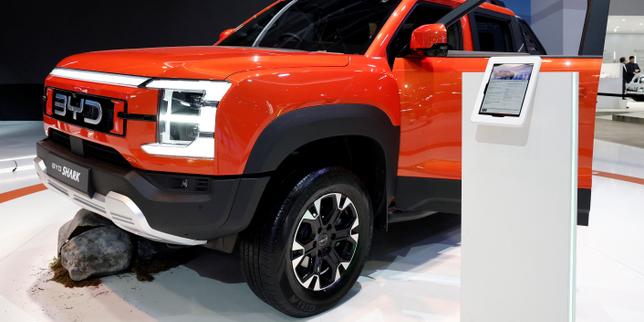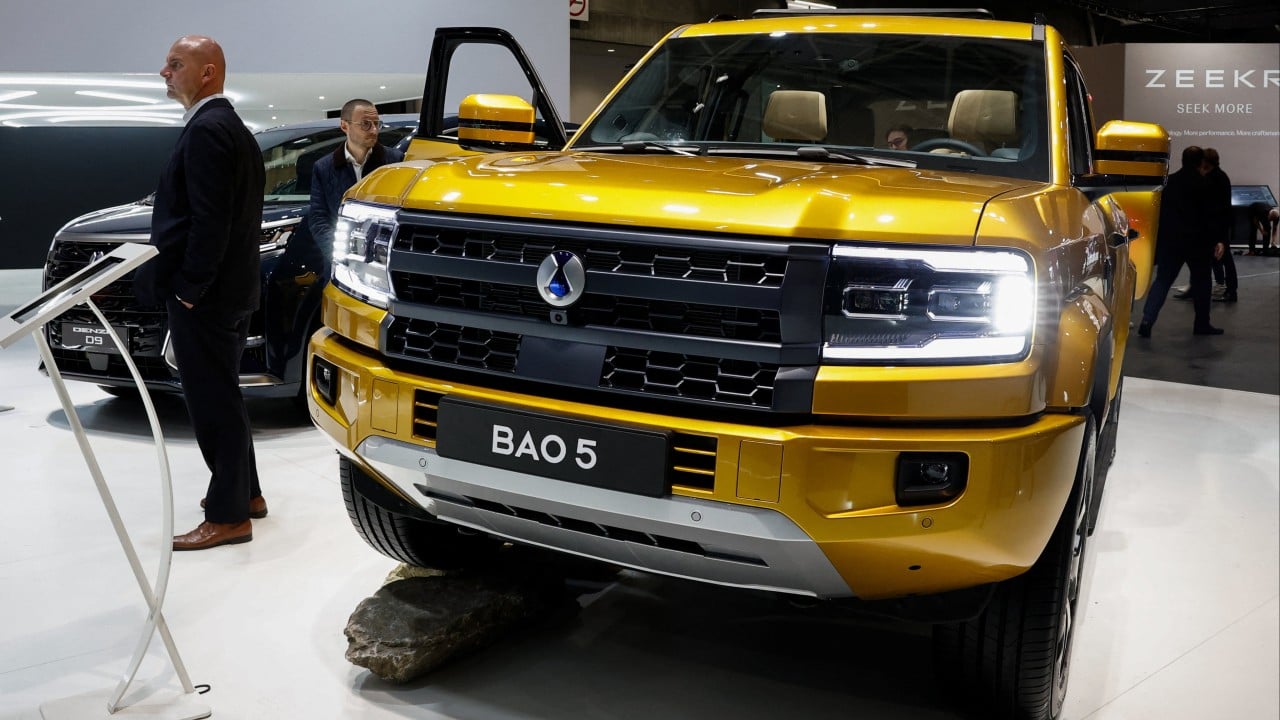
The coffee in the press lounge of the Paris Expo Porte de Versailles is always too bitter, but on that crisp autumn morning, nobody was drinking.
Outside, under the cavernous glass arches of the convention hall, a quiet revolution was unfurling its metallic wings. For decades, European automotive royalty treated this biennial exhibition as their private parlor. They brought concept cars wrapped in velvet rope, whispered about horsepower over champagne, and dictated the rhythm of global mobility. But history does not care for tradition when the electricity goes out. Or rather, when it comes back on in an entirely different language.
Consider the engineer standing by a sleek, midnight-blue electric sedan bearing a badge most European journalists could not yet pronounce correctly. Let us call him Marcus, though he could just as easily be any veteran designer from Stuttgart or Turin who spent thirty years perfecting the internal combustion engine. Marcus stood forty feet away from a display booth operated by BYD, staring not at the car’s aggressive chassis lines, but at its price tag and battery architecture. His hands were tucked deep into his wool coat pockets. They were trembling slightly. Not from the October draft creeping through the exhibition hall doors, but from the realization that the moat had dried up.
To understand why this year's Paris Motor Show felt less like a celebration and more like a wake, you have to look past the shiny paint and examine the shadow hanging over the hall. Brussels was busy drafting paperwork. Trade officials were whispering about countervailing duties, anti-subsidy investigations, and tariff walls designed to protect heritage manufacturers from an incoming tidal wave of Chinese electric vehicles. Import curbs were no longer a distant threat scribbled on policy memos; they were a looming iron gate, descending fast.
Yet, rather than retreating behind their borders or scaling back their ambitions, Chinese automakers did something audacious. They showed up in force.
Brands like BYD, Great Wall, and Leapmotor did not slip into the convention center through the side loading docks. They rented the grandest stages, booked the brightest lights, and parked rows of affordable, software-defined, luxury-appointed electric vehicles right in the backyard of the continent that invented the automobile. It was a calculated, high-stakes gamble. If the politicians in Brussels wanted to build walls, these companies were determined to make sure European consumers were already so captivated by what was on the other side that tearing those walls down would be the only politically viable option left.
Walk the floor for an hour, and the cultural shift becomes visceral. Traditional European car launches used to spend twenty minutes talking about engine displacement, exhaust notes, and heritage. Here, the presentation decks flashed data on infotainment processing speeds, over-the-air update frequencies, and cost-per-kilowatt-hour efficiencies.
A hypothetical buyer named Claire, living in a cramped apartment in the 11th arrondissement of Paris, represents the exact demographic keeping legacy executives awake at night. Claire does not care about piston rings or the romantic legacy of a century-old badge forged in coal smoke. She cares about a driving range that exceeds four hundred kilometers, a charging interface that behaves like her smartphone, and a price point that does not require taking out a second mortgage. When she sat inside the cabin of a Chinese EV at the exhibition, she did not find cheap plastics or crude assembly. She found vegan leather, voice commands that actually understood her accent, and a price tag thousands of euros lower than the domestic alternative parked across the aisle.
That is the invisible friction driving this entire drama.
European automakers are trapped in a generational transition. They spent a century mastering the art of the internal combustion engine—thousands of moving parts, meticulously engineered transmissions, complex supply chains built around fuel injection. Shifting to electric vehicles is not merely a change of fuel source; it is an amputation of their core competencies. Batteries are chemistry and software. Motors are electronics. And in those domains, Asian manufacturers have spent fifteen years building an unmatched, vertically integrated supply chain, from raw lithium extraction in remote provinces to the final microchip stamped in Shenzhen.
When governments threaten import curbs, they are trying to buy time. They are attempting to slow down a speeding freight train with a legislative stop sign.
The executives running these Chinese firms know this better than anyone. They sat under the bright lights of Paris knowing full well that punitive tariffs might soon hit their profit margins, adding ten, twenty, or thirty percent to the sticker price of every car shipped across the sea. But they also knew that desperation breeds innovation. If tariffs make exporting completely assembled cars too expensive, the next logical move is already mapped out on their strategic blueprints: localized manufacturing inside the European Union. Factories springing up in Hungary, Spain, or Germany. Local workers. Local supply chains. A complete sidestepping of trade barriers through sheer economic gravity.
By the final afternoon of the exhibition, the crowds had thinned out, leaving behind the faint scent of ozone, tire rubber, and expensive cologne.
Marcus was still near the central pavilion, watching a team of technicians polish the hood of a white electric SUV. He had seen the future, and it did not speak German, French, or Italian. The iron gates of trade protectionism may yet clang shut in the coming months, buying legacy brands a few precious years to catch up in the labs and assembly lines. But as the exhibition lights flickered and dimmed over the Parisian evening, one undeniable truth remained etched into the floorboards. You can legislate against imports, but you cannot outlaw progress once the public has already caught a glimpse of what is possible.