Salt crusts on eyelashes. The taste of cordite hangs heavy at the back of the throat, bitter and metallic, mingling with the copper tang of fear.
To understand what happened off the coast of Tinian in the sweltering summer of 1944, you have to abandon the sanitized altitude of maps and dry operational reports. You have to stand on the main deck of the USS Colorado. You have to feel the floor plates shudder beneath your boots not just as a mechanical reaction, but as a violent, living pulse.
Warships are often romanticized as impenetrable castles of steel. They are marketed to the public imagination as pristine, detached titans that glide across oceans untouched. But steel bleeds. Steel buckles. And sometimes, steel refuses to die simply because the men inside refuse to let go.
The morning air over the Marianas was thick enough to chew. July 24, 1944, began like any other purgatorial day in the Pacific campaign—punctuated by the relentless, thrumming roar of radial engines and the dull, concussive thud of heavy ordnance.
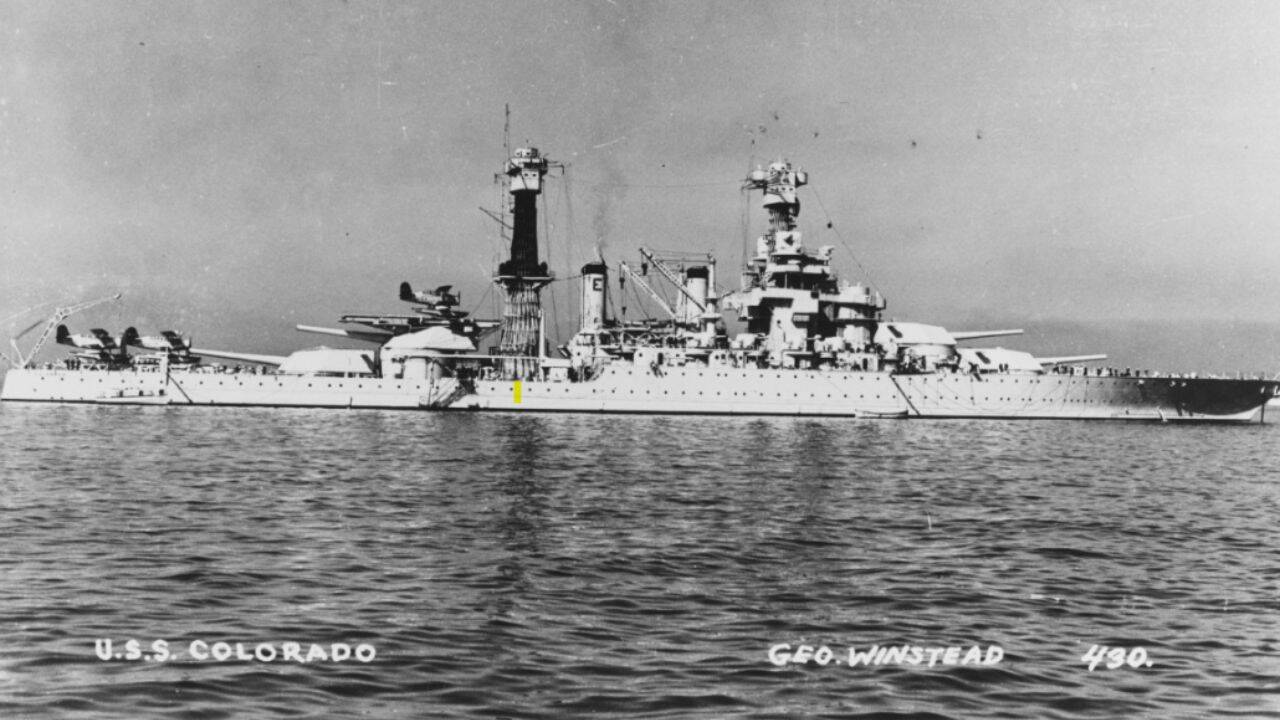
Aboard the Colorado, a standard Colorado-class battleship carrying a proud lineage and thousands of souls, the crew moved with the grim efficiency of veterans. They had seen action at Tarawa, Kwajalein, and Saipan. They knew the cost of island-hopping. They knew that behind every palm-fringed ridge lay an entrenched enemy with an absolute refusal to surrender.
Then came the scream from the sky.
It was not a bomb. It was a battery of coastal defense guns hidden deep within the volcanic rock of Tinian, locking onto the American dreadnought with chilling precision.
The first shell hit. Then the second.
Within minutes, the ship became the epicenter of a localized apocalypse. Twenty-two heavy caliber shells found their mark on the Colorado. Twenty-two catastrophic impacts. Each one arrived with the force of a falling meteor, tearing through armored plating, snapping thick pipes, and turning bulkheads into shrapnel-filled meat grinders.
Consider what happens to a human body when a 6-inch or 8-inch high-explosive shell detonates inside a confined steel compartment. The physics are absolute and merciless. The air pressure alone can rupture lungs. The heat turns the surrounding space into an oven.
Below decks, in the suffocating gloom lit only by flickering emergency lanterns and the orange glare of sudden fires, ordinary men faced an extraordinary choice.
Imagine a nineteen-year-old machinist's mate, let's call him Thomas—though his name could have been any of the thousands who wore dungarees soaked in grease and sweat that day. Thomas had enlisted in Ohio two years prior, driven by a mixture of patriotic fervor and the simple teenage desire to see the wider world. By the summer of 1944, the wider world had narrowed down to a four-inch gap between a jammed watertight door and a scalding steam pipe.
When the fourth shell slammed into the superstructure, the deck buckled upward. Darkness swallowed the compartment. The screaming started immediately—sharp, frantic cries for corpsmen that were swiftly drowned out by the renewed roar of the ship's own anti-aircraft batteries firing back in defiance.
A lesser machine would have broken its spine. A lesser crew would have abandoned ship.
Yet, the USS Colorado kept fighting.
This was not a cartoonish display of invulnerability. It was a messy, desperate, agonizing struggle against entropy. Sailors formed bucket brigades through choking black smoke. Damage control parties waded through waist-deep, oily water to shore up bulkheads that threatened to collapse entirely. Men with horrific shrapnel wounds kept turning the wheels of secondary gun mounts, their blood slicking the steel handles, refusing to step away from their stations until they collapsed from blood loss.
The sheer volume of incoming fire was staggering. The Japanese shore batteries on Tinian were dug into subterranean bunkers that resisted standard aerial bombardment. They had zeroed in on the American fleet with terrifying accuracy.
Shell after shell ripped into the Colorado's superstructure, destroying the auxiliary conning station, smashing communication lines, and turning the upper decks into a jagged wasteland of twisted girders and shattered glass. Forty-three men were killed outright, and over 150 others were severely wounded. The smell of burning flesh and melted rubber permeated every corner of the ship.
We often talk about military history in terms of tonnage, caliber, and strategic objectives. We map out the capture of Tinian as a vital stepping stone toward the Marianas campaign, a necessary operational box checked on the road to the Japanese mainland.
We forget the cost of the friction. We forget the deafening noise.
When a ship takes twenty-two direct hits, it is not merely sustaining structural damage; it is undergoing a profound test of human cohesion. Why didn't they break? Why didn't panic consume the remaining crew and turn the vessel into a floating coffin of paralyzed terror?
The answer lies in an invisible web of mutual obligation. It is the grim realization that your life is entirely dependent on the competence and courage of the stranger standing to your left and right. When the communication lines were severed by shellfire, runners became the nervous system of the dying ship, sprinting through open decks while shrapnel zipped through the air like angry hornets, simply to deliver a coordinate or a damage report.
The bridge was a scene out of a classical tragedy. Officers stood amidst the wreckage of shattered instrument panels, bleeding, shouting orders over the howling wind and the concussive concussions of continuous explosions. They did not retreat. They maneuvered the battered dreadnought into a position where it could continue to lay down devastating fire support for the Marines struggling to secure the beaches miles away.
The guns of the Colorado never truly went silent. Even as medical corpsmen tended to the fallen on the bloody mess decks, the main battery turrets—monolithic giants of engineering—continued to rotate, steadying themselves against the listing hull, hurling tons of high explosive back toward the shore.
History books record the outcome with clinical coldness. Tinian was secured. The airfield fell. The relentless march across the Pacific continued.
Statistically, the USS Colorado was repaired, patched up in dry dock, and returned to action later in the war, eventually participating in the invasion of Okinawa. The numbers are clean. The dates are precise.
But statistics fail to capture the ghost weight carried by the survivors. They fail to convey the way a generation of young men walked through the remainder of their lives with the sound of Tinian's coastal guns permanently ringing in their ears.
When you look at a photograph of the USS Colorado cutting through the deep blue expanse of the Pacific, do not just see a weapon of war. See a floating scar. See a monument to human stubbornness, built from thousands of tons of mined iron, animated entirely by the fragile, indomitable wills of teenagers and young men who refused to let the darkness take them.
The smoke cleared from the Marianas decades ago. The jungle reclaimed the bunkers of Tinian, turning concrete and rust into green hillsides. But out there on the open ocean, beneath the indifferent stars, the echo of those twenty-two strikes remains—a testament to what happens when ordinary people are pushed to the absolute edge of existence, and simply refuse to fall.



/getty-brown-bear-56afcf215f9b58b7d01d5195.jpg)