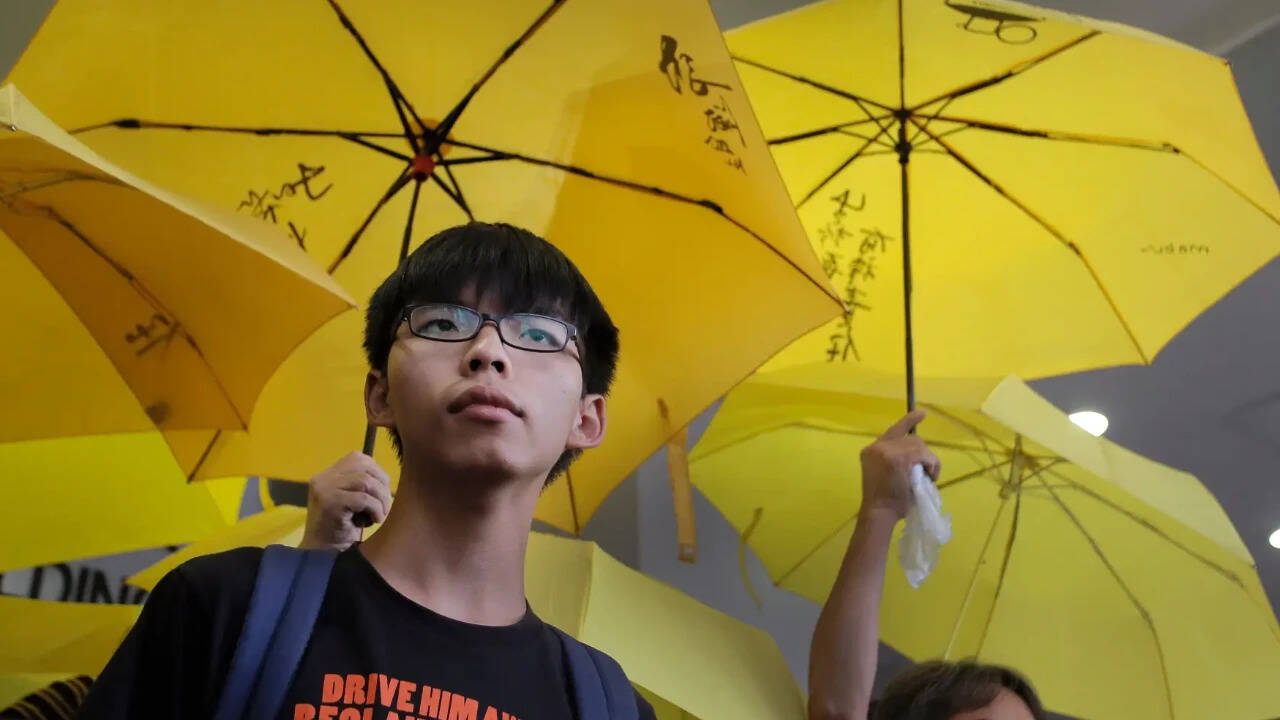
Joshua Wong pleaded guilty to foreign association charges in a Hong Kong court, sealing another grim milestone in the systematic dismantling of the city's once-vibrant opposition movement. For anyone who has tracked the territory's political transformation from the press benches of magistrate courts to the grand halls of international diplomacy, the plea was neither surprising nor anomalous. It was the predictable mechanical output of the National Security Law.
Beijing and its local proxies did not merely prosecute an individual. They codified a new legal reality where routine diplomatic engagement, international advocacy, and the simple act of talking to foreign journalists or lawmakers are treated as acts of subversion. When Wong stood in the dock to enter his plea, he was standing at the epicenter of a broader judicial strategy designed to sever Hong Kong from the global network of civil society that once sustained it.
The Architecture of the National Security Law
To understand why a guilty plea was the only available trajectory for Wong, one must examine the legal framework erected in the summer of 2020. The legislation passed by the Standing Committee of the National People's Congress fundamentally re-engineered the common law system inherited from the British.
Traditional safeguards vanished almost overnight. Bail became the exception rather than the norm for national security defendants, leaving activists languishing in pretrial detention for months or years. Juries were discarded in favor of handpicked panels of judges vetted for their reliability to the state.
Wong was already serving a prison sentence for other politically motivated charges related to unauthorized assemblies and unlawful protests when the new allegations were piled on. The foreign association charge leverages vague definitions of collusion with external elements. In a functioning democracy, meeting a foreign diplomat or testifying before a congressional committee is standard political operating procedure. Under the current regime in Hong Kong, that exact behavior constitutes a threat to national security.
The prosecution did not need to prove that Wong received funding or acted as a foreign agent in the traditional espionage sense. The statute is drafted broadly enough to capture any communication that might encourage foreign sanctions, blockades, or hostile activities against the central government or the local administration. By criminalizing advocacy, the state effectively outlawed political dissent.
The Chilling Effect on Global Networks
The implications of Wong's guilty plea extend far beyond the concrete walls of Stanley Prison. They signal the complete severance of Hong Kong civil society from international allies. During the mass protests of 2019, figures like Wong operated as bridges between local grassroots movements and global capitals. They penned op-eds in Western newspapers, spoke via video link to foreign parliaments, and met with diplomats to explain the erosion of the Sino-British Joint Declaration.
That bridge has been dynamited. The message sent to every remaining activist, academic, journalist, and NGO worker in the territory is unmistakable. Any contact with the outside world that deviates from the official party line can be retroactively investigated and prosecuted as foreign collusion.
International human rights organizations have condemned the proceedings as a mockery of justice. Yet, the protests from Western capitals have grown increasingly routine, reduced to diplomatic statements of regret that carry zero practical weight in Beijing or the Liaison Office in Sai Wan. The geopolitical balance of power shifted decisively, and the financial centers of the West proved unwilling to enact measures that would truly disrupt economic ties for the sake of Hong Kong's political prisoners.
The Manufactured Consensus of the Courtroom
Trials under the National Security Law possess a surreal theatrical quality. Defendants often face the choice of contesting charges before a stacked bench with almost zero chance of acquittal, leading to decades behind bars, or pleading guilty in the hope of securing a nominal reduction in sentence.
Wong chose the latter path, a pragmatic calculation familiar to political dissidents facing authoritarian tribunals throughout history. A guilty plea does not imply genuine contrition or ideological conversion. It represents an acknowledgment of overwhelming state power. The courtroom functions not as an arbiter of truth, but as an administrative clearinghouse for political neutralization.
The state media portrays these proceedings as a triumph of the rule of law, restoring stability after the chaos of 2019. This narrative relies on a deliberate inversion of cause and effect. The chaos was born from the systematic erosion of promised autonomies under the "One Country, Two Systems" framework. The stability that followed is the peace of the graveyard, achieved by silencing millions of residents who simply wanted to vote for their own leaders.
The Long Shadow Over Regional Advocacy
As Joshua Wong serves out his extended imprisonment, the activists who managed to escape abroad find themselves living in a state of permanent exile, haunted by the reach of transnational repression. Hong Kong authorities have issued bounties and arrest warrants for dissidents living in the United States, the United Kingdom, and Australia, signaling that the long arm of the security apparatus does not stop at the border.
The playbook perfected in Hong Kong is now studied by authoritarian regimes worldwide as a masterclass in subduing a globally connected metropolis without deploying tanks into the streets. It relies on financial pressure, bureaucratic harassment, retroactive laws, and compliant judiciaries.
Wong's name remains a potent symbol of defiance, but the political ecosystem that produced him has been ruthlessly eradicated. The courtroom where he entered his plea stands as a monument to the speed with which a free society can be dismantled when the institutions designed to protect liberty are captured by the state.