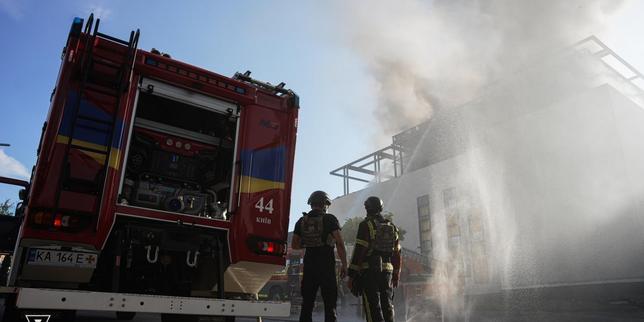
The latest waves of aerial bombardment slamming into Kyiv are not mere tactical engagements. They represent a calculated shift in how Moscow utilizes its aerospace assets to dismantle Ukrainian resilience. When authorities in Kyiv reported at least 15 fatalities following these strikes, the numbers confirmed a grim reality. The Russian military is no longer just targeting critical infrastructure to induce a blackout. It is refining its ability to strike urban centers with repetitive, overlapping waves of munitions, testing the saturation limits of Western-provided air defense systems.
For months, the rhythm of the war felt predictable. Kyiv would brace for nighttime drone swarms, followed by the familiar thud of interceptors. The events of this week shattered that cycle. By following nocturnal raids with daylight attacks, Moscow is forcing Ukrainian defenders into a state of permanent exhaustion. This is an attrition strategy that goes beyond artillery shells and trenches. It is an attempt to erode the mental and logistical capacity of a city that has become the symbolic heart of national defiance.
The Calculus Of Saturation
The technical objective behind these attacks is saturation. Air defense systems like the Patriot or the NASAMS operate on specific engagement parameters. They require a clear picture of incoming threats, locked-on targets, and a constant supply of interceptors. When a single wave arrives, the defense works with mathematical precision. When multiple waves arrive in rapid succession, the defenders face a different problem. They have to decide which targets to engage and which to ignore.
Moscow understands this logic intimately. By launching diverse types of munitions—ranging from low-cost, slow-moving loitering munitions to high-velocity ballistic missiles—they force the defenders to commit expensive, limited interceptors to targets that might otherwise be neutralized by cheaper assets. It is a cynical accounting exercise. A missile that costs millions of dollars is used to drain a stock of interceptors that are even harder to replace. If Ukraine burns through its stockpile faster than its allies can ship replacements, the protective umbrella over Kyiv will eventually develop holes.
Beyond The Headlines Of Casualty Counts
While the world watches the body counts and the burning debris, the real story is playing out in the power supply and the supply chains. Each strike adds a layer of uncertainty to the civilian infrastructure. It is not just about the loss of life, which is horrific and profound. It is about the cost of repair. A shattered power transformer is not replaced overnight. A destroyed apartment block necessitates a massive diversion of local resources, shifting focus away from the frontline efforts and toward basic survival and reconstruction.
This creates a hidden drag on the national economy. When a workforce is spent running to bunkers or dealing with the aftermath of a strike, productivity plummets. This is the secondary objective of the Kremlin. They want to turn Ukraine into a project that requires perpetual, expensive maintenance rather than a functioning, sovereign entity capable of sustaining its own defense.
The Flawed Logic Of Total Defense
Western analysts often talk about the ironclad nature of modern air defense. They praise the accuracy and the success rates of the interception efforts. However, those success rates ignore the psychological toll. Living under a regime of constant, unpredictable bombardment changes a population. It creates a friction that is difficult to quantify but impossible to ignore.
The current approach to defending Kyiv relies heavily on imported technology. This is a vulnerability. If the political appetite in Washington or Brussels for shipping these advanced batteries wavers, the entire defense posture of the capital collapses. Ukraine is effectively operating on a lease of security. That security is fragile because it depends on the consistency of foreign parliaments, not just the bravery of the soldiers manning the radars.
We have seen this dynamic before in other conflicts. When a defender is forced to play a purely reactive game, the initiator always holds the initiative. Russia picks the time. They pick the intensity. They pick the weapon mix. As long as Ukraine is forced to respond to these provocations on Moscow's terms, the defense will remain an exercise in damage control rather than strategic victory.
The Escalation Ladder And Its Limits
There is a dangerous assumption that these strikes are a sign of Russian desperation. Some suggest the intensity is a reaction to failures on the ground. This view underestimates the resilience of the Russian command structure. These attacks are not signs of a flailing military. They are signs of a military that has learned how to exploit the limitations of static, expensive defense systems.
The shift toward daytime attacks against urban areas suggests a willingness to ignore international scrutiny regarding civilian casualties. The Kremlin has decided that the diplomatic cost of these strikes is secondary to the strategic gain of exhausting the Ukrainian military’s resources. They are betting that the moral outrage of the international community will translate into nothing more than press releases and empty condemnation.
In the streets of Kyiv, the atmosphere is one of weary vigilance. The citizens have become experts in reading the signs of an impending barrage. They know the sounds of the engines. They know the difference between the defensive fire and the incoming impact. This is not the behavior of a broken society, but it is not the behavior of a society functioning as it should. It is a state of survival defined by the next siren.
The long-term impact on the Ukrainian military will depend on whether they can move from defense to disruption. They need a way to hit back at the launch platforms before they can reach the airspace above the city. Without the ability to degrade the Russian air force’s capabilities at the source, the current game of interception will continue until the interceptors run dry. History shows that no amount of static defense can withstand a persistent, evolving assault forever. The only way to win is to make the cost of the attack higher than the value of the target. Right now, Moscow is finding that the cost of these strikes is perfectly acceptable.