You have to respect the commitment, even if the execution fell flat.
In Latin American football, the "serenata" is a time-honored tradition. It's the psychological warfare of choice for passionate fans looking to give their national team a microscopic edge. Find out where the visiting team is sleeping, show up at 2:00 AM with fireworks, drums, and enough brass instruments to deafen a small village, and ensure the opposition plays on tired legs.
Ahead of Sunday's high-stakes World Cup Round of 16 clash between Mexico and England at the Estadio Azteca, El Tri supporters tried to pull off the ultimate sleep-deprivation heist. Armed with loudspeakers, horns, and pyrotechnics, dozens of fans descended upon the JW Marriott hotel in Santa Fe, an upscale district in the western part of Mexico City.
They wanted chaos. They wanted blurry-eyed Three Lions players looking for coffee instead of tactical briefs. Instead, they hit a metaphorical brick wall.
The Ring of Steel in Santa Fe
If you're going to wage psychological warfare, you have to get close enough for the enemy to hear you. Mexico fans learned the hard way that the Football Association (FA) and local authorities were already three steps ahead.
Earlier in the week, Ecuador fell victim to the exact same strategy. Dozens of fans kept the Ecuadorian squad awake for hours with revving motorcycle engines and megaphones before Mexico secured a 2–0 victory. Ecuador filed a formal complaint with FIFA, which basically served as a massive flashing neon sign for England's security detail.
The FA reviewed their plans and adapted. By the time the local crowd arrived at the JW Marriott on Saturday night, they didn't find an open street. They found an absolute fortress.
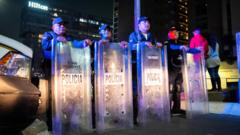
Around 300 heavily armed riot police officers, complete with shields and helmets, threw a literal ring of steel around the complex. The 50 or so passionate fans who turned up were shoved back a good 500 meters from the building.
Think about that math. A small crowd of fifty people setting off firecrackers and chanting "Mexico, Mexico, Mexico" from half a kilometer away isn't a disruption. It's background noise.
Earplugs and Afternoon Kicks
Even if a few rogue decibels managed to bounce off the skyscrapers of Santa Fe and reach the upper floors of the Marriott, England's squad had a secret weapon. Well, not so secret. They had earplugs.
Management handed them out to the entire traveling party as a baseline precaution. But the real reason this guerrilla tactic failed boils down to simple scheduling and a relaxed manager.
Thomas Tuchel knew exactly what was coming. He basically called the shot on Saturday afternoon during his press conference. He didn't complain. He didn't demand FIFA intervention. He just looked at the clock.
"We have a 6 p.m. kickoff," Tuchel told reporters. "So if we miss some hours of sleep, we'll make them up in the late morning."
It's a logical point that completely neutralizes the panic. When a match starts in the evening, players aren't waking up at dawn anyway. If a firework rouses you at 3:00 AM, you turn over, block out the muffled noise, and sleep until 11:00 AM.
The Real Threat is the Altitude
Honestly, the fans outside the hotel were the least of England's worries. If English media outlets want to obsess over a nightmare scenario in Mexico City, they should look at the barometer, not the brass bands.
The Estadio Azteca sits at roughly 7,220 feet above sea level. That's a brutal altitude for European players who spend their club seasons running around at sea level in Manchester, London, and Munich. Compounding the issue, England chose to fly into the capital just a day before the match to try to mitigate the effects of the thin air.
It's a risky strategy. Some medical experts argue that a quick in-and-out trip prevents the body from fully feeling the crushing fatigue of altitude hypoxia. Others think it leaves players completely exposed to heavy legs and splitting headaches by the 60th minute. Tuchel himself admitted to having a light headache upon landing.
That oxygen deficit is the true psychological weapon. When your lungs are burning and the ball is moving faster through the thin air than it did in the group stage, nobody is thinking about a few firecrackers from the night before.
Preparing for the Azteca Cauldron
If you ever find yourself backing a team playing a crucial knockout match in Latin America, expect the unexpected. Hotel disruptions are part of the ecosystem. If it's not fireworks, it's a fire alarm mysteriously going off at a random hour.
To survive this kind of environment, elite teams have to build structural redundancy into their travel plans. England handled the hotel situation perfectly by coordinating tightly with local law enforcement to create a massive physical buffer zone. They didn't engage, they didn't complain, and they insulated the players biologically and physically.
The takeaway here is pretty straightforward. Fans can bring all the passion, drums, and horns they want to the street corner, but professional squads operate in a tightly controlled bubble. The real battle won't be won by whoever brought the loudest speakers to Santa Fe. It will be decided on the pitch under the intense pressure of 83,000 screaming fans inside the Azteca. Pack your earplugs, stay inside the police perimeter, and save your energy for the whistle.
.png?width=1200&auto=webp&trim=0%2C0%2C0%2C0)