The fan on a cheap workstation laptop sounds like a small, desperate airplane trying to lift off a concrete runway.
If you have ever sat in a cramped apartment at two in the morning, watching a progress bar crawl across a terminal screen while your radiator hisses in the corner, you know that sound. It is the sound of someone trying to build something out of nothing. For the last decade, that sound has been the unofficial anthem of the open-source artificial intelligence movement.
Let us invent a character to stand in for thousands of real people sitting in those chairs tonight. Call him Mateo. Mateo is twenty-six, lives in a studio apartment in Guadalajara, and works a day job maintaining database pipelines for a mid-sized logistics company. At night, he downloads open-weight language models—systems whose mathematical blueprints have been released publicly by labs like Meta, Mistral, or DeepSeek—and fine-tunes them to translate indigenous Mexican languages that Silicon Valley will never bother to monetize.
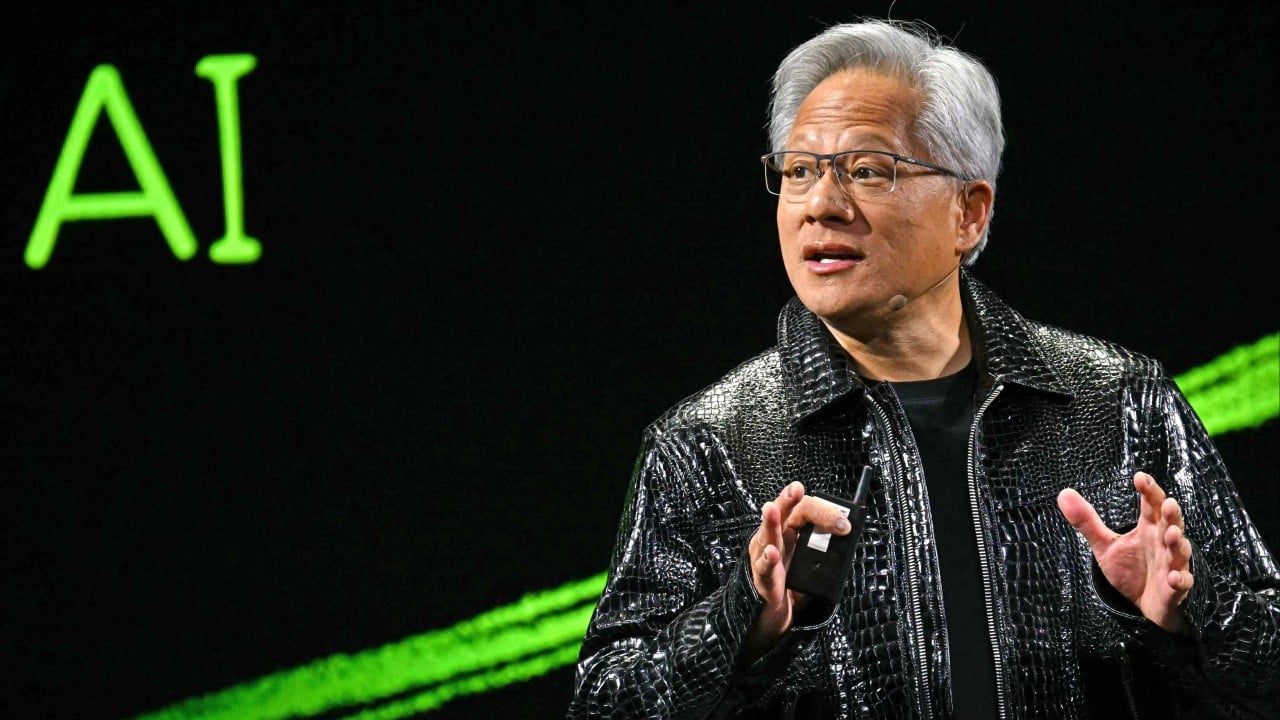
Mateo does not own a data center. He owns a desktop rig with two secondhand graphics cards strapped to a motherboard that runs hot enough to warm his coffee. Those cards carry a green logo. They were designed by Nvidia, a company run for over thirty years by a man in a black leather jacket named Jensen Huang.
And right now, a strange question is echoing through boardrooms, Discord servers, and financial newsletters: What happens to Mateo if Jensen Huang falls?
On the surface, the question sounds absurd. Nvidia spent the mid-2020s shattering every revenue record in semiconductor history, briefly becoming the most valuable company on earth. Asking about Jensen Huang’s downfall feels a bit like standing on the deck of a battleship during a sunny afternoon and asking what happens if the ocean dries up.
Yet in technology, empires rarely collapse because they run out of money. They collapse because the ground shifts beneath their architecture. And if you look closely at the uneasy, symbiotic marriage between Nvidia’s hardware empire and the open-source AI community, you realize something unsettling. The survival of free, accessible intelligence is tied far more tightly to one man’s silicon monopoly than almost anyone in the open-source world likes to admit.
The Strange Alliance in the Dark
To understand why, you have to strip away the boardroom jargon and look at how artificial intelligence actually works under the hood.
Think of an AI model—whether it is a locked-down corporate giant like OpenAI’s GPT series or an open-weight model you can download onto a hard drive—as a massive, intricate symphony. The model’s "weights" are the sheet music. Open-source AI is built on a simple, radical premise: the sheet music should belong to everyone. Anyone should be able to read it, rewrite the third movement, and play it in their own garage without asking permission from a tech conglomerate in San Francisco.
Sheet music, however, makes no sound on its own. You need an orchestra. In computing, that orchestra is made of graphics processing units, or GPUs, conducting trillions of tiny mathematical operations every second.
For nearly two decades, Jensen Huang bet his company on a software layer called CUDA. If the GPU is the orchestra, CUDA is the language the conductor speaks to the musicians. Before anyone outside a few university basements cared about neural networks, Huang insisted that every chip Nvidia shipped be compatible with CUDA. It was a stubborn, expensive gamble that nearly broke the company during the late 2000s.
When the deep-learning explosion finally hit, that stubbornness turned into an impenetrable moat. Virtually every major open-source AI library—PyTorch, TensorFlow, llama.cpp—was written to speak CUDA fluently.
Wait. Read that again.
The very tools that allow independent developers, university researchers, and garage tinkerers to break free from closed corporate AI monopolies run almost exclusively on proprietary software owned by a single hardware giant.
It is one of the great ironies of modern computing. Open-source AI preached decentralization while building its entire house on Jensen Huang’s private land. For years, the arrangement worked because Huang had every incentive to keep the gates wide open. Closed AI giants like OpenAI and Anthropic bought tens of thousands of Nvidia’s flagship data-center chips, paying tens of thousands of dollars apiece. Meanwhile, the open-source crowd bought consumer gaming cards and rented cheap cloud instances, creating an army of millions of developers who only knew how to code for Nvidia hardware.
Huang got rich off the kings, and he stayed untouchable because of the peasants.
How a King Actually Falls
So how does a setup that profitable ever unravel?
Not overnight. Nobody is going to walk into Nvidia’s Santa Clara headquarters tomorrow and turn off the lights. When analysts and engineers talk about Jensen Huang’s "downfall," they are usually describing one of three slow-motion earthquakes—or a collision of all three at once.
First, there is the rebellion of the biggest customers. Microsoft, Google, Amazon, and Meta spend tens of billions of dollars every year buying Nvidia chips, and they hate every second of it. No trillion-dollar company wants its survival dictated by a single supplier’s profit margins. Over the past few years, every hyperscaler has poured fortunes into designing custom silicon—Google’s TPUs, Amazon’s Trainium, Microsoft’s Maia—specifically engineered to bypass the "Nvidia tax."
Second, there is the geopolitical vice. Export controls between Washington and Beijing have repeatedly severed Nvidia from one of the largest technology markets on the planet. Every time regulators tighten the screws on what chips can cross the Pacific, domestic Chinese chipmakers get another surge of state funding and captive customers forced to build alternatives from scratch.
Third, and perhaps most dangerous of all, is the shift in how AI itself is used. Training a massive model from scratch requires brute-force supercomputers—Nvidia’s undisputed kingdom. Running a smaller, already-trained model on a phone, a laptop, or a local server—a process called inference—does not require the same kind of exotic hardware. As models get smarter and leaner, the heavy lifting moves away from giant data centers and toward everyday chips made by Apple, AMD, Qualcomm, and Intel.
Imagine, for a moment, a hypothetical scenario set three or four years from now. Nvidia does not go bankrupt, nor does Huang vanish from the stage. Instead, the moat drains. Custom cloud chips capture half the data-center market. Regulatory walls fracture global supply chains into regional silos. Nvidia’s stock stumbles, its gross margins compress from historic highs back down to earthly semiconductor averages, and Jensen Huang—now in his mid-sixties—steps back or watches his company transition from the undisputed kingmaker of computing into just another hardware vendor fighting for shelf space.
A lot of people in the open-source community think they would pop champagne on that day. They assume that breaking a hardware monopoly automatically liberates software.
They are dead wrong.
The Invisible Subsidy
Let us go back to Mateo in Guadalajara, sitting beside his humming desktop tower.
Why can Mateo download a cutting-edge open-weight model released by a major lab and run it on a consumer graphics card he bought used on an auction site?
Because of an invisible subsidy.
When Nvidia was minting money at seventy-five percent gross margins on enterprise AI servers, it could afford to keep its consumer cards backward-compatible with the exact same CUDA architecture used in million-dollar supercomputers. A researcher at Stanford and a hobbyist in a bedroom were speaking the exact same mathematical dialect. Better yet, Nvidia’s massive wealth allowed it to employ thousands of engineers whose entire job was optimizing open-source frameworks so they ran faster on Nvidia silicon.
Consider what happens next if Nvidia’s dominance fractures into a half-dozen competing hardware ecosystems.
Suppose Amazon’s Trainium chips dominate one cloud, Google’s TPUs dominate another, custom enterprise accelerators take over corporate servers, and three different chipmakers split the consumer market. None of those corporate cloud chips are sold to Mateo. You cannot buy a Google TPU at a computer store in Guadalajara and plug it into a home motherboard. Those chips live behind locked doors in windowless data centers owned by the very tech giants that want you to rent AI by the token through their proprietary APIs.
And what happens to the open-source software ecosystem when there is no single dominant hardware target?
Fragmentation.
Instead of one clean, universal standard that runs everywhere, open-source developers suddenly have to maintain five different backends, wrestle with buggy drivers from companies that treat hobbyists as an afterthought, and watch performance drop off a cliff on consumer hardware. Writing code that runs smoothly across incompatible chips is grueling, thankless work. Big corporations have the engineering budgets to optimize their closed models for custom cloud silicon. A twenty-six-year-old volunteer maintaining an open-source translation tool at two in the morning does not.
I saw a smaller version of this exact tragedy play out in mobile computing fifteen years ago. In the early days of smartphones, open web standards and hackable operating systems felt unstoppable. Then hardware and silicon integrated tightly inside closed ecosystems—Apple’s custom chips paired with iOS, Google’s services layered over fragmented Android hardware. Nobody passed a law banning open mobile computing. It simply became too exhausting to build for a fractured landscape when a slick, closed platform worked seamlessly out of the box.
Convenience killed the open frontier faster than censorship ever could.
The Trap of the Open Weights
There is another layer to this, and it is the part that keeps open-source advocates awake at night—even if they rarely say it out loud at conferences.
Open-source AI does not actually generate its own multibillion-dollar training runs out of thin air. Unlike Linux, which was built line by line by thousands of human programmers contributing code over decades, modern foundation models require tens of thousands of GPUs running continuously for months, burning enough electricity to power a small city.
Who pays for those runs?
In the mid-2020s, almost all of the flagship open-weight models came from two places: tech giants like Meta that used open releases as a strategic weapon to commoditize their rivals, or well-funded startups and research labs burning through venture capital on massive clusters of Nvidia hardware.
Notice the pattern. Open-source AI has been riding on the coattails of a hardware arms race. Because Nvidia made standardized, off-the-shelf supercomputing clusters available to anyone with enough cash, a startup or a university consortium could rent ten thousand H100 or Blackwell chips, train a frontier model, and release the weights to the public.
Now ask yourself: if Nvidia’s unified ecosystem breaks apart and compute power retreats behind the proprietary silicon walls of the three biggest cloud monopolies, where does the next open-weight frontier model get trained?
Not on custom chips that Google or Amazon keep strictly for internal use and locked enterprise contracts. And if consumer hardware diverges sharply from data-center hardware, even when a benevolent lab does release an open model, ordinary people will find it harder and harder to run locally without paying rent to a cloud provider.
At that point, "open-source AI" risks becoming open in name only—a free recipe book in a world where three corporations own all the ovens.
What Needs to Happen Before the Weather Changes
I do not know whether Jensen Huang will still be pacing stages in a black leather jacket five years from now, pulling gleaming circuit boards out of imaginary ovens to thunderous applause. History suggests that no hardware king reigns forever. Intel looked invincible in 1999. IBM looked like a force of nature in 1982. Gravity eventually finds every balance sheet.
What scares me is not the possibility that Nvidia loses its crown. Competition in silicon is healthy; paying a single company a massive markup for every matrix multiplication on earth was never sustainable.
What scares me is that the open-source AI community has spent years celebrating its ideological independence while remaining completely dependent on a single proprietary software moat—CUDA—and a single hardware supply chain.
If open intelligence is going to survive the eventual twilight of the Nvidia era, three things have to happen while the sun is still shining:
- Hardware-agnostic software must stop being a side project. Projects like Triton, Vulkan, ROCm, and open compiler stacks like MLIR need the same obsessive engineering focus that PyTorch received a decade ago. If an open-source model cannot run just as easily on an AMD card, an Apple chip, or a future RISC-V accelerator as it does on an Nvidia GPU, then open-source AI is merely a tenant living on borrowed time.
- Small models must become first-class citizens. The obsession with trillion-parameter giants plays directly into the hands of centralized data centers. Every breakthrough in quantization, pruning, and distilled architectures—techniques that let a model fit inside the memory of a modest laptop—is a direct transfer of power from monopolies back to individuals.
- Public and academic compute cannot remain an afterthought. If the only way to train a base model is to beg for credits from a cloud hyperscaler, the frontier will inevitably close. Shared, publicly funded compute infrastructure—governed like telescopes or particle accelerators rather than corporate cloud portals—is the only way to guarantee that foundational research stays out of private vaults.
None of this is glamorous. Nobody writes breathless headlines about compiler backends or memory bandwidth optimization. Those things do not wear leather jackets, and they do not ring opening bells on Wall Street.
Yet they are the difference between a future where artificial intelligence belongs to humanity and a future where we merely rent it by the month.
Late at night in Guadalajara, Mateo’s workstation fan finally slows down to a low, steady purr. The fine-tuning run has finished. On his screen, a small open-weight model translates a paragraph of Zapotec poetry into Spanish with quiet, startling grace—no subscription required, no telemetry sent back to California, no permission asked from anyone.
The green logo inside his computer case glows softly through the side panel. For tonight, the door is still open. The only question left is whether we will build our own hinges before the landlord decides to change the locks.