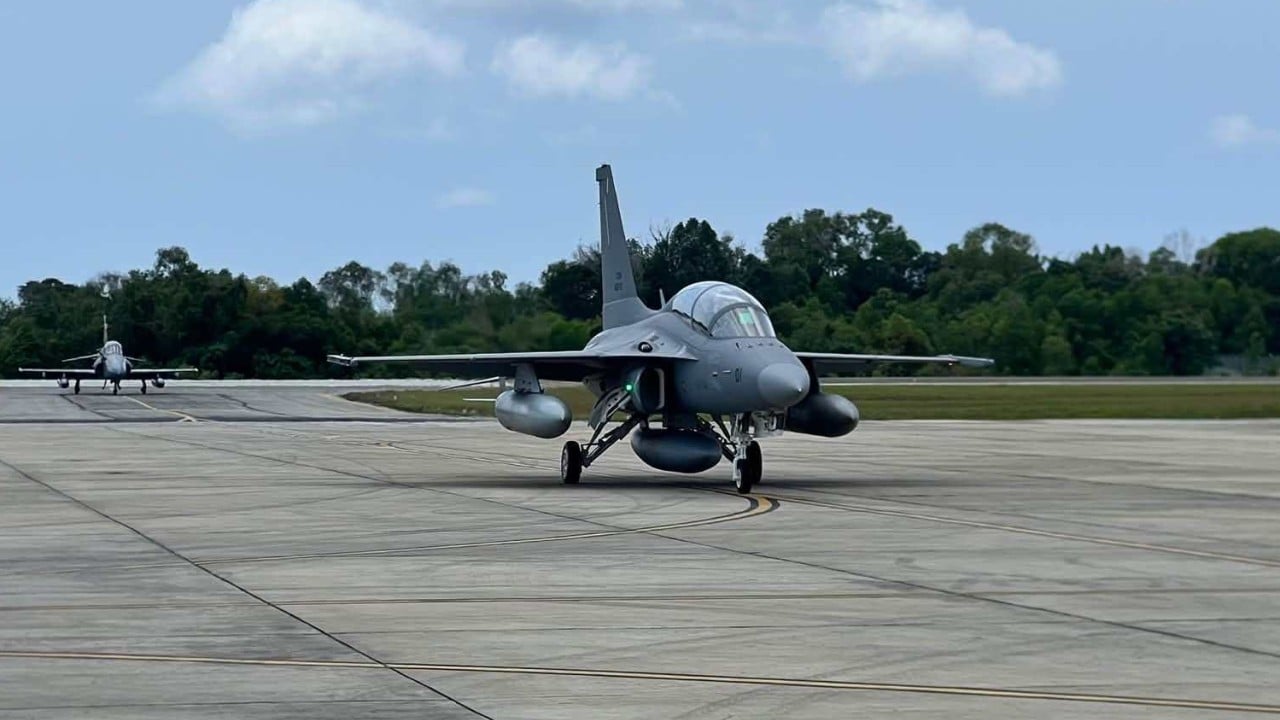
The Royal Malaysian Air Force (RMAF) is attempting to solve a structural force-generation crisis using a light combat aircraft procurement strategy. By acquiring 18 Korea Aerospace Industries (KAI) FA-50M Fighting Eagle jets, Kuala Lumpur aims to bridge an acute operational gap created by the simultaneous retirement of legacy platforms and chronic delays in its Multi-Role Combat Aircraft (MRCA) program. While surface-level commentary frames this acquisition as a binary choice between a permanent strategic salvation and a temporary patch, operational defense economics reveals a more precise reality. The FA-50M represents a calculated fleet-optimization maneuver designed to arrest capability atrophy, lower per-hour flight costs, and establish an industrial maintenance baseline, though its long-term viability remains strictly bounded by kinematic limitations and regional threat proliferation.
The Fleet Atrophy Equation and Platform Consolidation
Modern air force readiness is governed by the availability rate of airframes, the flight-hour cost per sortie, and the logistical complexity of the supply chain. For two decades, the RMAF operated a fragmented tactical inventory consisting of Russian-built MiG-29N interceptors, Sukhoi Su-30MKM heavy multi-role fighters, American F/A-18D Hornets, and British BAE Hawk 108/208 light attack and trainer aircraft. This multi-vendor architecture created severe sustainment friction. Operating divergent Western and Russian logistics pipelines fractured maintenance budgets, inflated spare-parts warehousing requirements, and depressed overall mission-capable rates.
The retirement of the MiG-29N fleet without an immediate replacement left a distinct void in Malaysia’s air defense network. Simultaneously, the BAE Hawk fleet—inducted in the mid-1990s—reached the end of its structural fatigue life, suffering from parts obsolescence and declining reliability. The RMAF faced a dual failure mode: an inability to generate sufficient combat air patrols over the South China Sea and a bottleneck in the fighter lead-in training pipeline. Without an advanced trainer capable of simulating fourth-generation avionics, transitioning pilots from basic turboprops to complex platforms like the Su-30MKM incurred prohibitive financial costs and accelerated airframe wear on frontline heavy fighters.
The FA-50M directly addresses this structural imbalance by consolidating the Fighter Lead-In Trainer (FLIT) and Light Combat Aircraft (LCA) roles onto a single airframe. This consolidation reduces the number of distinct logistical tails the RMAF must fund. Instead of maintaining separate supply chains for an aging subsonic trainer and a defunct interceptor fleet, Malaysia centralizes training, light strike, and basic air policing within one standardized airframe ecosystem.
Technical Architecture of the Block 20 Variant
Evaluating the operational utility of the FA-50M requires isolating the specific hardware baseline Malaysia procured. Kuala Lumpur did not purchase the baseline T-50 trainer or the early-block FA-50 operated by regional neighbors like the Philippines. The RMAF contracted for the Block 20 configuration—designated FA-50M—which alters the aircraft's sensor and weapons envelope.
Four hardware integrations define this capability jump:
- Active Electronically Scanned Array (AESA) Radar: The integration of the PhantomStrike AESA radar (or comparable fire-control architecture) replaces older mechanically scanned arrays. AESA technology allows the aircraft to track multiple targets simultaneously, resist electronic jamming, and interleave air-to-air and air-to-ground modes without mechanical latency.
- Beyond-Visual-Range (BVR) Engagement Capability: Previous iterations of the FA-50 were restricted to short-range infrared missiles like the AIM-9 Sidewinder, limiting them to visual-range dogfights and ground attack. The Block 20 architecture integrates medium-range active radar-homing missiles, enabling the aircraft to engage targets well outside visual range.
- Aerial Refueling Probe: The addition of a retractable refueling probe removes the primary operational penalty of a light fighter: limited internal fuel capacity. By coupling with the RMAF’s Airbus A400M tankers, the FA-50M can extend its combat radius from Peninsular Malaysia across the South China Sea to Sabah and Sarawak.
- Sniper Advanced Targeting Pod (ATP): This electro-optical and infrared sensor suite provides high-resolution imagery for precision-guided munitions delivery, intelligence, surveillance, and reconnaissance (ISR), and non-traditional intelligence gathering.
Through these upgrades, the FA-50M achieves sensor parity with early-model fourth-generation fighters while retaining the operating economics of a supersonic trainer.
The Cost Function of Sortie Generation
Defense procurement is an exercise in marginal utility under strict fiscal constraints. Heavy twin-engine fighters like the Su-30MKM offer superior payload, range, and kinematic performance, but they impose severe financial penalties per flight hour. Fuel burn, complex engine overhauls, and specialized avionics maintenance make deploying a heavy fighter for low-intensity missions economically irrational.
When an air force uses heavy multi-role fighters to intercept unidentified maritime patrol aircraft, shadow non-hostile intrusions in its Exclusive Economic Zone (EEZ), or conduct routine pilot proficiency flights, it burns through the finite structural life of its most expensive assets. Every flight hour logged by a Su-30MKM on a routine policing mission is a flight hour deducted from its availability during a high-intensity conflict.
The FA-50M alters this cost function. Powered by a single General Electric F404-GE-102 turbofan engine—a mature powerplant with an established global supply chain—the aircraft operates at a fraction of the hourly cost of a twin-engine heavy fighter. This economic differential unlocks a tiered force-employment doctrine:
- Routine Air Policing and Grey-Zone Deterrence: The FA-50M absorbs the daily burden of intercepting airspace intrusions and monitoring maritime borders. Its supersonic speed (Mach 1.5) allows rapid response times, while its operating cost permits sustained high-tempo patrols without exhausting the defense budget.
- Pilot Skill Retention: Frontline pilots can log higher annual flight hours in the FA-50M, practicing complex radar intercepts, electronic warfare, and weapons delivery in a cockpit environment that mirrors fourth-generation tactical displays, preserving the airframe hours of the Su-30MKM and F/A-18D fleets.
- Asymmetric Strike and Close Air Support: In contested littoral environments, the FA-50M can deploy precision-guided munitions against surface vessels or ground targets, freeing heavy fighters to focus exclusively on air superiority and deep strike missions.
Geopolitical Risk Mitigation and Supply Chain Resilience
Malaysia’s procurement decision cannot be separated from the geopolitical friction reshaping global arms markets. The RMAF’s historical reliance on Russian aerospace hardware became a critical vulnerability following international sanctions on Moscow’s defense-industrial base. Sourcing spare parts, executing engine overhauls, and securing software upgrades for the Su-30MKM fleet now entail severe financial transaction hurdles, secondary sanction risks, and extended logistical lead times.
Concurrently, acquiring top-tier Western platforms involves lengthy political approval cycles, strict end-user monitoring agreements, and high unit acquisition costs that strain Malaysia’s capital expenditure limits.
South Korea occupies a strategic middle ground in the defense trade. KAI offers Western-compatible subsystems—American engines, radars, and munitions—packaged within an airframe manufactured at high industrial scale, resulting in predictable delivery schedules and competitive unit pricing. By selecting the FA-50M, Malaysia insulates its light fighter fleet from Russian supply-chain collapse while avoiding the geopolitical conditionality and multi-year backlogs often associated with direct US Foreign Military Sales (FMS) of frontline fighters.
Furthermore, the contract structures industrial offset mechanisms that transfer maintenance, repair, and overhaul (MRO) capabilities to local Malaysian aerospace firms. Establishing domestic MRO infrastructure reduces long-term lifecycle sustainment costs and ensures that fleet readiness is not entirely hostage to foreign engineering teams during a regional crisis.
The Kinematic and Survivability Ceiling
Despite its upgraded avionics, treating the FA-50M as a direct substitute for a true Multi-Role Combat Aircraft introduces dangerous operational blind spots. Physics and airframe geometry impose hard boundaries on what a light combat aircraft can achieve in high-intensity warfare.
The primary constraint is payload-range trade-off. Because the FA-50M is built on a trainer airframe, its internal volume is limited. While the addition of an aerial refueling probe extends its range, the aircraft still lacks the hardpoint capacity and structural weight limits required to carry heavy loads of long-range air-to-air missiles alongside conformal fuel tanks and heavy standoff munitions. When configured for a combat air patrol with BVR missiles, external fuel tanks, and targeting pods, drag increases significantly, degrading acceleration, climb rate, and sustained turn performance.
In a high-end kinetic conflict against a peer or near-peer adversary operating fifth-generation stealth fighters, heavy air-superiority platforms, and long-range surface-to-air missile networks, the FA-50M faces severe survivability challenges:
- Radar Cross-Section (RCS): The airframe lacks stealth shaping or advanced radar-absorbent materials. Carrying external stores further amplifies its radar signature, making it easily detectable by hostile long-range sensors.
- Kinematic Energy: In beyond-visual-range combat, the range and lethality of a missile depend heavily on the altitude and speed of the launching aircraft. A heavy fighter cruising at Mach 1.8 at 45,000 feet imparts significantly more kinetic energy to a missile than a light fighter operating at lower altitudes and speeds, shrinking the FA-50M’s effective engagement envelope relative to larger adversaries.
- Electronic Warfare Suite: While the Block 20 includes radar warning receivers and countermeasures, its internal space and power generation capacity cannot match the integrated, high-power electronic attack suites found on dedicated heavy multi-role fighters.
The Two-Phase Acquisition Trap
A recurring failure pattern in mid-sized defense budgets is the permanentization of interim solutions. Malaysia’s defense white paper outlines a requirement for 36 FLIT/LCA aircraft, split into two phases of 18 units each, alongside a long-deferred requirement for true MRCAs to eventually replace the aging F/A-18D Hornets and Su-30MKMs.
The strategic risk is clear: budget compression, currency fluctuations, or competing maritime procurement priorities (such as the Littoral Combat Ship program) could force Kuala Lumpur to cancel or indefinitely delay both the second batch of 18 FA-50Ms and the future MRCA tender.
If the RMAF ends up operating only 18 FA-50Ms alongside a shrinking fleet of aging heavy fighters, the strategic calculus shifts entirely. Eighteen airframes, accounting for standard maintenance cycles, depot-level overhauls, and training allocations, typically yield only 10 to 12 mission-ready aircraft on any given day. Spread across Peninsular Malaysia and East Malaysia (Borneo), a dozen available light fighters cannot maintain persistent air sovereignty over vast maritime territories, nor can they absorb attrition in a sustained conflict.
To prevent the FA-50M from becoming an under-resourced stopgap rather than a foundational pillar of force modernization, defense planners must execute three sequential structural maneuvers:
- Lock in the Phase Two Option Early: Exercise the option for the second batch of 18 FA-50Ms within the current industrial production cycle. Standardizing on a 36-airframe fleet achieves the economies of scale necessary to justify domestic MRO investments, lowers per-unit sustainment costs, and provides the operational mass required to divide squadrons permanently between Peninsular and East Malaysia.
- Integrate Common Munitions Architecture: Standardize weapons procurement across the FA-50M and existing Western platforms (such as the F/A-18D or any future Western MRCA). Ensuring that BVR missiles and precision-guided munitions are interchangeable across fleets eliminates duplicated inventory costs and maximizes tactical flexibility during high-tempo operations.
- Ring-Fence Capital for Heavy MRCA Replacement: Establish a dedicated, multi-year capital expenditure line item specifically for the post-2030 replacement of the Su-30MKM and F/A-18D fleets. The FA-50M must remain strictly confined to its doctrinal role as a high-low mix enabler—handling training, light strike, and routine air policing—so that heavy multi-role platforms can be procured in smaller, focused quantities dedicated exclusively to high-end deterrence and contested airspace control.