Dirt gets under your fingernails in a way that hot water refuses to fix. You scrub, you scrape, and still, hours later, a dark crescent lingers beneath the skin, a quiet reminder of what you were touching. Felix Dennis knew that dirt. Or at least, he knew the desperate need to wash it off after spending a lifetime chasing things that glittered far brighter than leaves.
Most people remember the noise. The publishing empire. The roaring parties. The immense wealth accumulated by selling magazines that pushed cultural boundaries. Dennis lived out loud. He was a man who wrote poetry by the bookful and bought sprawling estates because he could. But fortunes do not whisper when they accumulate; they clang. And somewhere beneath the brass and the brashness, a quieter hunger gnawed at him. For a different perspective, see: this related article.
He wanted to plant a tree.
Not just one. Ten million. Further reporting on the subject has been provided by Apartment Therapy.
To understand why a billionaire magazine mogul decided to spend his final chapters obsessing over saplings, you have to look at the landscape of modern England. We tend to view our countryside as an eternal given. We see rolling green hills on postcards and assume they have always looked that way, an unchanging pastoral painting crafted by time itself.
They have not.
England is one of the most nature-depleted countries in Europe. Centuries of industry, agriculture, and urban sprawl stripped the land down to its bones. We traded ancient canopies for timber yards and coal mines. We forgot what a true forest smells like after a summer rain. We settled for clipped hedges and manicured lawns, mistaking them for wildness.
Dennis saw the ghost of what used to be.
Consider what happens next: a man diagnosed with a terminal illness looks at his bank account, looks at his poetry, and then looks out the window at a bald horizon. The juxtaposition is jarring. Wealth cannot buy a single extra breath, but it can buy dirt. It can buy seeds. It can buy time wrapped in bark and green shoots.
He didn't just donate a check. He launched the Heart of England Forest project. He bought the land acre by acre, paying top dollar to stitch fragmented parcels back together into a single, continuous corridor of life.
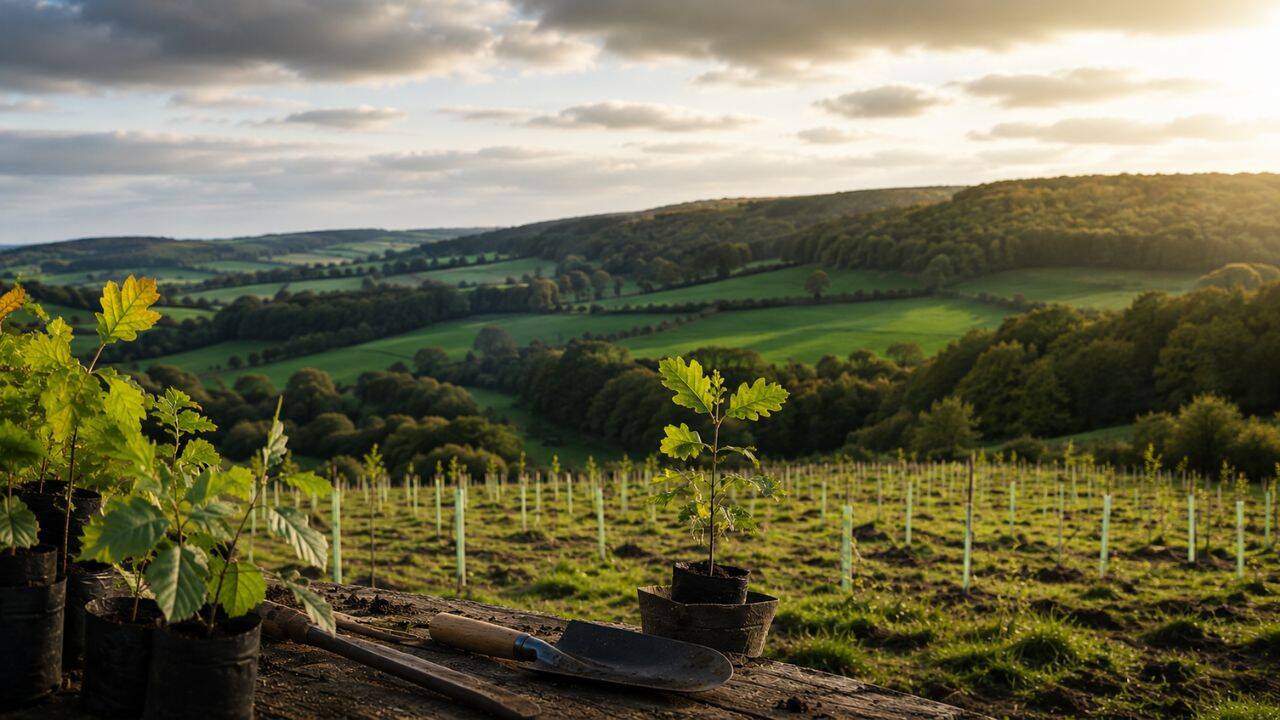
Imagine standing on a muddy Warwickshire tract in the early 2000s. There are no grand cathedrals of oak here yet. There are only rows of thin, vulnerable switches—whips, the foresters call them—staking their claim against a biting wind. They look fragile. A stray deer could snap them. A dry summer could bake them into kindling.
Dennis walked these fields. He didn't wear Italian loafers; he wore wellies caked in Warwickshire clay. He watched arborists dig holes in the heavy loam. He watched roots find their grip.
People laughed. Of course they did. Cynics always mock a billionaire trying to play Mother Nature. They whispered about legacy, about vanity projects, about a flashy life trying to buy a quiet exit through the backdoor of ecology. They assumed it was a tax write-off or a passing whim.
They were wrong.
Dennis poured tens of millions of his own hard-earned pounds into the ground. He set up a charitable trust designed to outlive him by centuries. Trees do not care about human cynicism. They do not read the tabloids. They simply photosynthesize, draw up groundwater, and grow.
Slowly. Painfully slowly.
That is the hardest part of reforestation for the modern mind to grasp. We live in an era of instant gratification. We tap a screen and summon food, cars, answers, entertainment. A tree rejects that timeline entirely. An oak planted today will not reach its majestic, sprawling prime until long after everyone reading this sentence has turned to dust.
It is an act of radical, defiant optimism.
When Dennis passed away in 2014, the forest was still a teenager. Patches of scrubland were transitioning into thicket, and thicket was beginning to look like woodland. Deer had returned in numbers not seen for generations. Buzzards circled overhead, hunting field mice in the tall grasses that grew between the rows of ash and beech.
The project did not die with him. That was his true genius. He left the bulk of his fortune to the trust, ensuring that long after his poetry books gathered dust on thrift-store shelves, the roots would keep spreading.
Walk through that forest today.
The air changes about fifty yards in. The roar of the nearby motorway softens, muffled by millions of damp, vibrating leaves. The light filters down in fractured, golden beams, painting the forest floor in shifting mosaics of green and brown.
You smell the rich, ferrous tang of decomposing leaf litter. It is the smell of creation happening in slow motion.
A red kite dips low over a clearing. It is hunting, indifferent to the human hands that carved this sanctuary out of flat farmland.
Ten million trees sounds like a statistic. It sounds like a corporate sustainability goal written by a committee in a glass-fronted office building. But strip away the numbers, and you are left with something deeply, achingly human. It is the story of a man who realized that the loudest life in the world is still deafeningly empty if it leaves nothing behind to breathe for you when you are gone.
The saplings Felix Dennis planted decades ago are teenagers now. They are thick-trunked, heavy with branches, dropping acorns that will sprout into the next generation. They do not bear his name carved into their bark. They do not need to.
They just stand there, drinking the rain, whispering in the wind, holding the earth together.


