The Summer the Neighborhood Went Silent
In the scorching July heat of 1952, suburban Dallas was gripped by a quiet, suffocating fear. Parents watched their children play in front yards, terrified of an invisible threat floating through swimming pools, movie theaters, and crowded parks.
Six-year-old Paul Alexander felt a sudden, throb in his neck. He ran inside, feverish and wet with sweat, leaving his muddy shoes on the porch. Within days, his legs stopped working. Then his muscles collapsed. By the time his mother rushed him to Parkland Memorial Hospital, the hallways were overflowing with paralyzed children, their cries echoing down tile corridors.
Before Paul understood what was happening, his lungs surrendered. Darkness settled in.
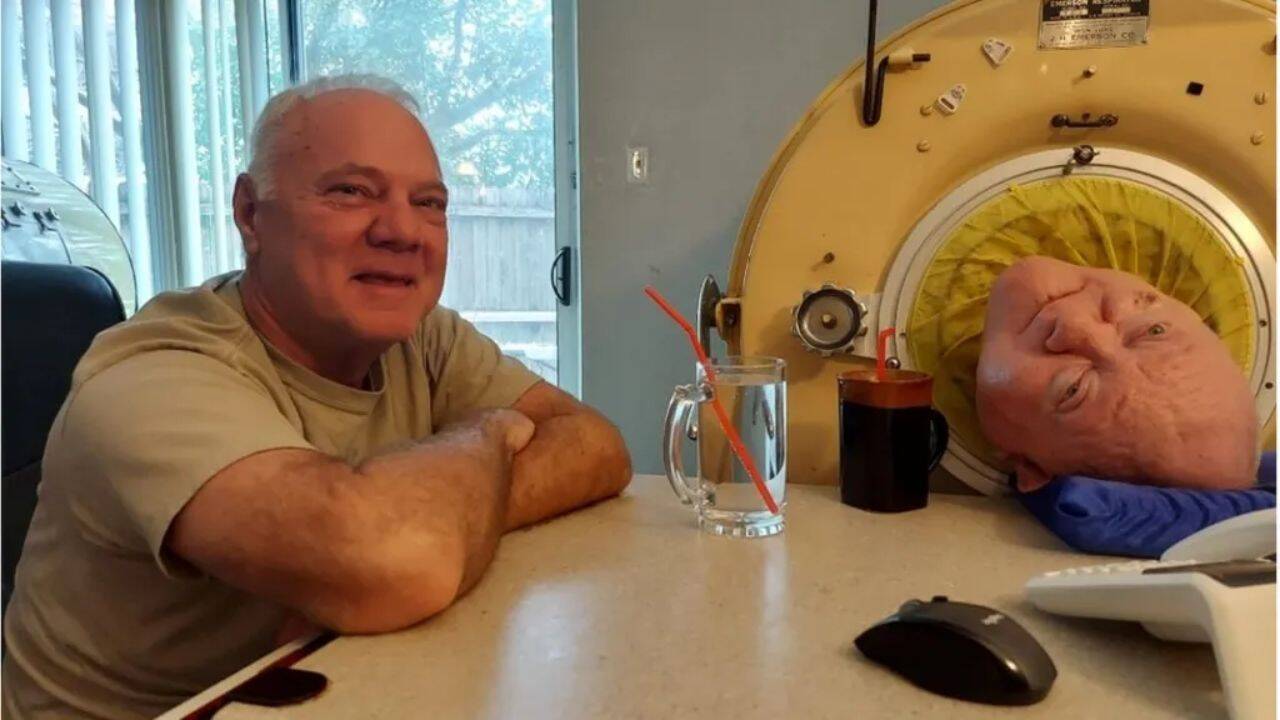
When he woke up, he was encased from the neck down in a massive, yellow steel cylinder. The machine hissed and groaned, rhythmically forcing air into his crushed chest. He could only see the world through a small mirror angled above his head. Doctors quietly told his parents to prepare for the worst. They said he wouldn't survive the week.
They were wrong. He would stay inside that metal tomb for more than seven decades.
The Rhythm of the Machine
To understand what it means to live in an iron lung, you have to understand the terrifying simplicity of human respiration. Your diaphragm contracts, creating a vacuum that pulls oxygen into your lungs. When polio destroyed the nerve paths between Paul’s spine and his breathing muscles, his body lost the ability to pull that vacuum on its own.
The iron lung—a massive metal canister sealed with a tight rubber collar around the neck—did the heavy lifting for him. Pumps inside the cylinder periodically reduced the air pressure inside the tank, forcing his rib cage to expand. Then, as pressure normalized, his lungs deflated.
Swoosh. Hiss. Pause. Swoosh.
That was his heartbeat, his clock, his entire sensory reality. If the power failed, if the rubber seal cracked, or if the mechanics seized, he had only minutes to live.
Most people trapped in such a device succumbed quickly—not just to secondary infections, but to despair. The sensory isolation alone was enough to shatter an adult mind, let alone a six-year-old boy who had only recently learned to ride a bicycle.
Paul refused to yield.
Learning to Breathe Like a Frog
For the first few years, Paul remained entirely dependent on the machine. But he possessed a fierce, stubborn intellect. He wanted to see the sun without looking through a tilted mirror.
In the mid-1950s, a physical therapist made him a deal: if he could learn to "glossopharyngeal breathe"—a painstaking technique that involved trapping air in his mouth and forcing it down his throat into his lungs like a frog—she would buy him a puppy.
It took months of agony. He would gulp air, gag, choke, and fail. Sweat poured off his forehead as he fought for a single breath independent of the mechanical pump.
Eventually, he mastered it. He gained the ability to survive outside the cylinder for minutes, then hours, at a time. He got his puppy. More importantly, he bought back his freedom, one agonizing gulp of air at a time.
A Life Built on Absolute Will
With his newly mastered frog-breathing, Paul did something nobody expected: he built a life that defied every medical consensus of the twentieth century.
He didn't just survive; he excelled. He graduated high school with top honors without physically attending a single class, memorizing vast swaths of coursework because he couldn't hold a textbook.
When he applied to Southern Methodist University, the administration rejected him, claiming he was too disabled to handle campus life. Paul picketed, argued, and badgered until they relented. He attended classes in a wheelchair, holding a paintbrush or a pen in his mouth to take notes and complete assignments.
He went on to earn a law degree from the University of Texas at Austin.
Think about that moment for a second. Picture a courtroom in the late 1980s. A trial attorney stands before a judge, arguing a complex civil case. He is in a wheelchair, his torso supported, his breathing rhythmic and precise. He is a man who cannot move a finger, yet he commands the room with a deep, resonant voice built on air swallowed through grit.
For decades, Paul represented clients in court, fought for disability rights, and traveled the country. At night, or whenever his fatigue grew too great, he returned home and slid back into the yellow cylinder that kept his vital organs moving.
The Forgotten Relic
As the decades slipped by, the world moved on. Jonas Salk’s polio vaccine, introduced in 1955, effectively wiped out the virus across most of the globe. Iron lungs disappeared from hospital wards, replaced by modern ventilators that breathed through tubes inserted into the trachea.
Most polio survivors transitioned to lighter mechanical ventilation or passed away as age wore down their fragile bodies.
Paul refused tracheostomy surgery, preferring the non-invasive iron lung he knew so intimately. But keeping a 1950s mechanical relic running in the 21st century became an existential challenge. Manufacturers stopped making replacement parts decades ago.
When the motor on his beloved Emerson respirator began to sputter in 2015, Paul was left in mortal danger. No repair technician knew how to fix a machine built during the Truman administration.
In a desperate plea uploaded to YouTube, Paul’s friends asked for help. An local machinist named Brady Richards answered the call. Richards found an old machine in a graveyard of discarded medical gear, machined custom parts in his shop, and restored Paul's lifeline.
"My life would be over if it wasn't for him," Paul said afterward. The machine kept humming.
Writing an Autobiography with a Pen in His Mouth
Age brings weariness to every human frame, but for a paralyzed man trapped in a metal tube, aging is an agonizingly slow siege.
In his later years, Paul could no longer leave the iron lung for extended periods. The frog-breathing that had granted him decades of partial mobility became too taxing on his heart and throat. He was largely confined to his yellow vessel once again.
Did he withdraw into bitterness? He did the opposite.
He spent eight years writing his autobiography, titled Three Minutes for a Dog: My Life in an Iron Lung. He didn't use voice-to-text software. He typed every single letter on an old computer using a plastic stick clamped between his teeth.
Letter by letter. Paragraph by paragraph. Page by page.
He wrote about the terrifying early days in the hospital ward, the smell of formaldehyde, the friends he lost in adjacent machines, and the overwhelming joy of winning his first court case. He wanted the world to remember a time before vaccines, when a summer virus could steal a child's breath in an afternoon.
The Final Chord
In March 2024, at the age of 78, Paul Alexander passed away. Guinness World Records had officially recognized him as the longest-surviving iron lung patient in human history.
For 72 years, he lived inside a machine designed as a temporary emergency measure. He outlived the doctors who predicted his death, the engineers who built his mechanical lung, and the era of medicine that birthed him.
Paul’s life was not a tragedy about a man trapped in a box. It was a triumph about a mind that refused to be contained by one.
When we look back at his seven decades inside that yellow drum, we aren't looking at a relic of medical history. We are looking at the absolute limit of human resilience—a man who swallowed air, defied gravity, and proved that a voice can carry across the world, even when the chest behind it cannot beat on its own.