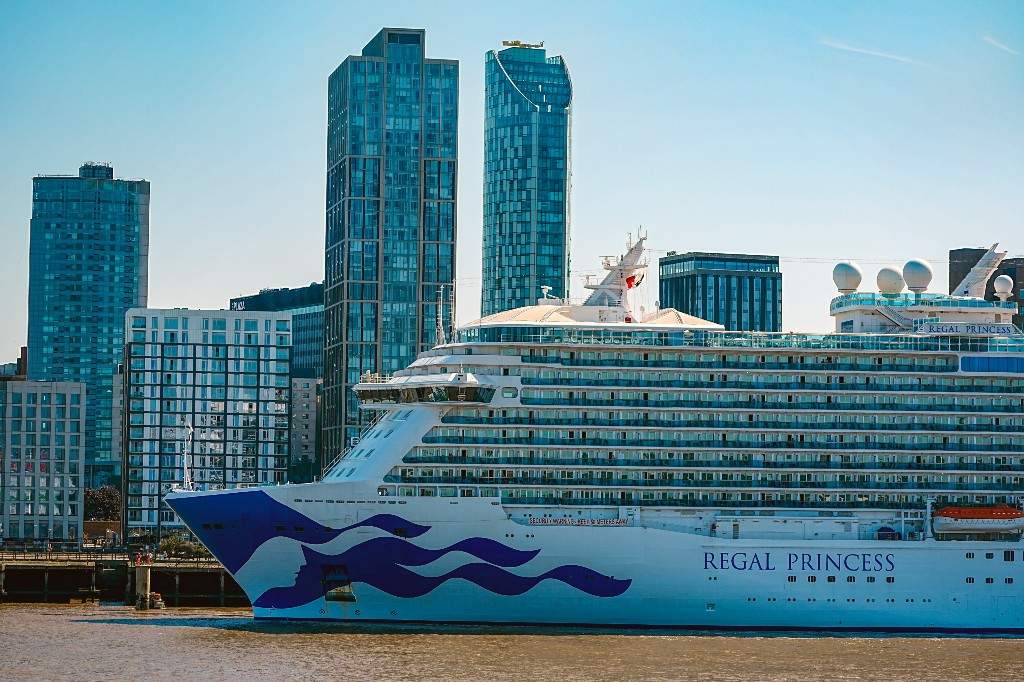
The death of a crew member falling overboard from a modern mega-vessel like the Regal Princess exposes a critical vulnerability in maritime safety architectures: the gap between immediate physical detection and practical survival windows. While cruise operators emphasize safety protocols and regulatory compliance, a clinical examination of the physics, vessel hydrodynamics, and detection technologies reveals that once an individual enters the water from a height of over 20 meters, the probability of a successful recovery declines exponentially.
Treating these incidents as isolated anomalies overlooks the systemic operational, mechanical, and physiological factors that govern deep-sea search and rescue operations. Resolving this challenge requires dissecting the mechanics of a man-overboard (MOB) event, quantifying the physical limits of survival, and analyzing the technical barriers that prevent the widespread adoption of real-time automated detection.
The Physics of the Fall and Immediate Survivability
The survival equation of a man-overboard incident begins with the physical descent. On a Royal-class cruise ship, passenger balconies and upper crew working areas sit between 25 and 45 meters above the waterline.
To quantify the forces involved, we apply the standard equations of motion under gravity, neglecting air resistance for the initial calculation to establish the baseline maximum impact velocity:
$$v = \sqrt{2gh}$$
Where:
- $g$ represents the acceleration due to gravity ($9.81 \text{ m/s}^2$).
- $h$ represents the height of the fall.
For a fall from a moderate height of 30 meters (approximately 100 feet):
$$v = \sqrt{2 \times 9.81 \times 30} \approx 24.26 \text{ m/s}$$
This velocity translates to approximately 87.3 km/h (54.3 mph). Upon contact with the water, the deceleration is violent and highly concentrated. The human body must displace water rapidly, and the resistance encountered mimics an impact with a semi-rigid surface. The primary cause of immediate mortality or incapacitation in high-altitude falls is physical trauma:
- Involuntary Inhalation and Cold Shock: If the fall occurs in water below 15°C (59°F), the body experiences an immediate trigeminal cold shock reflex. This triggers an involuntary gasp response. If the victim’s airway is submerged during this reflex, water inhalation is immediate, leading to rapid drowning.
- Deceleration Trauma: Impact velocities exceeding 20 m/s frequently cause skeletal fractures, extreme concussive trauma, and internal organ hemorrhaging. A fractured limb or spinal misalignment immediately compromises the individual's ability to remain afloat, even if conscious.
- Entrainment and Hydrodynamic Suction: Modern cruise vessels utilize massive propulsion systems, including podded azimuthing thrusters and propeller shafts, operating alongside boundary layer suction created by the hull moving through the water. A body falling close to the hull is vulnerable to being drawn into the boundary layer and swept toward the active propulsion units at the stern.
The Hydrodynamic Latency of Mega-Vessels
A common misconception is that a cruise ship can stop or turn quickly upon discovering an overboard incident. The laws of inertia and hydrodynamics dictate a substantial delay between incident recognition and vessel turnaround.
A vessel of the Regal Princess's scale—displacing roughly 142,000 gross tons and traveling at a cruising speed of 20 to 22 knots (10.3 to 11.3 m/s)—possesses immense momentum.
[Vessel detects MOB at Point A]
       │
       ▼ (1.5 to 3 minutes: Communication & bridge execution)
[Initiation of Williamson Turn at Point B]
       │
       ▼ (Tactical Diameter: 500m to 1000m turning radius)
[Return path to Point A takes 8 to 15 minutes total]
To return to the coordinate of the fall, the bridge team must execute a specialized recovery maneuver, typically a Williamson Turn or a Scharnow Turn.
The Williamson Turn
The Williamson Turn is the standard maneuver used when the coordinate of the fall is known but the vessel has already traveled a significant distance past the point.
- The rudder is ordered hard over toward the side of the casualty to swing the stern away from the person in the water.
- After deviating from the original course by approximately 60 degrees, the rudder is put hard over to the opposite side.
- As the vessel approaches the reciprocal of the original course, the rudder is brought amidships, placing the ship on a direct path back to the incident location.
This maneuver requires a massive tactical diameter. For a 330-meter-long vessel, the turning radius spans between 500 and 1,000 meters depending on draft, windage, and sea state. Completing the turn and slowing the vessel to a speed safe for deploying a Fast Rescue Craft (FRC) takes between 8 and 15 minutes.
This delay creates a critical recovery bottleneck. If the victim survives the initial fall and avoids the propulsion systems, they are left drifting in the open ocean for a minimum of 15 minutes before help can arrive. During this window, ocean currents and wind drift can displace the individual hundreds of meters from the original drop coordinate, compounding search complexity.
The Detection Dilemma: Automated Technology vs. Delayed Reporting
The primary variable limiting survival rates is detection latency. In many historical overboard incidents, the event is not discovered until a cabin search is conducted, hours after the fall. This delay expands the search area exponentially:
$$\text{Search Area} \propto (\text{Drift Velocity} \times \text{Time})^2$$
If a fall is not detected immediately, the search area grows too large for local recovery, necessitating a massive regional Search and Rescue (SAR) operation coordinated by Coast Guard assets.
To resolve this latency, the Cruise Vessel Security and Safety Act (CVSSA) of 2010 mandated that vessels integrate systems to detect when passengers or crew fall overboard, "to the extent such technology is available." However, widespread adoption of fully automated, highly reliable detection systems has faced severe technological constraints.
Active Infrared and Optical Camera Arrays
Thermal imaging cameras combined with computer vision algorithms are designed to scan the ship’s perimeter and trigger an automatic alarm on the bridge when a human-sized object breaks a defined virtual plane. The operational constraints of this approach include:
- Environmental Interference: Salt spray, heavy rain, fog, and condensation coat camera lenses, degrading the signal-to-noise ratio. Thermal signatures of birds, trash, or discharged water can trigger false alarms.
- The False Positive Dilemma: If a system triggers several false alarms per day due to sea spray or birds, crew members develop alarm fatigue, leading to delayed response times or system deactivation.
- High Contrast Boundaries: Transitioning between the hot engine exhaust plumes or structural lights and the cold ocean water creates massive thermal gradients that challenge simple edge-detection algorithms.
Radar and LiDAR Sensors
Microwave radar and LiDAR systems sweep the immediate perimeter of the hull to detect movement.
- Radar Clutter: Waves and sea spray near the hull create high backscatter (sea clutter), which can mask the radar cross-section of a falling human body.
- LiDAR Range Constraints: While highly accurate, LiDAR performance drops significantly in heavy rain or dense fog, exactly when risk profiles are highest.
The absence of a standardized, industry-wide, zero-fail automated detection system means that many vessels still rely on visual witnesses, manual reviews of closed-circuit television (CCTV) footage after a person is reported missing, or local radar targets if the victim manages to remain on the surface.
Physiological Degradation in Water: The Thermal Clock
Once an individual is in the water, their survival is governed by a strict biological countdown. The rate of heat loss in water is approximately 25 times faster than in air of the same temperature.
| Water Temperature | Time to Exhaustion or Unconsciousness | Expected Time of Survival |
|---|---|---|
| 0°C to 4°C (32°F to 40°F) | 15 to 30 minutes | 30 to 90 minutes |
| 4°C to 10°C (40°F to 50°F) | 30 to 60 minutes | 1 to 3 hours |
| 10°C to 15°C (50°F to 60°F) | 1 to 2 hours | 1 to 6 hours |
| 15°C to 20°C (60°F to 70°F) | 2 to 7 hours | 2 to 40 hours |
| 20°C to 25°C (70°F to 80°F) | 3 to 12 hours | 3 hours to indefinite |
The critical threshold for a successful rescue is rarely the "time of survival" limits; instead, it is the time to exhaustion or unconsciousness.
In water below 15°C, a person loses the fine motor control required to swim or hold onto a life ring within 10 to 15 minutes due to peripheral vasoconstriction (the body shunting warm blood away from extremities to protect core organs). Once physical coordination is lost, drowning occurs rapidly unless the individual is wearing a flotation device.
In crew fatalities, personal flotation devices (PFDs) are rarely worn unless the individual was actively performing scheduled maintenance on an open deck, meaning survival times are governed strictly by physical stamina and immediate surface buoyancy.
Operational and Structural Vulnerabilities of Crew Members
The occupational risk profile of a crew member differs significantly from that of a guest. While guest overboard incidents are frequently linked to voluntary actions, high-altitude balconies, or alcohol consumption, crew incidents are deeply intertwined with the operational realities of working on a maritime vessel.
Structural Access Points
Crew members operate in areas of the ship closed to passengers, including mooring decks (hull openings close to the waterline), lower embarkation platforms, and maintenance catwalks. These areas feature lower railing heights to facilitate rope handling, equipment deployment, and maintenance tasks.
Physical Fatigue and Shift Patterns
Maritime operations require 24/7 coverage, with crew members often working split-shift patterns that can disrupt circadian rhythms. Fatigue impairs cognitive processing, slows reaction times, and degrades physical balance. Under wet, high-motion marine conditions, a momentary slip on a metal deck plate near an open shell door can result in an immediate fall into the water.
The Mooring and Maintenance Risk Profile
Working with high-tension mooring lines and heavy machinery introduces mechanical hazards. A snap-back event (where a high-tension rope breaks and whips backward) can strike a crew member with enough kinetic energy to throw them directly through a shell door or over a low railing.
Operational Deficiencies and Strategic Mitigation
The loss of life on the Regal Princess underscores that relying on retrofitted detection systems and manual bridge maneuvers is an inadequate strategy for managing maritime human risk. To shift from reactive search operations to reliable prevention and immediate recovery, vessel operators must implement three structural changes.
First, ship design must prioritize physical exclusion over behavioral compliance. Lower crew decks and mooring stations must incorporate automatic interlocks on shell doors, preventing them from being opened when the vessel is underway unless explicitly authorized by the bridge for pilot transfers or emergency operations. High-risk maintenance areas must feature integrated, permanent fall-arrest track systems that allow crew to remain tethered at all times without restricting their operational mobility.
Second, the industry must transition from passive CCTV monitoring to active sensor fusion networks. Combining thermal imaging with high-frequency micro-radar arrays allows vessels to filter out environmental noise and eliminate the false positive bottleneck. These sensors must be programmed to automatically execute three simultaneous actions without human intervention:
- Log the exact GPS coordinate of the event.
- Release a localized GPS-enabled marker buoy from the stern to serve as a physical drift anchor.
- Stream the live sensor feed directly to the officer of the watch on the bridge with an audible high-priority alarm.
Finally, operators must establish clear operational limits on crew fatigue, treating rest periods as critical safety parameters rather than flexible scheduling variables. By treating the human element with the same engineering rigor applied to hull integrity and propulsion systems, maritime operators can close the gap between an emergency event and a successful recovery.