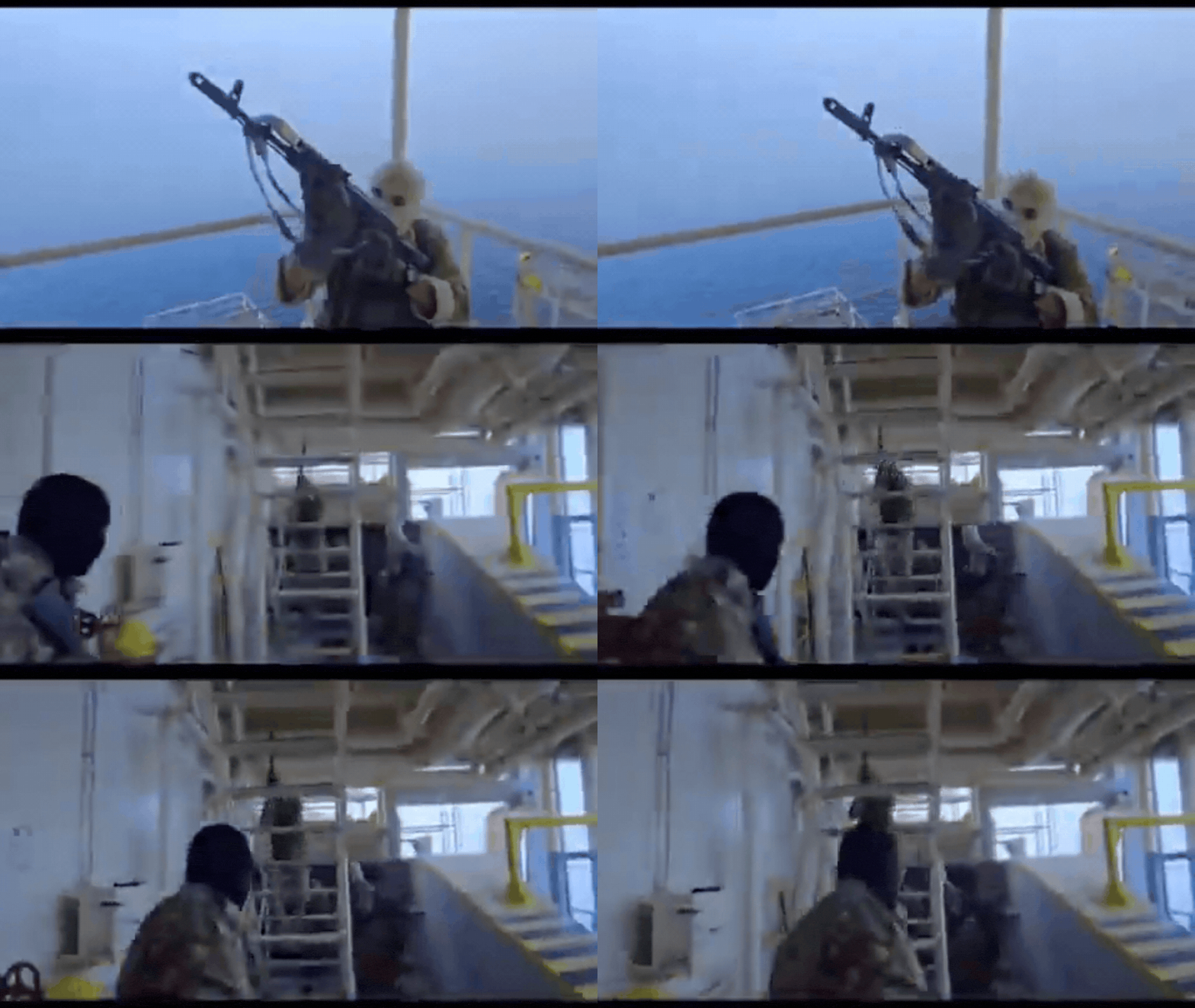
The seizure of commercial vessels in the Strait of Hormuz is not a series of isolated maritime incidents but a calculated execution of asymmetric naval doctrine designed to exploit specific vulnerabilities in global energy supply chains and international maritime law. When the Iranian Navy or the Islamic Revolutionary Guard Corps Navy (IRGCN) interdicts a tanker, they are utilizing a high-leverage tool to rebalance power dynamics against a conventional military superior, specifically the United States and its regional allies. This strategy functions by transforming a geographic chokepoint into a theater of political theater and economic coercion.
The Strait of Hormuz serves as the world’s most sensitive maritime artery, with approximately 21 million barrels of oil—roughly 21% of global petroleum liquid consumption—passing through its 21-mile-wide navigable channel daily. The physical constraints of this waterway dictate the operational reality: deep-water channels for VLCCs (Very Large Crude Carriers) are narrow, forcing predictable transit patterns that Iranian forces exploit through a framework of Kinetic Signaling.
The Mechanics of Maritime Interdiction
To understand the efficacy of these seizures, one must categorize the Iranian approach into three distinct operational pillars:
1. The Legality of "Innocent Passage" vs. "Transit Passage"
Under the United Nations Convention on the Law of the Sea (UNCLOS), ships enjoy the right of transit passage through international straits. However, Iran—which has signed but not ratified UNCLOS—often asserts a more restrictive interpretation. They utilize domestic legal pretexts, such as claims of environmental pollution, maritime collisions, or "judicial orders" resulting from unrelated diplomatic freezes, to justify boarding actions. This provides a thin layer of legal "gray zone" deniability that complicates a direct military response from Western powers.
2. Asymmetric Force Composition
The Iranian naval strategy does not rely on matching the U.S. Fifth Fleet in tonnage or firepower. Instead, it utilizes a Swarm Logic model. This involves:
- Fast Attack Craft (FAC): Highly maneuverable, missile-armed small boats that can overwhelm the targeting systems of larger, slower destroyers through sheer volume.
- Vertical Envelopment: The use of Mi-17 or similar helicopters to fast-rope commandos onto the decks of merchant vessels. This happens in minutes, often before nearby naval assets can reach the scene.
- Coastal Defense Cruise Missiles (CDCMs): Land-based batteries that create a "no-go" zone, forcing escorting warships to prioritize their own defense over the protection of a merchant hull.
3. The Escalation Ladder
Seizures are rarely random. They are reactionary tools within a broader negotiation framework. If Iranian oil assets are seized or sanctions are tightened, the IRGCN increases the "Risk Premium" for all shipping in the Gulf. This forces insurance companies (like Lloyd’s of London) to raise War Risk premiums, effectively imposing a tax on the global economy that pressures Western governments to seek de-escalation.
The Economic Cost Function of Maritime Instability
The primary objective of interdicting a ship in the Strait is to trigger a spike in the Volatility Index (VIX) of energy markets. This creates a specific cost function that affects stakeholders differently:
- The Shipowner’s Burden: Beyond the physical loss of the vessel and cargo, the owner faces catastrophic reputational damage and a permanent increase in insurance overhead. A single seizure can lead to a 10-15% jump in operational costs for fleets traversing the Middle East.
- The Flag State Dilemma: Iran frequently targets ships flying "Flags of Convenience" (e.g., Panama, Marshall Islands). These states lack the naval power to protect their registered vessels, forcing them to rely on the U.S. Navy. This creates a diplomatic bottleneck where the U.S. is expected to provide security for ships that contribute nothing to its tax base.
- Market Contango: When the Strait is threatened, oil prices often enter a state of contango, where the future price is higher than the spot price. This incentivizes hoarding and further destabilizes global supply/demand balances.
Tactical Realities: The Seizure Process
A typical interdiction follows a rigid, choreographed sequence designed to minimize the window for external intervention.
Phase I: Intelligence and Surveillance
Iranian shore-based radar and AIS (Automatic Identification System) monitoring identify a high-value target. "High value" in this context is defined by the ship’s flag, its cargo destination, and its proximity to Iranian territorial waters.
Phase II: Harassment and Redirection
Multiple fast craft surround the vessel, using aggressive maneuvers to force it off its course. Bridge-to-bridge radio communication is used to issue "orders" to steer into Iranian waters. If the captain complies, the legal argument for "illegal entry" is strengthened.
Phase III: The Kinetic Boarding
If the vessel maintains its course, Iranian forces execute a boarding. Unlike Somali piracy, which is profit-driven and disorganized, these are professional military operations. Commandos secure the bridge, disable the AIS transponder to "blind" global tracking systems, and redirect the vessel to an Iranian port like Bandar Abbas.
The Strategic Failure of Conventional Deterrence
The persistent nature of these seizures indicates a failure in current Western deterrence models. The U.S. and its partners have attempted to counter these moves via Operation Sentinel (International Maritime Security Construct), but the framework faces several structural bottlenecks:
- The Proportionality Gap: If Iran seizes a tanker using a $50,000 boat and 10 sailors, a conventional military response (sinking the boat or striking a base) is seen as a disproportionate escalation that could lead to a full-scale regional war. Iran relies on this Western "escalation fatigue."
- The Escort Logistics: There are approximately 2,000-3,000 large tankers moving through the Strait annually. It is mathematically impossible for any naval coalition to provide individual hull-to-hull escorts for every ship. The "zone defense" model currently employed leaves gaps that are easily exploited.
- Technology vs. Mass: While U.S. ships have superior sensors, they are designed for blue-water engagements against peer adversaries. In the cluttered, "noisy" environment of the Strait—filled with dhows, fishing boats, and commercial traffic—separating a threat from a civilian actor remains an unsolved identification problem.
Counter-Strategy: The Shift Toward Autonomous Defense
To mitigate the risk of vessel seizure without triggering a kinetic war, the strategic response must shift toward Distributed Maritime Operations (DMO) and autonomous systems.
Unmanned Surface Vessels (USVs)
Deploying fleets of low-cost, sensor-heavy USVs (such as the Saildrone or MARTAC systems) allows for 24/7 persistent surveillance. These drones can "shadow" every merchant vessel, providing live-streamed video evidence to the global community in real-time. This eliminates the "gray zone" and forces Iran to conduct its actions under total transparency, increasing the diplomatic cost of interdiction.
Electronic Warfare (EW) Bubbles
Commercial tankers should be equipped with non-kinetic EW suites. These systems can jam the communications and GPS of approaching fast craft, making it difficult for swarms to coordinate or for helicopters to maintain a hover for boarding operations. By raising the "technical barrier to entry" for a seizure, the success rate of the IRGCN is lowered without firing a shot.
Legal and Financial Reprisals
The maritime industry must move toward a Unified Insurance Block. If all major insurers agree to a "reinsurance freeze" on any entity that facilitates the sale of oil from seized tankers, the economic incentive for Iran to hold these assets diminishes.
The standoff in the Strait of Hormuz is not a nautical problem; it is a game theory problem. As long as the cost of seizing a ship remains lower than the diplomatic or economic concessions Iran gains from it, the seizures will continue. Success depends on flipping that equation—not through a single massive naval engagement, but through a granular, persistent, and technologically driven increase in the friction Iran faces for every mile of water they attempt to claim.
The immediate move for regional players is the integration of "Smart Escort" protocols, where AI-driven analytics predict seizure attempts based on Iranian naval sortie patterns, allowing for the preemptive rerouting of high-risk hulls. Neutralizing the threat requires moving away from reactive patrolling and toward a model of Predictive Maritime Interdiction.