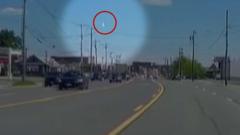
You are sitting in your living room on a quiet Saturday afternoon, and your entire house violently shakes. The windows rattle. The dog bolts under the couch. Your first instinct isn't to look at the sky for a shooting star. You assume a massive tree just crushed your roof, a gas main blew up down the street, or maybe an earthquake is rolling through New England.
That is exactly what thousands of people across Massachusetts, Rhode Island, and New Hampshire experienced at 2:06 p.m. on May 30, 2026. The culprits weren't faulty utility lines or shifting fault lines. It was a space rock the size of a beach ball moving at a mind-boggling 75,000 miles per hour.
NASA later confirmed that this daytime bolide—a technical term for an exceptionally bright meteor that explodes in the atmosphere—generated a supersonic shock wave that rocked the region. Let's break down exactly what happened, why it made so much noise, and what actually happens to the space rocks that survive the plunge.
The Anatomy of a 300 Ton Blast
When we think of meteors, we usually picture silent, elegant streaks of light slicing through the night sky during the Perseids. We don't think of them as atmospheric bombs.
This particular rock was only about three feet wide. Yet, when it slammed into Earth's upper atmosphere, it was traveling at Mach 100, which is roughly 100 times the speed of sound. Harvard University astrophysicist Dr. Avi Loeb noted that moving at 33 kilometers per second creates an unimaginable amount of friction and air compression.
The meteor didn't hit the ground, and it didn't burn up slowly. Instead, it experienced what scientists call an airburst.
As the rock plunged deeper, the air in front of it compressed into a dense, superheated wall. The pressure building on the nose of the meteor grew drastically higher than the internal strength of the rock itself. At roughly 40 miles above the Massachusetts–New Hampshire border, the rock simply couldn't hold together anymore. It pancaked and shattered in a fraction of a second.
That sudden fragmentation released an energy yield equivalent to 300 tons of TNT. To put that in perspective, that is roughly 2% of the energy released by the Hiroshima atomic bomb, detonated high in the upper atmosphere. That extreme release of energy sent a linear shock wave screaming toward the ground, which is why people from the Boston metro area all the way to northern Rhode Island heard the exact same terrifying rumble.
Hunting for Fishy Squishers in Cape Cod Bay
The internet quickly flooded with home security footage capturing the sound of the blast, but many people were left wondering where the actual rock went. If it exploded with the force of hundreds of tons of explosives, is there anything left to find?
The answer is yes, but you will need a wetsuit.
NASA scientists tracked the trajectory of the fireball and confirmed that the blast produced a legitimate meteorite fall. The pieces didn't rain down on Boston common or block traffic on I-95. Instead, the debris field sits right in the middle of Cape Cod Bay, resting under about 34 meters of water.
In the planetary science community, when a meteorite falls directly into the ocean or a large body of water, it gets a hilarious, highly unofficial nickname. Scientists call it a "fishy squisher."
Recovering space rocks from the bottom of a murky bay is nearly impossible, but researchers don't necessarily need to hold the stones to learn from them. Organizations like the American Meteor Society rely heavily on public data to reconstruct the event. By analyzing the speed, the brightness of the flash captured by NOAA weather satellites, and the precise timing of the acoustic boom from doorbell cameras, experts can determine the original orbit of the rock before it crossed paths with Earth.
Are Meteor Explosions Becoming More Common
If it feels like we are hearing about these sudden atmospheric explosions more often lately, you aren't imagining things. Just a day before the New England event, residents across South Carolina reported a mysterious aerial blast that rattled homes and sent people running outside.
Scientists at the American Meteor Society have actually documented a statistical uptick in large fireball events and acoustic booms during the early months of 2026. This has naturally led to some wild internet conspiracy theories. People are asking if we are currently passing through a strangely dense cloud of space debris or if our planetary defense systems are missing something major.
The reality is much more grounded. We aren't under bombardment; we are just better at watching.
- Ubiquitous Surveillance: Twenty years ago, if a daytime bolide exploded over the coast, a few fishermen might have seen a flash, and a few coastal residents might have heard a rumble. Today, every third house has a smart doorbell, every car has a dashcam, and everyone has a high-definition camera in their pocket.
- Advanced Satellites: Spaceflight meteorologists now instantly track these events using tools like the Geostationary Lightning Mapper on NOAA’s GOES-19 weather satellite. The satellite spots the sudden, anomalous flash of light over the ocean even in broad daylight, instantly confirming the exact coordinate of the airburst.
- Crowdsourced Science: Platforms like the American Meteor Society allow hundreds of eyewitnesses to log reports within minutes, giving scientists instant triangulation data that used to take weeks to collect.
What to Do If You Experience an Airburst
Living through a nearby bolide fragmentation can be jarring, but it offers a great opportunity to assist actual scientific research. If you ever hear a sudden, unexplained explosion that shakes your home without an obvious local cause, you can take a few immediate steps to help researchers map the event.
First, check the United States Geological Survey website to see if a seismic event was recorded. If the seismographs are quiet but the windows rattled, you are likely dealing with an atmospheric sonic boom.
Next, check your outdoor security cameras or dashcam footage. Do not look for the visual flash alone. Note the exact timestamp when the audio of the boom occurs. Scientists use the delay between the satellite-recorded flash and the ground-recorded audio to calculate the precise altitude and distance of the explosion.
Finally, head over to the American Meteor Society website and file a fireball report. Your location data, combined with hundreds of others, helps researchers trace the trajectory backwards into the solar system, mapping the invisible stray rocks that share our cosmic neighborhood.