The death of 39 people off the coast of Senegal is not an isolated maritime accident; it is the predictable output of a high-risk transit market operating under extreme structural pressure. Standard reporting treats these capsizes as sudden tragedies driven by bad weather or reckless captains. That framing misses the operational reality. The Atlantic route from West Africa to the Canary Islands functions as an illicit logistics network where vessel design, enforcement displacement, and asymmetric economic incentives intersect to produce high mortality rates.
To understand why boats continue to depart from Senegal despite catastrophic failure rates, one must strip away emotional narratives and examine the route through three operational lenses: the physics of the vessels, the displacement effects of border enforcement, and the risk-reward calculus of the migrants and facilitators.
The Structural Physics of Pirogue Failures
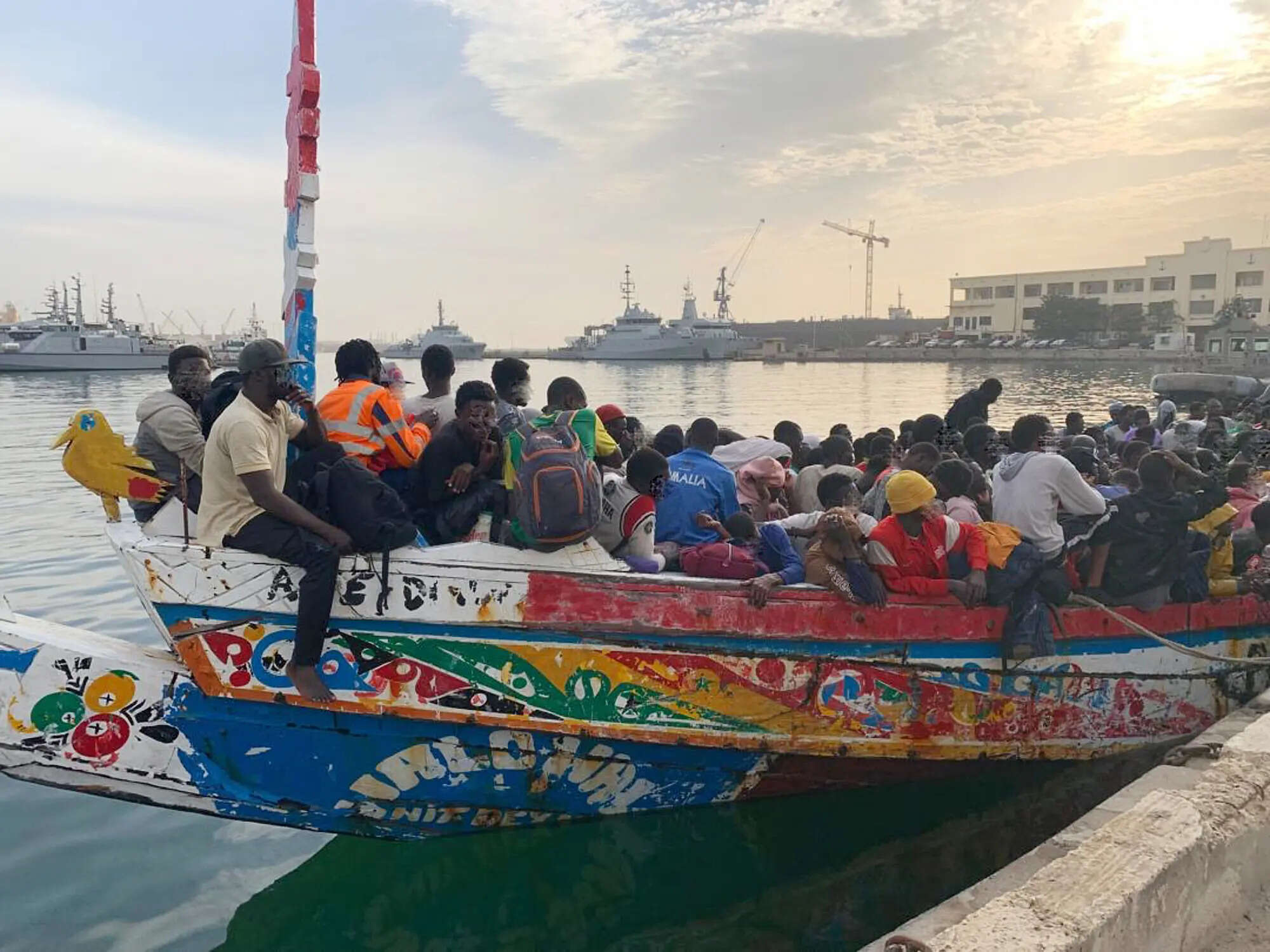
The primary vehicle used on the Senegal-to-Canary Islands corridor is the pirogue—a long, narrow, open wooden fishing boat traditionally engineered for nearshore operations. When repurposed for a 1,500-kilometer open-ocean transit across the Atlantic, these vessels operate entirely outside their design parameters.
A standard maritime vessel relies on a deep keel, sealed decks, and compartmentalized hulls to maintain stability in heavy swells. A wooden pirogue possesses none of these features. Its stability depends entirely on weight distribution and freeboard—the distance between the waterline and the upper edge of the hull. Smuggling operators routinely overload these craft to maximize revenue per departure, often packing between 100 and 200 individuals onto a hull built for a fraction of that payload.
This overloading initiates a predictable chain of mechanical failures:
- Freeboard Reduction: Excess weight pushes the hull deeper into the water, reducing the margin required to keep ocean swells from spilling over the gunwales.
- Center of Gravity Shift: Passengers sitting on the upper edges of the hull or standing during panic raise the vessel's center of gravity, drastically reducing its righting moment—the force that returns a tilting boat to an upright position.
- Hydrodynamic Drag and Fuel Exhaustion: A submerged, heavy hull requires significantly more propulsion energy to cut through ocean currents. Outboard motors, often poorly maintained and running continuously for days, burn through fuel reserves faster than calculated, leaving the vessel adrift without steerage.
- Synchronous Rolling: Once a pirogue loses engine power, it turns beam-on (parallel) to the waves. In the Atlantic swell, continuous wave impacts cause the open hull to take on water. Because the boat lacks bilge pumps or sealed compartments, water sloshes freely across the deck—a phenomenon known in naval architecture as the "free surface effect." This shifting water weight rapidly accelerates tilting until the vessel capsizes.
The capsize off Senegal demonstrates this exact failure cascade. When a vessel sinks shortly after departure or midway through the transit, the primary cause is rarely a single rogue wave; it is the cumulative loss of stability caused by maximizing passenger volume on an unsealed wooden hull.
The Enforcement Displacement Mechanism
A common misconception in migration policy is that increasing patrol density in one geographic zone reduces overall transit volume. In practice, localized enforcement alters the routing geometry, forcing operators to select longer, more dangerous corridors. This is known in criminology and border studies as the displacement effect.
Over the past two decades, European and North African authorities systematically fortified the shortest maritime crossings into Europe: the Strait of Gibraltar, the Alboran Sea, and the Central Mediterranean route from Libya to Italy. Radar networks, coast guard interdictions, and bilateral containment agreements raised the operational cost and interception probability in these northern corridors.
Smuggling networks responded by shifting departure hubs southward to Mauritania, Senegal, and The Gambia. This geographic shift introduced severe operational penalties for the migrants:
- Distance Multiplication: While the Strait of Gibraltar is roughly 14 kilometers wide, the distance from Dakar, Senegal, to El Hierro or Tenerife in the Canary Islands exceeds 1,400 kilometers. Increasing transit distance by two orders of magnitude exposes open boats to days of open-ocean weather systems rather than hours.
- Current and Wind Exposure: Vessels departing Senegal must navigate against the Canary Current and the Northeast Trade Winds. Operators frequently swing wide into the open Atlantic to bypass coastal patrols before turning northeast toward the archipelago. A minor navigation error—often caused by reliance on handheld consumer GPS units or low-battery smartphones—pushes the vessel past the islands into the empty expanse of the central Atlantic, where rescue is statistically impossible.
- Search and Rescue Deficits: The maritime search and rescue (SAR) zone covering the West African coast is vast, spanning millions of square kilometers. Neither Senegalese maritime authorities nor Spanish SAR assets possess the continuous aerial surveillance or vessel density required to monitor this entire sector. Consequently, distress calls often go unheard, and capsizes are only discovered when survivors wash ashore or are spotted by commercial shipping lanes.
The fatalities off Senegal are a direct byproduct of this spatial displacement. By closing off short-distance routes without altering the underlying demand for migration, policy frameworks inadvertently pushed human cargo onto one of the deadliest stretches of open water in the world.
The Economic Calculus of the Corridor
The persistence of the Atlantic route relies on a distorted market structure where the financial incentives of the facilitators are completely decoupled from the survival of the passengers.
In legitimate transport markets, the operator bears financial, legal, and reputational liability for passenger safety. In illicit maritime smuggling, the transaction is front-loaded. Migrants pay between $400 and $1,000 upfront—often pooled from extended family savings or local debt networks—before the boat leaves the beach. Once the vessel departs, the organizer's revenue is secured.
This payment structure creates severe moral hazard. Because the organizer does not travel on the boat—piloting duties are typically handed over to a migrant with basic fishing experience in exchange for a free passage—the organizer faces zero physical risk. Spending additional capital on safety equipment, such as life jackets, satellite phones, spare outboard engines, or higher-grade fuel, directly reduces the organizer's profit margin without increasing their revenue.
From the migrant's perspective, the decision to board an unseaworthy pirogue is often framed in mainstream reporting as desperation. While economic pressure is a primary driver, the decision also stems from information asymmetry. Migrants in inland regions or coastal towns rarely possess accurate data on mortality rates. Smuggling brokers actively suppress failure statistics, emphasizing only the successful arrivals—those who reach the Canary Islands, enter the Spanish asylum or processing system, and begin remitting capital back home.
In local economies where youth unemployment is structural, inflation erodes purchasing power, and traditional sectors like artisanal fishing have been depleted by industrial foreign trawlers, the expected value of migration remains positive in the minds of participants. Even if a migrant estimates a high probability of failure, the perceived certainty of economic stagnation at home outweighs the probabilistic risk of death at sea.
Limitations of Current Interdiction Models
Current state responses to the Senegal-Canary Islands route rely heavily on supply-side disruption: arresting boat builders, confiscating outboard motors, and deploying joint naval patrols. While these tactics produce measurable short-term metrics—such as boats seized or departures prevented—they suffer from three structural limitations.
First, the capital barrier to entry for smuggling networks is exceptionally low. Wooden pirogues are built using local timber and traditional carpentry skills found in every coastal village. Outboard motors are standard commercial equipment imported for the regional fishing industry. Disrupting one workshop simply shifts production to an adjacent cove.
Second, heightened coastal surveillance forces boats to depart at night, during poor weather windows, or from unmonitored river deltas like the Saloum or Casamance. These adaptations directly increase the probability of a capsize immediately after launch, as vessels navigate treacherous sandbars and heavy surf in zero-visibility conditions.
Third, bilateral containment agreements often falter due to domestic political friction. Intercepting citizens who are attempting to leave—rather than foreign nationals attempting to enter—places local governments in a difficult position, particularly when diaspora remittances represent a significant percentage of national GDP. Enforcement therefore oscillates between periods of intense crackdown and periods of tacit tolerance, allowing smuggling networks to clear backlogs of paying passengers.
Strategic Allocation of Maritime Assets
Reducing mortality on the Atlantic corridor requires abandoning the assumption that coastal interdiction alone will deter departures. As long as the economic differential between West Africa and the European Union remains vast, demand for transit will persist. Policy and operational resources must be reallocated to alter the physical and informational parameters of the route.
Maritime authorities and international partners should prioritize three operational shifts:
- Deploy Persistent Aerial Surveillance Over Departure Zones: Shift funding from reactive naval patrols to continuous drone and satellite monitoring of known staging beaches in Senegal and Mauritania. Early detection of vessel movements allows interception within territorial waters—within two to five nautical miles of the coast—where rescue operations are safe and survival rates near 100 percent, rather than attempting rescues hundreds of kilometers offshore.
- Target the Supply Chain of High-Horsepower Outboards: Instead of policing individual beaches, implement strict end-user tracking and import controls on commercial outboard engines exceeding 40 horsepower across West African ports. Without high-thrust engines, overloaded pirogues cannot clear coastal surf zones or sustain multi-day transits, effectively grounding the smuggling fleet at the component level.
- Establish Real-Time Casualty Verification Channels: Counter broker misinformation by funding independent, verifiable tracking of missing vessels and recovered bodies, broadcasting this data directly through local radio and community networks in high-departure regions. Correcting the information asymmetry forces potential passengers and their financial backers to price the true mortality risk into their capital allocation decisions.