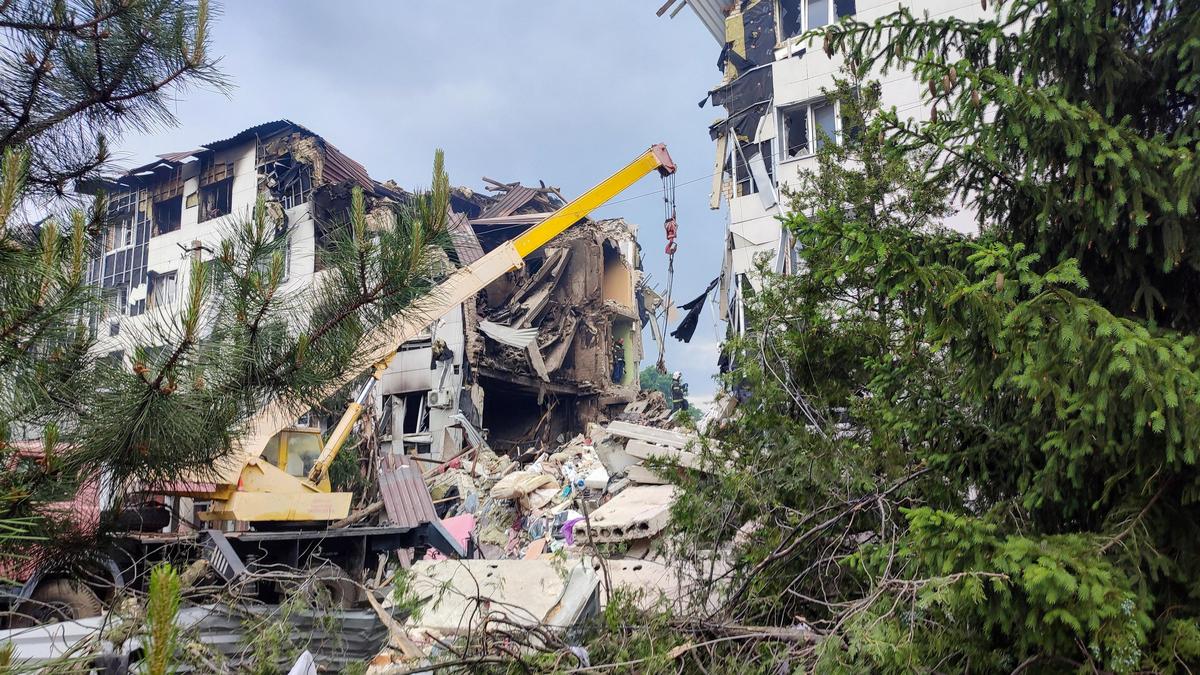
The lethal kinetic strike on a vocational college in Russian-occupied Makiivka establishes a critical baseline for analyzing modern high-density troop billeting vulnerabilities. While media coverage focuses on immediate casualty counts, a rigorous strategic assessment requires deconstructing the operational architecture that enabled the strike: target acquisition physics, structural vulnerability exploitation, and the systemic failure of decentralized force protection protocols.
When deep-strike artillery intersects with concentrated human infrastructure, the resulting lethality is not a function of chance. It is a predictable output of specific logistical bottlenecks and electronic signatures. By isolating these variables, analysts can map the exact vulnerabilities that transformed a civilian educational facility into a catastrophic single point of failure. If you enjoyed this post, you might want to read: this related article.
The Triad of Target Acquisition
The success of long-range precision fires relies on a tripartite intelligence framework. For a fixed facility like the Makiivka vocational school to be targeted successfully, three distinct data vectors must converge simultaneously.
- Electronic Emissions (SIGINT): High-density troop concentrations invariably generate localized spikes in cellular and radio traffic. When hundreds of personnel bypass operational security protocols to access commercial telecommunications networks, they emit a distinct radio frequency footprint. This signature is easily geolocated by airborne or ground-based signals intelligence assets, providing a real-time coordinate grid for high-density occupancy.
- Persistent Overhead Imagery (GEOINT): Satellite reconnaissance and long-endurance unmanned aerial vehicles track anomalies in local infrastructure usage. The sudden influx of military transport vehicles, the establishment of ad-hoc checkpoints, and the modification of perimeter security around a civilian college serve as high-confidence indicators of military repurposing.
- Human Intelligence Networks (HUMINT): In occupied territories, localized partisan networks provide the final layer of target verification. While electronic and imagery assets reveal a presence, human observers on the ground confirm the specific nature of the occupancy—distinguishing between regular personnel rotations, high-value command staff meetings, and ammunition storage.
When these three vectors align, the target graduates from a point of interest to a high-priority kinetic objective. The bottleneck shifts from intelligence gathering to the physics of structural destruction. For another angle on this event, check out the latest coverage from TIME.
Structural Vulnerability and Explosive Chemistry
The high fatality rate in the Makiivka strike—reported at 18 by regional officials but structurally indicative of a much higher localized casualty density—stems from the compounding effects of building materials and secondary detonations. The architecture of Soviet-era vocational schools relies heavily on prefabricated reinforced concrete panels and unreinforced masonry.
The Mechanism of Progressive Collapse
The primary kinetic impact of a guided rocket or missile generates a high-velocity shockwave. In unreinforced or poorly reinforced concrete structures, this pressure wave induces immediate shear failure in load-bearing walls.
The failure of a single foundational support triggers a chain reaction known as progressive collapse, where the upper floors lose structural integrity and pancake downward. Personnel trapped within these structures face multi-axial compression injuries and asphyxiation, drastically reducing survival rates compared to impacts on reinforced bunker networks.
Co-location of Munitions and Personnel
The lethality function increases exponentially when operational commanders co-locate troops with tactical ammunition stockpiles.
$$\text{Total Explosive Yield} = \text{Warhead Mass} + \text{Stored Munitions Chemical Energy}$$
When an incoming warhead detonates within a facility utilized as an impromptu arms depot, the initial kinetic energy acts as a primary charge, triggering the sympathetic detonation of stored artillery shells, small arms ammunition, and rocket-propelled grenades. This secondary blast destroys any remaining void spaces within the collapsed structure, erasing the survivability margins typically found in standard urban bombardment.
The Cost Function of Centralized Billeting
Logistical efficiency frequently conflicts with operational security in prolonged conflicts. Depleted or poorly trained command structures lean heavily on centralized billeting due to three primary operational constraints.
- Command and Control Simplification: Managing a battalion-strength formation across decentralized, hidden positions requires sophisticated, secure communication networks and disciplined lower-tier leadership. Centralizing hundreds of personnel under one roof allows a minimal officer cohort to maintain accountability, distribute orders, and enforce basic discipline.
- Logistical Consolidations: Distributing food, thermal heating, medical supplies, and ammunition across dozens of dispersed micro-locations creates a massive transport and distribution burden. A single centralized hub, such as a college campus, optimizes the supply chain by reducing the required delivery touchpoints for logistics convoys.
- Climate and Infrastructure Availability: Winter operations necessitate access to hardened shelter with existing heating, sanitation, and cooking infrastructure. Large civilian institutions are frequently the only structures capable of absorbing hundreds of personnel without requiring extensive engineering support or field fortification deployments.
The strategic trade-off is severe. By minimizing immediate logistical friction, commanders maximize their vulnerability to high-impact precision strikes, effectively trading long-term survivability for short-term administrative ease.
Tactical Distances and Fire Symmetry
The geographic location of Makiivka places it within the optimal engagement envelope of Western-supplied precision guided rocket systems, such as the M142 HIMARS utilizing GMLRS munitions. These systems operate with a Circular Error Probable (CEP) of less than five meters, rendering large static buildings highly vulnerable targets.
| System Attribute | Operational Impact on Static Infrastructure |
|---|---|
| Range Envelope | Allows launch platforms to operate deep within secure rear areas, minimizing counter-battery risk while striking up to 80-90 kilometers behind the forward line of troops. |
| GPS/INS Guidance | Eliminates the variance associated with traditional unguided artillery, ensuring the entire explosive payload deposits directly into the structural center of mass. |
| Salvo Density | The ability to launch multiple rockets simultaneously overwhelms localized point-defense air systems, ensuring at least a partial penetration of the target space. |
The deployment of these assets fundamentally alters the definition of "rear areas." Infrastructure that sits tens of kilometers behind the active trench lines can no longer be treated as secure administrative zones. Instead, every static coordinates set within the maximum range envelope must be managed with the same operational security posture as a frontline fighting position.
Strategic Realignment Protocols for Force Protection
Mitigating the vulnerabilities exposed by the Makiivka strike demands a complete overhaul of force posture and infrastructure utilization in contested zones. Continuing to rely on large civilian structures for military aggregation introduces an unsustainable attrition rate.
Mandatory Dispersion Metrics
Force elements must be broken down into company and platoon-strength detachments, with a strict cap on the number of personnel permitted to occupy a single coordinate footprint. No more than 30 personnel should be billeted within the same structural complex. This limits the maximum potential loss from any single kinetic event to a manageable operational fraction rather than a catastrophic battalion-level deletion.
Radio Silence and Digital Quarantine
Entering a designated operational zone must require the physical confiscation of all civilian cellular devices. Communication must rely exclusively on hardwired field telephones or low-probability-of-intercept (LPI) encrypted tactical radios utilizing frequency-hopping spread spectrum technology. Eliminating the localized commercial SIGINT footprint removes the primary triggering mechanism for target acquisition.
Deceptive Asymmetry and Decoy Deployment
To counter overhead imagery and human intelligence networks, military forces must employ active deception operations. Empty infrastructure must be actively modified to mimic troop presence via artificial thermal signatures and decoy vehicle placement, while actual personnel occupy non-traditional, highly camouflaged positions. Forcing the adversary to expend limited precision munitions on zero-value targets degrades their overall strike efficiency and dilutes their intelligence-gathering capabilities.