The Proximity Fallacy in Street Justice
Mainstream reporting on civil unrest follows a predictable, lazy script. A tragedy occurs. The public finds out where the perpetrator, or the perpetrator's family, lives. Protesters gather. Riot police form a skirmish line. Bricks fly, tear gas deploys, and cameras roll.
The coverage always focuses on the immediate choreography of the clash. Journalists treat the street corner like a self-contained theater production. They frame the anger as a direct, localized response to a specific crime.
This framing is entirely wrong.
When crowds gather near the home of an individual tied to a high-profile killing, like the Henry Nowak case, they are not actually protesting the individual. The individual is already caught in the gears of the legal system. The mob knows this. The media knows this.
What you are actually witnessing is a breakdown in institutional trust, weaponized by geographic proximity. The crowd gathers at a residential address because the actual target of their rage—the systemic failure of accountability—doesn't have a single front porch you can throw a rock at. Municipal buildings are hardened fortresses. Neighborhoods are soft targets.
By focusing the narrative on the proximity of the killer's ties to the neighborhood, media outlets create a false narrative of localized vengeance. This completely misses the deeper, more dangerous reality: these flashes of violence are decentralized franchise operations of a broader anti-institutional movement.
The Operational Failure of the Skirmish Line
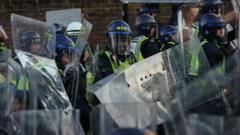
Look closely at the footage of these encounters. You see police departments deploying classic, mid-20th-century crowd control tactics. They line up shield-to-shield. They establish a perimeter around a specific property. They wait for the crowd to escalate before deploying less-lethal munitions.
This strategy is obsolete. It actively escalates the violence it is meant to deter.
Traditional Escalation Cycle:
Static Police Line -> Perceived Defensiveness -> Crowd Consolidation -> Projectile Launch -> Indiscriminate Retaliation
Forcing police officers to act as a stationary human wall in a highly emotional residential zone creates a symbolic challenge. To a crowd operating on high adrenaline, a static line of riot police looks like a protection racket for a criminal. It shifts the crowd’s focus from the original grievance (the killing of Henry Nowak) to an immediate adversary (the police officers standing right in front of them).
I have spent years analyzing municipal crisis responses and advising on public safety infrastructure. The departments that survive these flashpoints without burning down their own business districts are the ones that reject the static line.
- Mobility over Mass: Deploying rapid-extraction teams to remove agitators rather than holding a fixed perimeter.
- Targeted Dispersion: Utilizing intelligence to disrupt gathering points before they consolidate into a critical mass.
- Geographic De-escalation: Moving the defensive perimeter away from the emotionally charged focal point entirely, rendering the specific address useless as a stage for protest.
When you lock down a single block with a hundred officers in tactical gear, you aren't containing a riot. You are staging a arena.
Why Media Outlets Feed the Chaos
The business model of modern journalism requires high-stakes visual narratives. A peaceful vigil for a victim does not drive digital engagement. A burning police cruiser does.
By framing these clashes as a direct consequence of the killer's location, outlets create a recurring content loop. They signal to radical elements exactly where the flashpoint is occurring, effectively acting as a beacon for out-of-town agitators who have no connection to Henry Nowak or the local community.
Imagine a scenario where media coverage stripped away the live-streamed, play-by-play sensationalism and focused exclusively on the systemic failures of the local precinct's communication strategy. The crowd would lose its global audience. Without an audience, the performative element of street violence loses its utility.
The hard truth nobody wants to admit is that the media and the rioters exist in a parasitic relationship. The rioters provide the raw, cinematic content; the media provides the amplification that validates the rioters' existence.
The Cost of the Wrong Lens
When we misdiagnose the cause of street violence, the remedies we implement only guarantee future outbreaks. City councils respond to these events by purchasing more armored vehicles or issuing toothless press releases about community healing. Both approaches miss the mark.
The solution isn't more force, nor is it more dialogue. The solution is the ruthless, clinical dismantling of the flashpoint environment.
Stop treating residential neighborhoods as acceptable battlegrounds for abstract political grievances. Turn off the cameras. Shift the police tactics from defensive posturing to aggressive, mobile intervention. If you want to stop the clashes, you have to stop feeding the theater.