History loves a clean narrative. We prefer our ancestors neatly sorted into categories of devout Christians, stubborn pagans, or isolated practitioners of ancient folklore, completely divorced from one another.
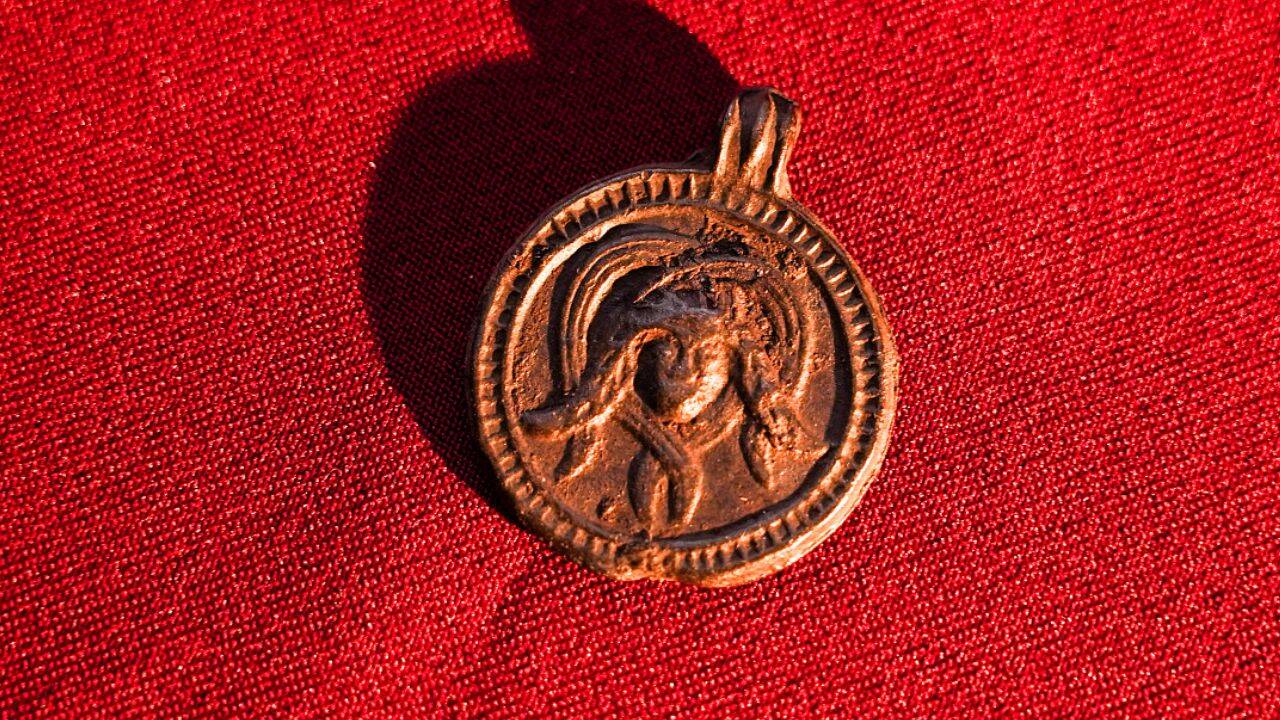
That comfortable illusion took another hit at an 11th-century excavation site in Staraya Russa, Russia. Archaeologists unearthing an ancient urban estate stumbled upon a small, copper-alloy pendant. On one side, it features a crisp relief of a Christian warrior saint holding a spear and shield, likely Saint Theodore Stratelates. Flip it over, and you find a female visage crowned with writhing snakes—an unmistakable invocation of the Greek Gorgon Medusa.
For traditionalists who view medieval religion through the lens of strict, unyielding dogma, objects like this are deeply uncomfortable. Yet for anyone who understands how ordinary humans actually navigate shifting cultural tides, this artifact is entirely predictable. It is a textbook example of a Zmeevik, or serpentine pendant, a class of medieval Russian talismans that deliberately welded incompatible spiritual frameworks into a single piece of wearable protection.
The Anatomy of a Contradiction
To understand why a medieval person would wear an object featuring both a defender of the Christian faith and a pagan symbol of dark or chthonic forces, we have to look past official church decrees.
Orthodox clergy in medieval Rus railed against pagan survivals, magical amulets, and dualistic folk practices with predictable frequency. Their sermons treat religious blending as a spiritual infection. But sermons tell us what authorities wished was happening, not what was happening in the mud and timber houses of towns like Staraya Russa.
The Staraya Russa pendant is crafted from a copper-based alloy, small enough to hang comfortably around a neck. It was not found in a grand cathedral or an elite princely hoard, but within an ordinary urban residential layer. This was everyday material culture. The owner was likely an average town resident navigating a world filled with very real fears: epidemic disease, infant mortality, crop failure, and sudden violence.
In that context, theological purity is a luxury. When a child falls sick or a neighbor's livestock drops dead, abstract doctrinal debates over Greek mythology versus Christian orthodoxy take a back seat to survival. People reach for every tool in the toolbox.
Byzantine Pipelines and Local Workshops
The presence of a Medusa-like motif in northwestern Russia is not an accidental slip of a craftsman's chisel. It points directly to deep, active cultural arteries connecting early Rus to the Byzantine Empire.
Byzantium had inherited a rich vocabulary of classical Greco-Roman symbolism. Figures like Medusa were often reinterpreted in Christianized contexts not merely as literal monsters from pagan myth, but as generalized manifestations of malevolent forces, disease, or spiritual darkness that could be warded off, bound, or conquered by higher powers. When these motifs migrated north along trade and religious networks, local artisans in Rus adapted them.
In fact, material analysis of the Staraya Russa find suggests local production. Researchers note that the pendant may have been cast using another similar object as a direct model, hinting at a local workshop operating right there in the household precinct. Artisans were not just passive recipients of imported Byzantine ideology; they were actively mass-producing syncretic protection tailored to local consumer demand.
Before this excavation, only four other serpentine pendants had ever been recovered in Staraya Russa, and those examples dated significantly later, spanning from the late 12th to the 14th centuries. Pushing this tradition back securely into the 11th century changes our timeline. It demonstrates that the integration of Christian iconography with older protective paradigms happened much earlier, and much more deeply, in the fabric of everyday urban life than older institutional histories suggested.
Why Syncretism Terrifies Dogma
Modern observers often suffer from a historical blind spot regarding syncretism. We expect people to undergo a clean conversion experience: flip a switch from pagan to Christian, throw away the old idols, and adopt a monolithic worldview.
Real human populations do not behave that way. When a new religion arrives—whether introduced by sword, trade, or political decree—it does not instantly erase the cognitive frameworks built over generations. Instead, the new framework is laid on top of the old foundation like a fresh coat of paint over weathered timber. Over time, the layers bleed through.
The warrior saint on the front of the amulet offered heavenly muscle, protection from external foes, and alignment with the rising political power of the Christian state. The serpent-haired visage on the back provided an ancient, primal defense against internal invisible threats, like illness and malevolent magic. Together, they covered all bases. To the medieval owner, there was likely no cognitive dissonance here. Both sides served a single practical purpose: keeping the dark out.
Archaeology continues to strip away the sanitized myths we tell about the past. Every birch-bark letter, every wild-boar tusk amulet, and every double-sided bronze pendant pulled from the damp earth of Staraya Russa reminds us that history was lived by pragmatic, anxious, and endlessly creative people who cared far more about results than theological consistency.
The Zmeevik remains a permanent physical record of a society refusing to choose between its new faith and its old fears.