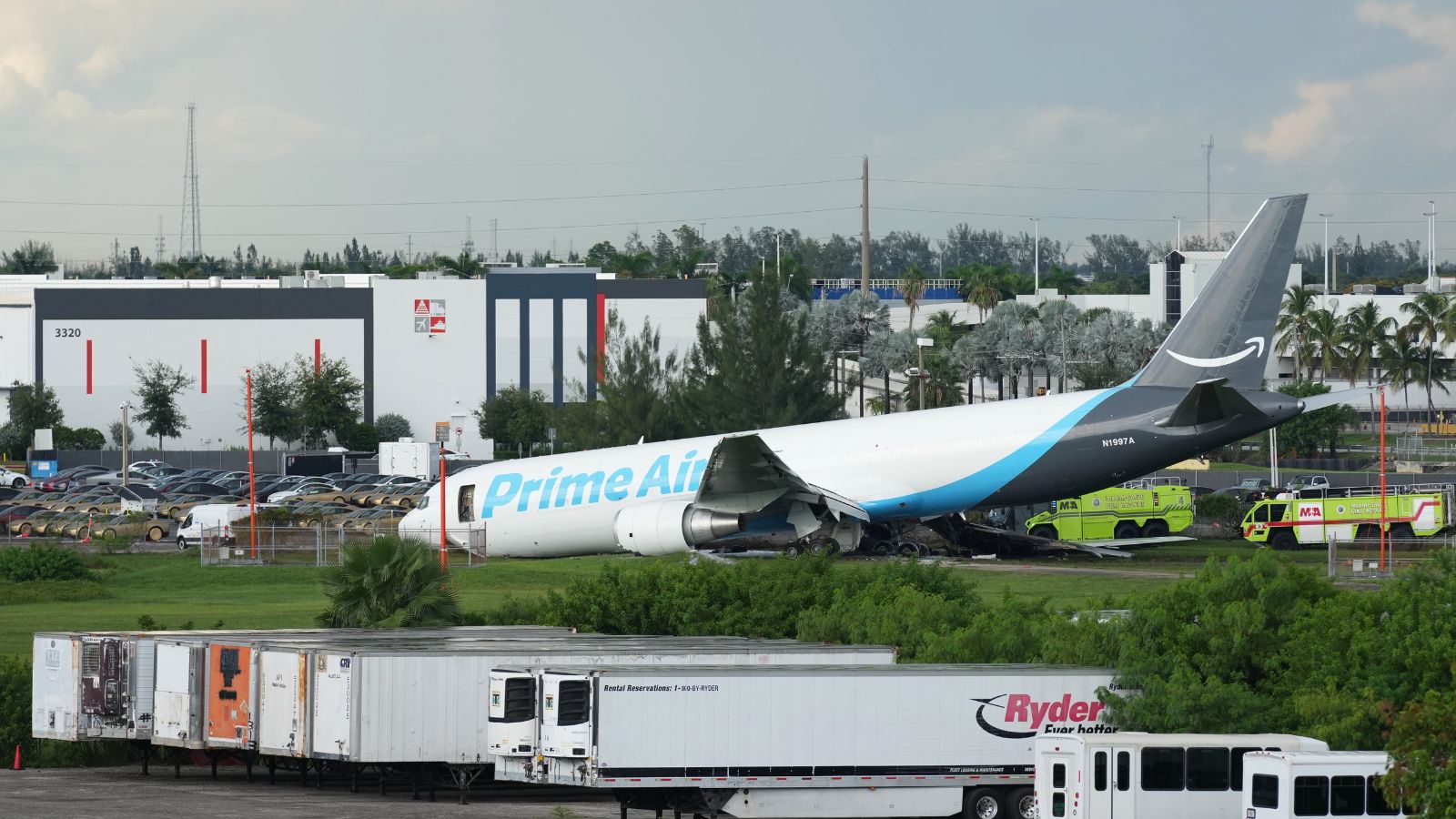
Planes are not supposed to leave the tarmac. When a massive wide-body freighter goes barrelling off a runway, hits civilian vehicles, and erupts into flames, something has gone catastrophically wrong.
At least five people died when an Amazon Prime Air cargo flight failed to stop at Miami International Airport, overrunning the runway and crashing into surrounding perimeter traffic. Flight 7598, a 32-year-old Boeing 767-300 operated by 21 Air, arrived from San Juan, Puerto Rico, before turning a routine landing into a disaster zone. Five others sustained injuries, with multiple victims trapped in crushed cars and the flight deck itself.
Let's look past the breaking news alerts and examine why this happened, what investigators face, and why heavy cargo operations deserve closer scrutiny.
The Anatomy of a Runway Overrun
Runway overruns are terrifyingly straightforward in physics. A heavy aircraft touches down too far down the strip, or it's traveling too fast, and the remaining pavement simply runs out.
Flight-tracking data indicates the aircraft was moving at roughly 112 knots as it breached the usable boundary of the tarmac. Witnesses and aviation analysts reviewing early video footage noted that the jet appeared to float for an extended period during its approach. Floating means eating up precious feet of usable runway before the wheels ever touch pavement.
When you combine a long touchdown with gusty winds and potential wet pavement from local thunderstorms—meteorologists recorded wind gusts up to 30 mph in the area around the time of the incident—the margin for error shrinks to zero. The plane plowed through the airport perimeter, crossing local roadway areas used by commercial transport trucks and warehouse personnel before coming to rest on its belly.
The Ageing Cargo Fleet Problem
We need to talk about the plane itself. This particular Boeing 767-300 was old. Built back in 1994, it spent more than two decades hauling passengers for commercial airlines before undergoing a freighter conversion in 2015.
Old planes aren't automatically unsafe. Commercial airframes are maintained through rigorous, multi-layered inspection schedules. However, the sheer volume of goods moving through online retail supply chains has placed unprecedented pressure on secondary cargo carriers. Companies like Amazon rely heavily on outsourced networks—in this case, North Carolina-based 21 Air—to keep packages moving overnight.
When corporate logistics demand 24/7 velocity, maintenance windows tighten, and older aircraft fly gruelling schedules. Investigators from the National Transportation Safety Board (NTSB) and the Federal Aviation Administration (FAA) are currently digging into maintenance logs, cockpit voice recorders, and flight data to determine whether mechanical failure, pilot fatigue, or environmental factors triggered the catastrophe. NTSB Chairwoman Jennifer Homendy deployed a specialized team immediately, signalling the gravity of the probe.
Ground Zero Risks Around Major Hubs
Most passengers worry about what happens at 30,000 feet. They rarely think about the perimeter roads hugging airport boundaries.
Miami International Airport is tightly hemmed in by urban infrastructure, warehouses, and busy freight corridors. When a heavy freighter overruns a runway, it doesn't just slide into a grassy field. It crosses active traffic lanes. The fact that civilian vehicles were struck highlights a long-standing vulnerability in civil aviation design: the hazardous proximity of public roads and industrial service centers to runway ends.
Emergency responders faced a nightmare scenario. More than 60 units and roughly 200 personnel rushed to the scene, battling heavy flames, thick plumes of black smoke, and an active, dangerous fuel leak that persisted for hours. Technical rescue squads had to physically cut victims out of flattened automobiles and extract the flight crew trapped in the crushed cockpit.
What Happens Next for Air Cargo
The immediate fallout brought a major transport hub to a standstill. The FAA issued an immediate ground stop, shutting down operations and forcing hundreds of flight cancellations and diversions to alternate airports like Orlando.
As the airport slowly reopens its remaining runways, the broader aviation industry has to answer tough questions. We are seeing a recurring pattern of runway incursions and ground mishaps across American transport hubs. Regulators cannot treat incidents like this as isolated tragedies.
If you are tracking supply chain reliability or flying out of busy cargo-heavy airports this season, expect tighter scrutiny, delayed schedules, and mounting pressure on logistics providers to prove their subcontractors meet the highest safety thresholds. Watch the NTSB docket over the coming weeks. The findings will likely force a hard look at how cargo carriers operate ageing wide-body jets near densely populated metropolitan zones.


