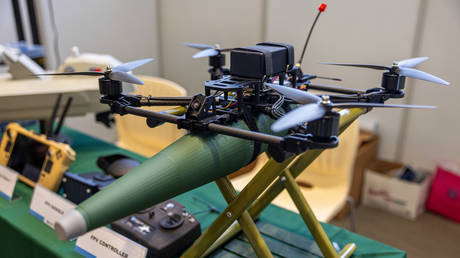
Deterring a cross-strait amphibious invasion requires shifting the adversary's cost-benefit calculus from a calculation of high-probability victory to one of unmanageable operational friction. While diplomatic rhetoric frequently employs metaphors like a "hornet's nest" of autonomous systems, the strategic reality hinges on a cold mathematical equation: the ratio of defensive attrition capacity to offensive mass. For Taiwan, achieving effective asymmetric deterrence requires deploying multi-domain unmanned systems—spanning aerial, surface, and subsurface environments—to disrupt the logistical and kinetic phases of a People's Liberation Army (PLA) invasion fleet.
This strategy operates on the principle of distributed mass. Rather than relying solely on concentrated, high-value conventional assets like fighter squadrons or capital warships, which are vulnerable to preemptive missile strikes, an asymmetric framework deploys thousands of low-cost, decentralized nodes. To understand how this architecture alters the dynamics of cross-strait defense, the operational mechanics must be broken down into three core pillars: sensing density, targeting cost-asymmetry, and multi-domain denial.
The Three Pillars of Unmanned Deterrence
The strategic utility of an unmanned architecture is not derived from weapon sophistication, but from the deployment of distributed operational capabilities across distinct tactical phases.
1. Sensing Density and Early Warning
The primary challenge in cross-strait defense is maintaining situational awareness under heavy electronic warfare and kinetic bombardment. High-altitude, long-endurance platforms are easily targeted. A resilient architecture relies on a dense network of micro-surveillance drones operating via mesh networks.
- By deploying hundreds of small, sensor-equipped aerial units, the defense creates an observation layer that cannot be disabled by a single strike.
- The continuous data streams from these platforms feed localized command nodes, ensuring that tracking of adversary troop movements, landing craft, and missile batteries persists even if centralized communications are severed.
2. Targeting Cost-Asymmetry
An effective defense forces the attacker to expend expensive, limited munitions on cheap, mass-produced targets.
- If a PLA air-defense battery fires a surface-to-air missile costing several hundred thousand dollars to down an aerial drone worth a fraction of that amount, the attacker suffers a negative economic return on military capital.
- When the defense possesses superior numbers of expendable systems, it forces the attacker into a resource depletion loop, draining precision-guided munitions stockpiles before primary objectives are achieved.
3. Multi-Domain Denial Mechanics
True deterrence requires interdiction across all three operational vectors: air, surface, and subsurface.
[Air Domain: Micro-UAV Swarms] --------> Disrupts Airborne Assaults & Deploys Decoys
[Surface Domain: Unmanned Vessels] ----> Targets Amphibious Transport & Transports Hull Charges
[Subsurface Domain: Autonomous UUVs] -> Plants Smart Mines & Strikes Hull Underbellies
In the air domain, low-altitude swarms disrupt airborne assaults, blind optical tracking systems, and act as kinetic decoys. On the water's surface, small unmanned surface vessels (USVs) configured with high-explosive payloads operate as low-profile, high-speed anti-ship assets targeting amphibious transport docks. Subsurface autonomous underwater vehicles (UUVs) monitor acoustic chokepoints, deploy smart naval mines, and deliver payload strikes against transport hulls below the waterline, where vessels are most vulnerable.
The Cross-Strait Cost Function
The viability of this multi-domain architecture is defined by the cost function of mass production versus defensive utility. The Taiwanese government has proposed a NT$210 billion ($6.59 billion) defense package dedicated to surveillance, coastal attack, and small unmanned surface systems extending through 2031. To evaluate the strategic impact of this capital allocation, the investment must be weighed against the operational requirements of cross-strait denial.
Total Defensive Capacity = (Unit Production Cost * Manufacturing Velocity) * Attrition Resilience
A primary variable in this cost function is manufacturing velocity. If production lines cannot generate units at a rate that replaces combat losses, the mass advantage evaporates. Furthermore, domestic political fragmentation introduces structural friction. The legislative division over defense allocations—evidenced by the opposition party's counterproposal to cap drone spending at NT$240 billion over six years via the regular budget rather than a special budget—creates institutional bottlenecks. This legislative dispute is not merely financial; it alters procurement velocity. Shifting funding from a dedicated special budget to the annual general budget exposes long-term technological development to yearly political adjustments, complicating multi-year component contracting.
Supply Chain Interdependencies and Structural Bottlenecks
A military strategy based on mass production is only as secure as its underlying industrial supply chain. The primary risk to an unmanned defense architecture is a reliance on components manufactured by the adversary. Global commercial drone supply chains remain heavily integrated with Chinese manufacturing networks, particularly concerning electric motors, speed controllers, optical sensors, and rare-earth magnets.
To build a secure supply chain, Taiwan and its international partners must establish localized production ecosystems free from adversary influence. This requires standardized component architectures, domestic semiconductor allocation for flight controllers, and alternative sourcing for lithium-ion battery cells.
However, building independent supply chains introduces major structural limitations:
- Higher Unit Costs: Transitioning away from high-volume commercial components increases the cost per unit, which directly reduces the total number of systems that can be purchased under a fixed budget.
- Extended Industrial Scaling Timelines: Establishing domestic manufacturing facilities for specialized precision components requires years of lead time, creating a vulnerability window before mass production capacity is achieved.
- Component Standardization Deficits: Without strict cross-industry standards, proprietary designs from different defense contractors prevent rapid field repairs and component swapping.
Operational Integration and Electronic Warfare Vulnerabilities
Deploying thousands of unmanned systems creates a complex command-and-control challenge. Without advanced operational integration, a mass of independent platforms becomes chaotic rather than coordinated. The systems must communicate through dense electronic warfare environments where satellite navigation signals are jammed and radio frequencies are blocked.
If these platforms rely on continuous human operator links, they are highly vulnerable to localized electronic jamming. The system architecture must emphasize terminal autonomy—the capability of an unmanned vehicle to navigate, identify, and strike pre-designated target classes using onboard edge-computing visual recognition when communications are completely lost. This requires significant software integration, machine-learning target libraries, and resilient inertial navigation sensors. Without these capabilities, an uncoordinated deployment risks rapid neutralization through systematic electronic warfare denial rather than kinetic interception.
The Strategic Resource Allocation Equilibrium
To maximize cross-strait deterrence, defense planners must balance funding between conventional heavy platforms and distributed asymmetric systems. Over-indexing on either architecture creates dangerous strategic vulnerabilities.
| Capability Matrix | Conventional Platforms (Jets, Tanks, Destroyers) | Asymmetric Unmanned Systems (UAVs, USVs, UUVs) |
|---|---|---|
| Primary Strength | High kinetic payload delivery, long-range power projection, gray-zone enforcement. | Extreme cost-efficiency, high attrition tolerance, rapid industrial scaling. |
| Core Vulnerability | High target profile, concentrated financial risk, vulnerable to preemptive strikes. | Range limitations, payload capacity restrictions, heavy reliance on spectrum availability. |
| Strategic Function | Prevents peacetime airspace incursions and maintains maritime sovereignty. | Inflicts unsustainable friction during high-intensity amphibious invasion phases. |
The optimal strategic play requires maintaining conventional forces to counter everyday gray-zone pressure and maritime incursions, while simultaneously building out the asymmetric unmanned reserve. This dual-track approach ensures that the state can manage low-intensity security challenges without sacrificing the mass-attrition capabilities required to defeat a full-scale invasion attempt.
Prioritizing legislative approval for long-term component procurement, standardizing communication protocols across air and maritime unmanned assets, and securing non-adversarial manufacturing supply chains form the operational foundation required to transform abstract deterrence concepts into a functional, resilient defense architecture.