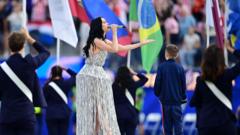
The opening ceremony of a major international sporting event operates as a high-stakes capital allocation exercise masked as cultural entertainment. While traditional media coverage framing focuses on celebrity rosters—such as the inclusion of Katy Perry, Future, and Tyla at the United States World Cup kickoff—this surface-level analysis ignores the underlying economic mechanics. Global sports governing bodies and host nation organizing committees do not book talent to entertain a stadium; they deploy cultural assets to solve specific structural bottlenecks in viewership, brand alignment, and demographic acquisition.
To understand the strategic utility of these performances, one must analyze the event through three core pillars: demographic bridging, global broadcast synchronization, and the monetization of multi-genre cultural capital.
The Demographic Bridging Framework
International sports tournaments face an inherent demographic optimization problem. The core audience for men's professional soccer is highly concentrated within specific age, geographic, and gender distributions. To maximize the valuation of broadcast rights, organizers must attract non-endemic viewers—individuals who do not regularly watch the sport but are drawn to cultural spectacles.
The selection of Katy Perry, Future, and Tyla represents a deliberate, calculated portfolio diversification strategy designed to capture three distinct consumer segments.
The Pop-Mainstream Mass Market
Katy Perry represents low-risk, high-recognition cultural equity with massive appeal across families and older millennial demographics globally. Her portfolio of multi-platinum singles functions as safe, globally recognized intellectual property. This minimizes churn among casual viewers who have tuned into the broadcast before the sporting match begins.
The Urban-Streaming Core
Future addresses a critical gap in younger, highly engaged male demographics (Gen Z and younger Millennials) who over-index on streaming platforms and hip-hop culture. This demographic possesses high lifetime value for sponsors but low affinity for traditional linear television broadcasts.
The Global-Emerging Demographic
Tyla, an artist leveraging the rapid international rise of Amapiano and African electronic music, serves as a geographic and cultural bridge. Her inclusion directly targets a growing African consumer market and global youth subcultures that value sonic novelty and globalized identity.
[Consumer Segment] --------> [Artist Choice] --------> [Strategic Value]
Pop-Mainstream              Katy Perry                Broad Reach & Low Churn
Urban-Streaming             Future                    Youth Engagement & Streaming
Global-Emerging             Tyla                      Geographic & Cultural Expansion
By layering these three distinct profiles into a single broadcast window, the organizing committee creates a synthetic audience profile that traditional sports programming cannot capture on its own. The cause-and-effect relationship is clear: the broader the demographic net cast in the first 30 minutes of the broadcast, the higher the baseline viewership retention for the subsequent sporting event.
The Broadcast Synchronization and Advertising Cost Function
The opening ceremony is a critical mechanism for solving the synchronized attention problem in modern media. In a fragmented digital landscape, capturing hundreds of millions of concurrent live viewers is exceptionally rare. Broadcast networks price their commercial inventory based on predicted peak concurrent viewership. The opening ceremony acts as a deliberate demand-generation tool to accelerate the accumulation of these concurrent eyeballs before the first whistle blows.
The financial performance of the broadcast relies on a specific sequence of audience accumulation.
The pre-match window typically suffers from slow audience buildup. Viewers tune in sporadically over the 60 minutes leading up to a game. By embedding a high-production musical performance directly before kickoff, broadcasters create an artificial viewership spike.
This spike alters the advertising cost function. Instead of selling ad space during the pre-game show at a discount, networks can price inventory during and immediately following the opening ceremony at a premium that rivals the match itself. The economic value of the musical performance is directly tied to its ability to compress the audience accumulation timeline into a sharp, predictable vertical curve.
The structural limitation of this strategy lies in retention decay. While a musical performance can spike viewership numbers, the conversion rate—the percentage of music fans who remain tuned in to watch 90 minutes of sports—is highly volatile. If the transition between the musical spectacle and the sporting event is jarring, the broadcaster experiences a immediate drop-off in active screens, degrading the value of mid-game advertising slots.
Cultural Capital Arbitrage and Host Nation Soft Power
For the host nation, the United States, hosting a global tournament is an exercise in soft power optimization and commercial market expansion. While the US possesses the largest domestic sports market by revenue, association football has historically competed against deeply entrenched domestic leagues (NFL, NBA, MLB). The opening ceremony serves as a platform to domesticate a global sport by filtering it through recognizable American entertainment frameworks.
The choice of venue and production style reflects a specific institutional logic. By staging the event with high-gloss production values native to the Super Bowl Halftime Show, the organizers signal structural familiarity to the American consumer. This strategy lowers the barrier to entry for domestic viewers who may view soccer as an exogenous cultural product.
Simultaneously, the event exploits cultural capital arbitrage. The global governing body leverages American pop culture dominance to elevate the international prestige of its tournament, while the host nation leverages the tournament's global footprint to export a curated image of domestic cultural diversity and economic strength. This mutual exploitation of assets creates value that extends far beyond ticket sales and immediate merchandising revenue. It establishes long-term brand equity that influences future sponsorship valuations, host city tourism pipelines, and youth participation rates in the sport.
Operational Execution Vulnerabilities
The execution of a multi-genre, high-velocity opening ceremony introduces severe operational risks that can compromise its strategic utility. The most significant bottleneck is logistical synchronization.
- The Turf Degradation Problem: Transforming a professional sports field into a concert stage and back into a pristine playing surface within a 45-minute window requires flawless mechanical execution. Any delay or structural damage to the pitch directly impacts the sporting product, creating immediate friction with teams, coaches, and fans.
- The Acoustic Compression Deficit: Stadiums engineered for sports acoustics are notoriously poor environments for complex live musical mixing. If the audio quality fails to translate through the broadcast feed, the consumer experience degrades immediately, leading to negative engagement on social media platforms and driving immediate audience churn.
- The Narrative Fragmentation Risk: Forcing disparate musical styles (Pop, Trap, Amapiano) into a condensed timeline can result in a disjointed aesthetic experience. Without a unifying narrative or thematic continuity, the performance risks feeling like an algorithmic playlist rather than a premium global event, diluting its branding power.
Strategic Asset Reconfiguration
To maximize the return on cultural expenditures in future global sports properties, organizing committees must shift away from treating opening ceremonies as isolated entertainment blocks. The current model relies too heavily on hope-based retention—hoping that a fan of an artist will naturally transition into a fan of the sport.
The optimal play requires an integrated digital ecosystem approach.
[Broadcast Performance]
       │
       ▼
[Interactive Digital Touchpoints] (Real-time micro-engagements)
       │
       ▼
[Direct Conversion Pipeline] (Immediate merchandise & streaming capture)
Broadcasters must embed interactive, instantaneous conversion mechanics directly into the performance window. This involves utilizing real-time micro-engagements, where viewers can access exclusive digital content, artist-curated playlists, and limited-edition tournament merchandise directly through their viewing screens or mobile integrations during the live performance.
By capturing consumer identity and data at the peak of the cultural spectacle, organizers create a direct conversion pipeline. This asset reconfiguration transforms the opening ceremony from a high-cost viewership spike into a structured, data-rich customer acquisition engine that fuels the entire economic lifecycle of the tournament.