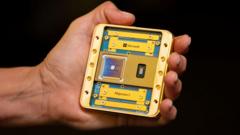
Quantum computing has a noise problem. It's an agonizing, fundamental mess that has stalled the industry for years. You can build a chip with hundreds of qubits, but if they collapse into useless static after a fraction of a millisecond, you don't have a supercomputer. You have an expensive heater.
Microsoft thinks it just solved this. At its Build 2026 conference, the company announced its new Majorana 2 quantum chip, boasting qubits that are 1,000 times more reliable than its previous hardware.
Instead of measuring qubit lifetimes in microseconds like IBM or Google, Microsoft claims a mean lifetime of 20 seconds, with some lasting up to a minute. That isn't a small iteration. It's a massive structural shift that has allowed Microsoft to aggressively slash its timeline for a commercial, utility-scale quantum computer from 2033 right down to 2029.
Let's look past the corporate hype and break down what actually happened here, why the materials science matters, and how autonomous software built this hardware.
The Chemistry Bet That Paid Off
To understand why this chip is different, you have to look at what it's made of. Most superconducting quantum efforts rely heavily on aluminum. For Majorana 2, Microsoft threw out the old playbook.
They replaced aluminum with lead as the primary superconductor.
Lead is a larger-gap superconductor. In plain English, it acts as a natural shield against the external cosmic noise and thermal fluctuations that instantly destroy quantum states. They also overhauled the semiconductor active region, swapping things out for a specific combination of indium arsenide and indium arsenide antimonide to get massive spin-orbit coupling.
The result is a major increase in the topological gap—more than doubling the previous generation's metrics. This provides hardware-level protection.
The old hardware kept its quantum state for a few milliseconds at best. Jumping to a 20-second average means the information stays stable long enough to actually do something complex with it. Microsoft loves using the analogy that it's like replacing a phone battery that dies in a single day with one that lasts three years. It sounds ridiculous, but the math behind the stability jump checks out.
AI Agents as Hardware Engineers
We're all tired of hearing about AI agents writing emails or summarizing meetings. But Microsoft didn't build this chip using human hands alone. They used a specialized, autonomous system called Microsoft Discovery.
Materials science is usually a slow, brutal process of trial and error. Humans guess a composition, bake it in a cleanroom, test it, fail, and start over.
Microsoft let loose autonomous AI agent teams to run massive simulations, parsing through nearly twenty years of disparate experimental data to spot microscopic correlations no human engineer could see. The agents didn't just model the lead stack; they ran the physical fabrication and automated the testing loops. Processes that used to take weeks of manual calibration were compressed into hours.
In one instance, an AI agent flagged an uncalibrated temperature sensor in the fabrication lab that was bleeding subtle noise into the chip stack. Human teams had completely missed it. This is where the real speedup comes from. The engineering cycle itself has been automated.
Rejecting the Modular Status Quo
There's a quiet battle happening over quantum architecture. IBM and several prominent startups are pursuing a modular approach. Because qubits are so volatile, the common wisdom says you need to link multiple smaller chips across a network of separate dilution refrigerators.
Microsoft is explicitly rejecting that path.
Chetan Nayak, Microsoft's VP of quantum hardware, made it clear that they aren't building multi-chip modules or stringing fridges together. Because topological qubits are incredibly tiny—about 1/100th of a millimeter—Microsoft's entire roadmap hinges on cramming over one million qubits onto a single, monolithic chip.
If you can fit the entire machine on one piece of silicon, you eliminate the massive latency and error rates that come from trying to send quantum information between different physical chips. It's a high-stakes gamble. If they can't get the yield right on a single massive chip, the whole strategy collapses. But if they're right, they bypass the plumbing issues that will plague modular systems.
Physical Qubits vs. Reality
Don't buy into the raw numbers blindly. When a company says they have a 1,000-times improvement, you need to ask what exactly improved.
Majorana 2 improves the reliability of physical qubits. But physical qubits aren't what run actual enterprise algorithms. For real work, you need logical qubits—virtual blocks created by bundling lots of physical qubits together to self-correct errors.
On typical noisy hardware, the overhead is embarrassing. You might need 1,000 messy physical qubits just to get one reliable logical qubit. It's a terrible ratio.
The value of Microsoft's material breakthrough isn't just that the physical qubits live longer. It means the overhead for error correction drops off a cliff. If your physical hardware is naturally shielded and stable, you need far fewer qubits acting as safety nets. Microsoft has already shown they can compress this footprint down significantly in separate virtual tests, and applying that to the Majorana 2 architecture could make a 1,000-logical-qubit machine viable far sooner than anyone predicted.
What Happens Now
The announcement is impressive, but quantum history is littered with brilliant lab results that died during manufacturing scaling. The immediate test for Microsoft isn't another press release; it's the peer-reviewed paper accompanying this reveal. The broader scientific community is going to pick apart the lead-based material stack and verify if that 20-second lifetime holds up under intense, continuous computational loads rather than just idle state storage.
If you're tracking the quantum space for your own enterprise roadmap, stop counting raw qubit numbers on competitor press releases. Focus heavily on two metrics: mean physical lifetime and logical error rates. Watch how quickly Microsoft integrates Majorana 2 into its Azure Quantum cloud ecosystem. That will be the definitive signal of whether this is a practical computing tool or just a world-class physics experiment.


