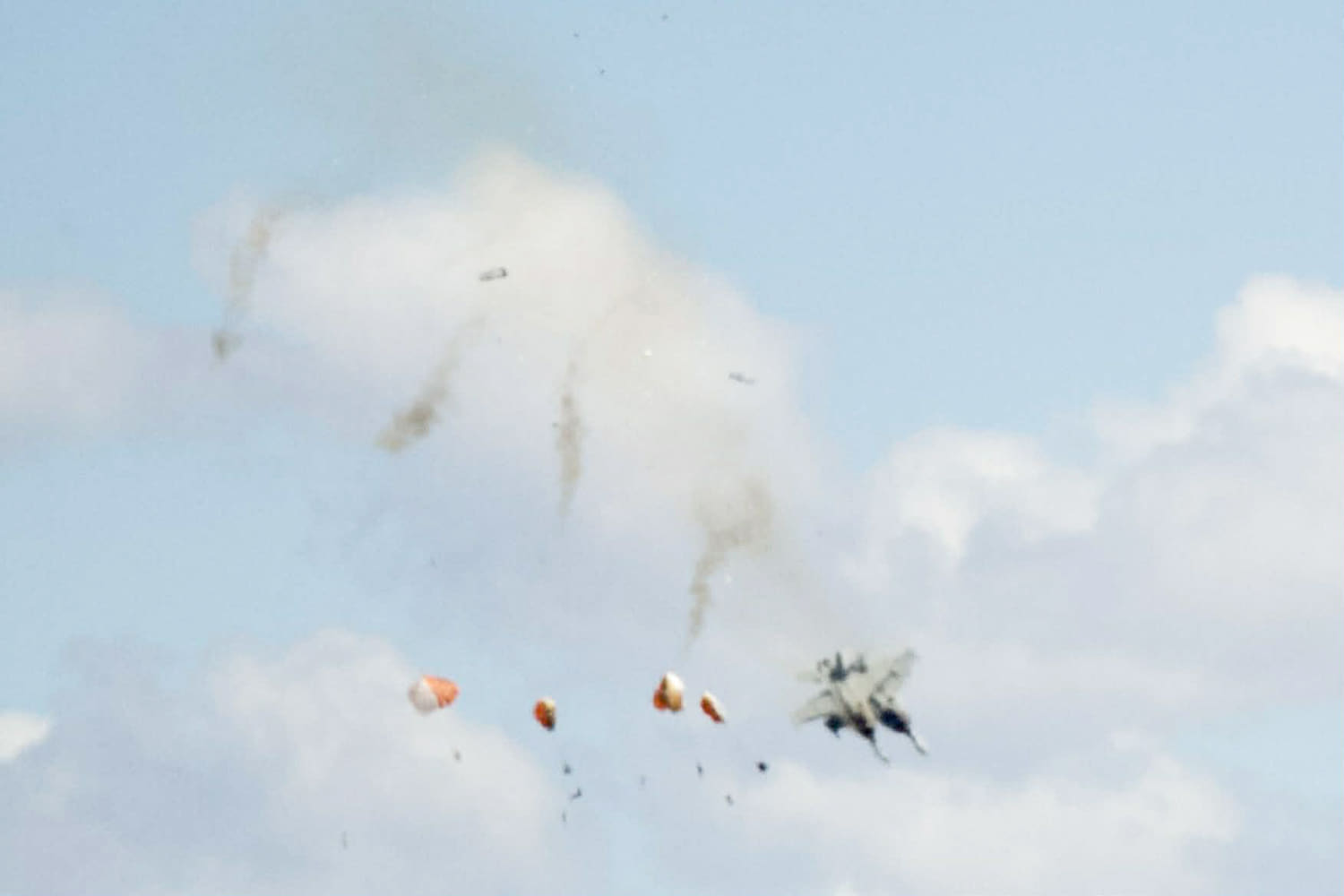
The immediate reaction to a midair collision at an airshow follows a scripted, predictable choreography. Mainstream media outlets rush to print breathless headlines about fiery near-misses. Pundits demand immediate safety reviews. The public questions whether flying multimillion-dollar fighter jets in close proximity for entertainment is worth the inherent danger.
This entire reaction is fundamentally flawed.
When two jets clip wings and four aviators are forced to pull their ejection handles, the public sees a catastrophic failure. Aviators and systems engineers see something entirely different. They see a system working exactly as it was designed to work. The narrative surrounding military aviation mishaps is broken because it views peace-time demonstration flying through the lens of commercial aviation.
Commercial aviation aims for zero risk. Military aviation manages calculated risk to maintain operational readiness. Airshows are not just public relations stunts; they are highly complex, live-fire environments where pilots push human and machine capabilities to the absolute limit. If you eliminate the risk, you eliminate the training value.
The Myth of the Zero-Risk Exhibition
Every time a military aircraft crashes during a public demonstration, critics call for the cancellation of these events. They argue that risking elite pilots and expensive hardware for a crowd pleaser is irresponsible.
This argument misses the point of military aviation.
"We do not train to be safe. We train to be lethal. Safety is a byproduct of discipline, not the primary objective."
I have spent years analyzing military mishap reports and working alongside defense aviation experts. The consensus among those who actually sit in the cockpit is clear: the maneuvers executed at airshows are the exact same high-g, low-altitude, high-aspect visual engagements required in modern air combat. A visual merge at 400 knots requires split-second spatial awareness.
To suggest that pilots should only practice these maneuvers over empty desert ranges is a misunderstanding of human psychology. The added pressure of a live audience, strict time constraints, and fixed geographic boundaries simulates the cognitive load of a high-stress operational environment.
When an accident happens, the media treats it as proof that the event shouldn't have occurred. In reality, the fact that all four aviators successfully ejected and survived is a testament to the rigorous engineering and procedural redundancies built into modern military aviation. The system tolerated a worst-case scenario and preserved the most valuable asset: the human life.
Dismantling the Airshow Safety Questions
People frequently ask the wrong questions following a high-profile aviation mishap. Let's dismantle the most common inquiries with brutal reality.
Why do military pilots still fly in such tight formations?
Because modern warfare demands it. Tight formation flying is not a gimmick. It is the fundamental method used to mask radar signatures, execute coordinated radar searches, and pass through contested airspace as a single, cohesive tactical unit. If a pilot cannot maintain a three-foot wingtip clearance at an airshow, they cannot execute a night-refueling mission in a combat zone during a storm. The precision displayed for crowds is the baseline standard for survival in theater.
Can automated collision-avoidance systems prevent these accidents?
The short answer is no. Ground Collision Avoidance Systems (GCAS) have saved countless lives by pulling jets out of dives when pilots suffer G-induced loss of consciousness (G-LOC). However, Air Combat Maneuvering (ACM) relies on intentional, rapid closure rates that would trigger automated systems to constantly override the pilot. If the computer takes control every time an aircraft enters the weapon engagement zone of another, the aircraft becomes useless in combat. The pilot must remain the final authority.
The Engineering Triumph Inside the Catastrophe
Let's look at the mechanics of an ejection. The mainstream media focuses on the collision; tech insiders focus on the escape system.
When two high-performance jets collide, the structural integrity of the aircraft is compromised in milliseconds. The human body cannot react fast enough to manually open a canopy and climb out. The modern zero-zero ejection seat—meaning it can safely deploy at zero altitude and zero airspeed—is an engineering marvel that operates on a deterministic timeline.
- The Pull: The pilot pulls the ejection handle between their legs.
- Canopy Clearance: Explosive cords shatter the canopy glass, or miniature rockets blow the entire canopy structure away from the airframe.
- Catapult Phase: A telescopic gun fires, launching the seat up a rail, subjecting the pilot to up to 20G of acceleration to clear the twin tails of the aircraft.
- Rocket Sustainer: A solid-propellant rocket motor ignites beneath the seat to gain altitude and clear the fireball.
- Stabilization and Deceleration: A drogue parachute deploys to stabilize the seat and slow it down, preventing the main parachute from shredding upon deployment.
- Separation: The seat drops away, and the main canopy opens automatically based on altitude and speed sensors.
All of this occurs in less than two seconds.
[Mishap Occurs] -> [Handle Pulled] -> [Canopy Blown (0.10s)] -> [Seat Launches (0.25s)] -> [Rocket Burn (0.45s)] -> [Drogue Deploys (0.85s)] -> [Pilot Separates (1.20s)] -> [Main Canopy Opens (1.50s)]
When four pilots eject from a midair collision and walk away with minor injuries, the narrative shouldn't be about failure. It should be a celebration of the life-support engineers who designed a survival envelope capable of defying physics.
The Cost of Risk Aversion
The real danger to military readiness isn't the occasional airshow mishap. It is the creeping culture of risk aversion that follows these events.
When bureaucracies respond to accidents by grounding fleets, increasing minimum altitudes, and widening separation distances, they degrade the combat capability of the entire force. A pilot who has only flown conservative, sanitized maneuvers in a sterile environment will freeze when a real adversary forces them into a high-aspect, high-G turning fight.
There is a downside to this contrarian view, and we must acknowledge it. The material cost is astronomical. Two destroyed fighters represent tens of millions of taxpayer dollars vaporized in seconds. The risk to ground spectators, though heavily mitigated by Federal Aviation Administration (FAA) regulations governing show lines, is never exactly zero.
But freedom and air dominance are not cheap commodities. They are paid for in relentless, high-stakes training.
Stop viewing military aviation through the sterile lens of commercial transport. Airshows are a public demonstration of tactical proficiency, not an amusement park ride. The day we guarantee zero accidents at airshows is the day our pilots stop training for the realities of war.