In a small, windowless briefing room in Manila, a career diplomat adjusts his tie. He is looking at a map, but he isn't looking at the giant landmasses of the United States or China. His eyes are fixed on the blue space between them. For decades, the script was simple: you picked a side, or you waited for the giants to decide your fate. But the air in Southeast Asia has grown heavy with a new kind of realization. The giants are loud, they are unpredictable, and they are increasingly distracted by their own internal fires.
Dependence feels like a safety net until you realize the person holding the ropes is looking the other way.
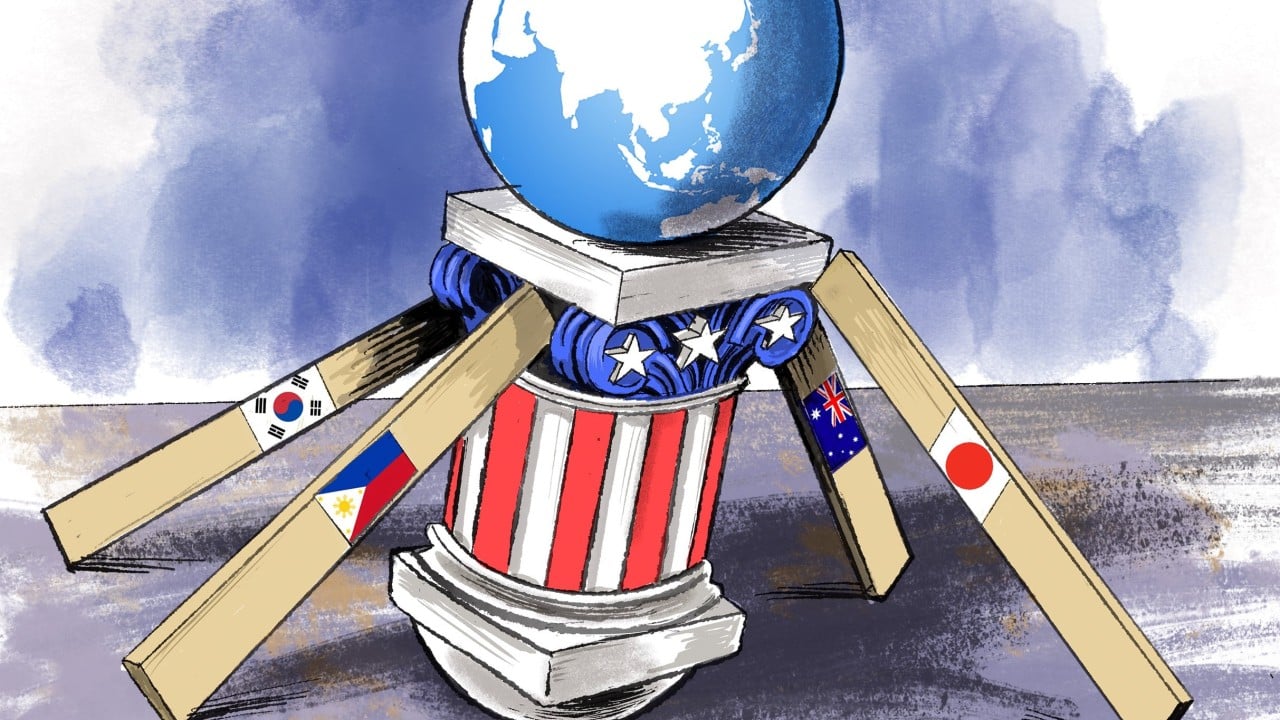
This isn't just about navy ships or trade tariffs. It is about the visceral, late-night anxiety of leaders in Seoul, Canberra, Tokyo, and Hanoi who have realized that being a "junior partner" is a dangerous occupation in 2026. They are the middle children of the Pacific. They are tired of the binary choice. So, they have started doing something quietly radical: they are talking to each other.
The Breakdown of the Old Guard
For half a century, the "hub and spoke" system defined Asian security. Washington sat at the center of the wheel, and every other nation was a spoke connected only to the middle. It worked. It provided a predictable rhythm to life and commerce. But wheels break when the hub wobbles. When the United States pivoted, then hesitated, then pivoted again, the spokes began to feel the vibration.
Consider a hypothetical logistics manager in Ho Chi Minh City named Minh. For years, Minh’s business relied on a stable flow of American tech and Chinese raw materials. He didn't need to care about geopolitical theory. Now, he watches news of "decoupling" and "chip wars" with the same dread a sailor watches a darkening horizon. If the two biggest economies in the world stop speaking, Minh’s warehouse goes silent.
Minh is the human face of a statistical reality. The nations caught in the middle are no longer content to be the grass that gets trampled when the elephants fight. They are building their own gardens.
The Rise of the Mini-Laterals
The shift is subtle, often hidden behind the dry language of "defense cooperation agreements" and "technology sharing initiatives." But look closer at the movement between Japan and Australia. Look at the way the Philippines is suddenly finding common ground with Vietnam, two nations that have historically been wary of one another.
These aren't grand, sweeping alliances like NATO. They are smaller, sharper, and more functional. Think of them as "mini-laterals."
By linking up in groups of three or four, these countries are creating a web that doesn't rely on a single central point of failure. If one giant retreats into isolationism or the other becomes too aggressive, the web holds. It is a survival strategy born of necessity. Australia provides the raw materials and the strategic depth; Japan provides the high-end technology and the capital; India provides the sheer scale and the human power. Together, they form a bloc that is too large to ignore and too integrated to easily bully.
The Invisible Stakes of the Silicon Shield
The most intense part of this struggle isn't happening on the water, but inside a vacuum-sealed clean room in Taiwan or South Korea. Technology has become the new geography. In the past, you fought over mountain passes and deep-water ports. Today, the high ground is the three-nanometer chip.
When the U.S. restricts exports to China, the ripple effect hits a factory in Malaysia or a design firm in Singapore within hours. These middle powers are realizing that if they don't control their own technological destiny, they have no sovereignty at all. This is why we see Japan and South Korea—nations with a deeply painful and complicated history—attempting to patch over old wounds. They aren't doing it because they’ve suddenly forgotten the past. They are doing it because the future is terrifying if they face it alone.
Fear is a powerful lubricant for diplomacy.
The stakes are invisible until your phone stops updating, your car's navigation glitches, or the power grid in your city becomes a pawn in a distant cyber-war. The middle powers are building a "Silicon Shield" by diversifying where things are made and who owns the patents. They are trying to ensure that no single phone call from a capital thousands of miles away can shut down their modern world.
The Cost of Stepping Out
Building a coalition of the middle isn't free. It requires these nations to spend more on their own militaries, to take risks with their economies, and to stand up to pressure from both sides. When Australia asked for an investigation into the origins of a global pandemic, it faced a massive trade blockade from China. It was a brutal lesson in the cost of autonomy.
But a strange thing happened. Australia didn't collapse. It found other markets. It leaned on its neighbors. It proved that the middle powers are more resilient than the giants assumed.
This resilience is infectious.
In Jakarta and Bangkok, officials are watching. They see that the old "Choose A or B" game is a trap. The new game is "C"—the coalition. It is the realization that while you might not be a superpower, you are also not a pawn.
The Human Element in the War Room
We often talk about these shifts as if they are movements of tectonic plates—cold, inevitable, and unfeeling. But they are driven by people. They are driven by a generation of leaders in Asia who grew up during the miracle years of growth and have no interest in seeing that progress burned away in a conflict they didn't start.
There is a profound sense of exhaustion.
The rhetoric coming from the superpowers feels like a relic of a century they’ve moved past. In the tech hubs of Bangalore or the shipyards of Busan, the focus is on the next twenty years of development, not the next twenty minutes of a cable news cycle. The move toward middle-power coalitions is, at its heart, an act of collective maturity. It is the kids in the back of the classroom realizing they can learn more by helping each other than by waiting for the teacher to notice them.
The Geometry of a New Era
What does this look like in practice? It looks like a Japanese destroyer docking in a Philippine port for joint exercises. It looks like a South Korean aerospace firm selling fighter jets to Poland and Malaysia. It looks like an "India-Middle East-Europe" economic corridor that bypasses the traditional routes dominated by the giants.
It is a messy, complicated geometry. It lacks the clean lines of the Cold War. There will be disagreements, old rivalries will flare up, and the giants will certainly try to pull the spokes back toward the hub.
But the momentum has shifted.
The middle powers have tasted a version of the world where they are the protagonists. They have looked into the abyss of total dependence and decided they didn't like the view. They are no longer waiting for a protector who might not show up or a partner who might demand too much in return.
The diplomat in Manila turns off the light in the briefing room. He isn't waiting for a call from Washington or Beijing. He is checking his calendar for a meeting with his counterpart in Canberra. The room is quiet, but the map on the wall seems different now. The blue space is no longer just a gap between powers. It is a bridge they are building themselves, one steel beam and one trade deal at a time. The era of the lonely spoke is over. The web is beginning to glow.