The silence inside a county election warehouse at 2:00 AM is heavier than it has any right to be. It smells of dust, cardboard, and the faint, sweet scent of industrial adhesive from millions of envelope flaps. Under the harsh glare of fluorescent tubes, heavy-duty sorting machines sit motionless, their metal rollers cooling after a grueling eighteen-hour shift.
But the room is not empty. Stacked on steel pallets, organized in neat, gray plastic bins, are the uncounted paper ballots of California.
Each one is a fragment of a human life. One belongs to a nurse in Fresno who filled it out on her kitchen table after a twelve-hour shift, weighing which candidate might actually fix the crumbling healthcare safety net. Another belongs to a mechanic in Redding, angry about skyrocketing gas prices and an insurance premium that doubled overnight, who stamped his choice with a definitive, frustrated press of a blue pen.
Outside these walls, the world is screaming for answers. Television anchors stare into cameras, gesturing at colorful digital maps that refuse to update. Political consultants pace hotel suites in Sacramento, their phones buzzing with text messages they cannot answer. The race to become the next governor of the world’s fifth-largest economy is completely deadlocked.
Yet inside the warehouse, time slows down. The democratic process does not care about the twenty-four-hour news cycle. It moves at the speed of paper.
The Ghost in the Machine
To understand why California takes weeks to decide what other states wrap up before the midnight news, you have to look at the sheer scale of the mechanics involved. This is not a failure of the system. It is the system working exactly as it was designed.
Consider how a single vote travels. When a resident drops an envelope into a curbside mailbox or a secure ballot drop box on election day, that piece of paper begins a journey of meticulous verification. Every single signature on every single envelope must be matched by a human eye against the signature on file from the day that citizen registered to vote, sometimes decades ago.
If a signature does not match—perhaps because an elderly voter’s hand now shakes, or a young person signed in a rush—the ballot is not thrown away. Instead, a county worker must pause, log the discrepancy, and reach out to the voter to "cure" the signature. This is a labor of intense patience. It is an intentional drag on speed, implemented to ensure that no legitimate voice is silenced.
Then there is the law of the postmark. In California, if a ballot is stamped by the post office on election day, it remains legally valid even if it takes a full week to arrive at the registrar’s office.
This means that long after the polling booths have been packed into the backs of trucks, the mail trucks are still arriving. Thousands of voices are literally still in transit, moving through sorting facilities, riding in the back of delivery vans, completely invisible to the statisticians trying to predict the future on television.
The Survival of the Underdog
Because of this slow-motion reveal, the public leaderboard currently offers nothing more than a blurred snapshot of a race that is still very much alive.
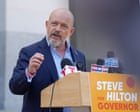
Right now, Steve Hilton holds a narrow, fragile lead. The British-born conservative pundit and former television host found his footing by speaking directly to the deep undercurrent of economic exhaustion that runs through the state. For a Republican running in a deeply blue territory, a first-place finish in the primary is a powerful symbolic victory, one that quickly drew a celebratory public nod from Donald Trump. Hilton’s supporters see the early numbers as proof that the state is desperate for a hard, structural reset after more than fifteen years of unified Democratic control.
But that lead exists in a vacuum. Trailing just behind him is Xavier Becerra, the former federal health secretary and state attorney general.
Becerra’s presence at the top of the ticket is a testament to the unpredictable nature of political gravity. Just three months ago, his campaign was sputtering so badly that he failed to qualify for a major televised debate. He was outspent by massive margins. His opponents possessed vast financial war chests and early name recognition, while he was largely written off by the political establishment.
Yet, as the field narrowed and the reality of the state's deep structural problems—wildfire risks driving insurers out of the state, an unstable budget, and a crushing cost of living—settled into the minds of voters, the mild-mannered institutionalist began to climb. At his watch party in Los Angeles, surrounded by supporters who refused to pack up early, Becerra smiled and called it a classic underdog story. He stayed in the fight when the smart money said he was done.
Meanwhile, Tom Steyer, the billionaire environmental activist who poured nearly a quarter of a billion dollars of his own wealth into a populist-coded campaign, finds himself trailing in third place. Steyer’s massive advertising blitz covered the state's airwaves for months, a relentless drumbeat designed to shock the system into a progressive awakening.
But money can only buy attention; it cannot buy trust. In the final weeks, a massive portion of the electorate held onto their mail-in ballots, agonizing over their choices until the very last minute. They wanted to see where the chips would fall. They wanted to see who had the best chance of surviving the top-two system, where the highest two vote-getters advance to November, regardless of their political party.
The Human Weight of the Delay
It is easy to look at the current percentages—Hilton at twenty-seven percent, Becerra at twenty-five, Steyer hovering around twenty—and see only a math problem. But those numbers represent a profound psychological tension gripping millions of people.
Imagine a family sitting in a small apartment in Glendale. The rent went up again in the spring. They pay more for groceries than they ever have. They look at the state government and wonder if anyone in power actually sees them, or if the machinery of politics has become too massive to notice individual suffering. For them, this election isn't a game of strategy. It is a referendum on their ability to afford to stay in the place they call home.
When the results are delayed for weeks, that anxiety doesn't disappear; it curdles.
The human mind hates an informational vacuum. In the absence of clarity, suspicion grows. Neighbors look at neighbors with doubt. Social media feeds fill with conspiracy theories, fueled by an impatience that mistakes accuracy for corruption. We have become so accustomed to instantaneous validation—to pushing a button and receiving a product, a video, a response within seconds—that the slow, deliberate pace of counting physical paper feels like an anachronism.
But democracy was never meant to be efficient. It was meant to be thorough.
The workers inside those election warehouses understand this weight. They operate under a pressure that few see. They know that a single misplaced tray of ballots can trigger a lawsuit, a media firestorm, or the loss of public faith in the entire process. They work in pairs, checking and cross-checking every batch, logging serial numbers, moving with the quiet, rhythmic focus of monks.
By law, California’s counties have until June 15 to finalize their counts. It is a deadline that feels an eternity away for campaigns operating on adrenaline and anxiety.
Until then, the destiny of the state sits in those gray plastic bins. The narrow lead held by a conservative reformer, the remarkable resurgence of an establishment underdog, and the fading hopes of a billionaire activist will all be tested by the slow, relentless arrival of the mail.
The television screens will keep flickering with speculation, but the real power remains where it has always been: in the quiet, dark warehouses, where every single piece of paper is waiting for its turn to speak.