The ink on the parchment was still wet when the myth took root. We all know the caricature. He is the foaming, bug-eyed tyrant of the silver screen, a crown tilting precariously on his powdered wig as he screams at the rain. He is the man who lost America because he was too stubborn, too cruel, and eventually, too mad to hold it.
We needed him to be that way.
If you walk through the quiet, climate-controlled corridors of Windsor Castle today, you will find thousands of pages of personal letters, ledger entries, and essays written in a neat, obsessive cursive. They belong to George William Frederick. To history, he is King George III. For generations, schoolbooks painted him as a one-dimensional villain, the perfect foil to a band of immaculate, liberty-loving revolutionaries.
But history is rarely written by the nuanced. It is written by the marketers of the winning side. When you strip away two and a half centuries of wartime propaganda, a terrifyingly different picture emerges. King George III was not a tyrant. He was something far more dangerous to the American rebellion: a deeply conscientious, highly intellectual constitutional monarch who genuinely believed he was protecting the rule of law.
Discovering the truth about Britain's most maligned king does not just change how we look at a crown. It fundamentally shatters the origin story of the United States.
The Farmer in the Palace
Picture a man waking up at 5:00 AM. He does not summon a fleet of servants to dress him. Instead, he lights his own fire, drinks a cup of plain tea, and sits down at a wooden desk to balance his household accounts. He doesn't care for the lavish pageantry of the European courts. He prefers writing agricultural essays under a pseudonym and chatting with local stable boys about the price of wheat.
This was the "tyrant" of colonial imagination.
The George found in the Royal Archives is an intellectual sponge. He founded the Royal Academy of Arts. He accumulated a massive personal library that eventually became the bedrock of the British Library. He was a man obsessed with order, detail, and system.
More importantly, he was the first monarch of his house to be born in England and speak English as his first language. He took his coronation oath with a terrifying level of sincerity. When he swore to maintain the laws and customs of the land, he did not view it as a boilerplate ritual. He viewed it as a covenant with God.
Herein lies the tragic irony of the American Revolution. The colonists believed they were fighting against an autocrat who wanted to crush them under his boot. In reality, they were fighting a bureaucrat who was utterly incapable of breaking the rules.
The Ghost in the Parliament
To understand why the revolution happened, we have to look at what the British Empire actually was in 1775. It was not a dictatorship. It was a constitutional monarchy governed by a supreme Parliament.
When the colonists shouted "no taxation without representation," they weren't actually angry at the King. They were angry at the British Parliament, which kept passing tax acts to pay off the crippling debt incurred during the Seven Years' War—a war fought, notably, to protect those very colonies from the French.
The colonists wanted to bypass Parliament entirely. They wanted to appeal directly to King George, asking him to use his royal prerogative to veto the taxes and govern them as separate dominions, tied only to the crown.
They were asking him to be a dictator.
Consider the psychological whiplash the King must have experienced. For his entire reign, George had operated under the principle that Parliament was supreme. The British Bill of Rights of 1689 had stripped the monarchy of absolute power. If George had bypassed Parliament to please the colonies, he would have been violating the very constitution he had sworn to uphold.
So, he did the most legally responsible, politically disastrous thing possible. He deferred to Parliament. He backed the laws passed by the elected legislature of his realm.
To the Americans, this looked like tyranny. To George, it was the definition of British liberty. The colonists wanted an absolute king to save them from a representative parliament. When the King refused to play the autocrat, the colonists decided to reinvent him as one.
The Anatomy of a Smear Campaign
Thomas Jefferson was a genius, but his greatest talent was not political philosophy. It was copyediting.
When Jefferson sat down to write the Declaration of Independence, he faced a massive marketing problem. He had to convince a deeply religious, traditionally minded population to commit high treason against their legal sovereign. You cannot rally a continent to war by saying, "We have a complex disagreement with the British Board of Trade regarding maritime tariffs."
You need a monster.
Jefferson took the grievances of an entire imperial system and pinned them squarely on the chest of one man. Look at the Declaration. It is a laundry list of accusations, all beginning with a accusatory drumbeat: He has refused... He has forbidden... He has plundered...
It was a brilliant piece of character assassination. Jefferson transformed a distant, rule-abiding monarch into a malicious despot. The American narrative required a black-and-white struggle between pure freedom and absolute tyranny. A nuanced debate about imperial federalism does not inspire men to freeze to death at Valley Forge.
The myth was so powerful that it swallowed the reality whole. We forgot that George was a man who deeply loved his wife, Queen Charlotte, in an era when kings almost always took mistresses. We forgot that he wept when he signed the peace treaty acknowledging American independence, not out of malice, but out of genuine sorrow for a broken family.
"I was the last to consent to the separation," George famously told John Adams, the first American minister to Great Britain. "But the separation having been made and having become inevitable, I have always said, as I say now, that I would be the first to meet the friendship of the United States as an independent power."
These are not the words of a mad tyrant. They are the words of a heartbroken statesman trying to find his footing in a world that had suddenly turned upside down.
The Darkness in the Mind
Then, of course, there is the madness.
The popular image of George III is inextricably linked to his mental health crises. We see him talking to oak trees, foaming at the mouth, trapped in straightjackets while sadistic doctors leech his blood.
Modern medical historians suspect George suffered from porphyria, a genetic blood disorder that causes severe physical pain, delirium, and blue-colored urine. Others argue he suffered from severe bipolar disorder, exacerbated by the unimaginable stress of watching his empire tear itself apart.
But here is the timeline we choose to ignore: George's first major prolonged bout of illness did not occur until 1788.
That is five years after the American Revolution ended.
During the entire period of the Stamp Act, the Boston Tea Party, and the Revolutionary War, George III was in complete control of his faculties. He was sharp, focused, and meticulous. The story of the "Mad King" losing America is a chronological lie. It conflates the tragic physical decline of an aging man with the political calculations of his youth.
By linking his political failure to mental incompetence, history managed to rob George of his humanity twice. First, by making him a monster in war; second, by making him a laughingstock in sickness.
The Mirror of History
Why does this historical rewrite matter to us now? Why should we care about the reputation of a dead British king?
Because when we caricature our enemies, we blind ourselves to how tragedy actually happens.
If the American Revolution was a fight against a cackling tyrant, then the lesson is simple: watch out for bad men with too much power. But if the revolution was a tragic, irreconcilable clash between two different definitions of liberty—one based on traditional British constitutionalism, the other on a radical new vision of self-determination—then the lesson is far more terrifying.
It means that good intentions, strict adherence to the law, and a deep sense of moral duty can still lead to catastrophic fragmentation and blood in the streets.
The American experiment was not born from a victory over an evil empire. It was born from a painful divorce within a family that could no longer understand each other's language.
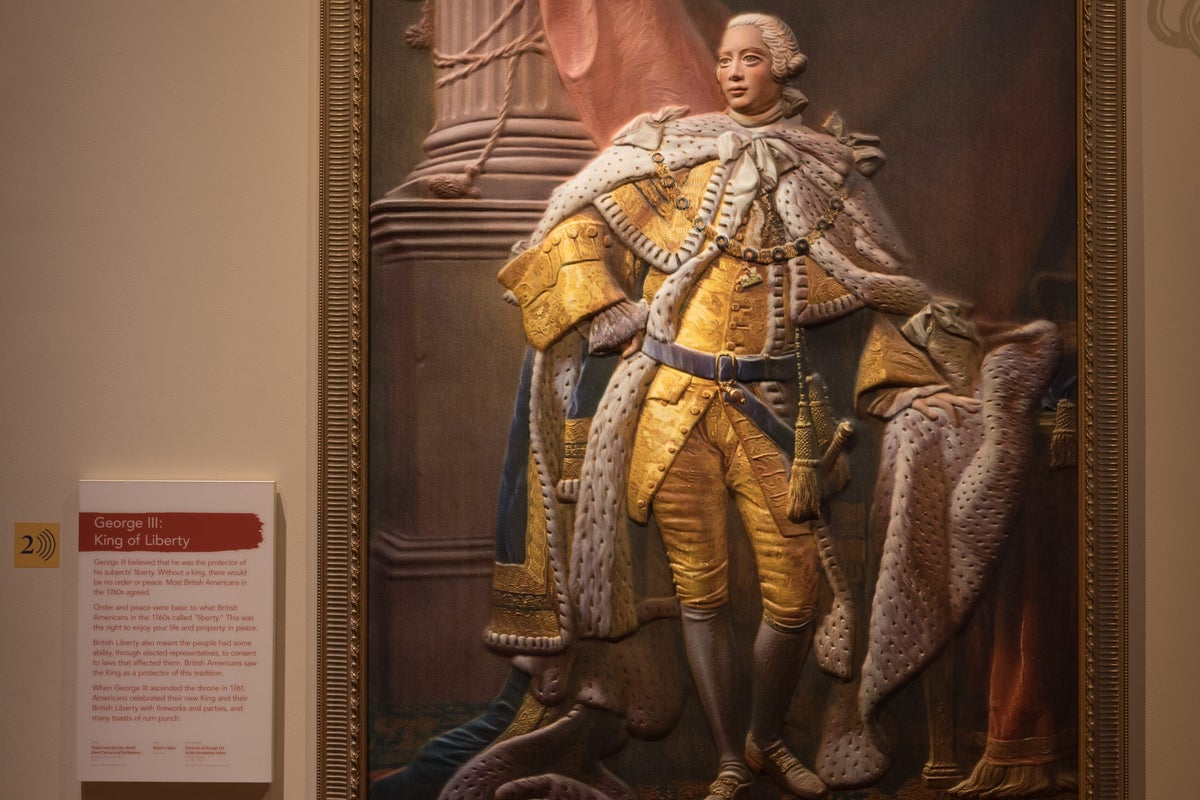
When you stand in front of the portraits of George III today, you do not see the fierce eyes of a dictator. You see a tired, heavy-lidded man wearing the robes of a state he did not design, holding a scepter that felt heavier with every passing year. He was a man caught in the gears of a historical shift too massive for any one human being to halt.
The Americans built a monument to freedom. To do it, they had to build a monster out of a king.