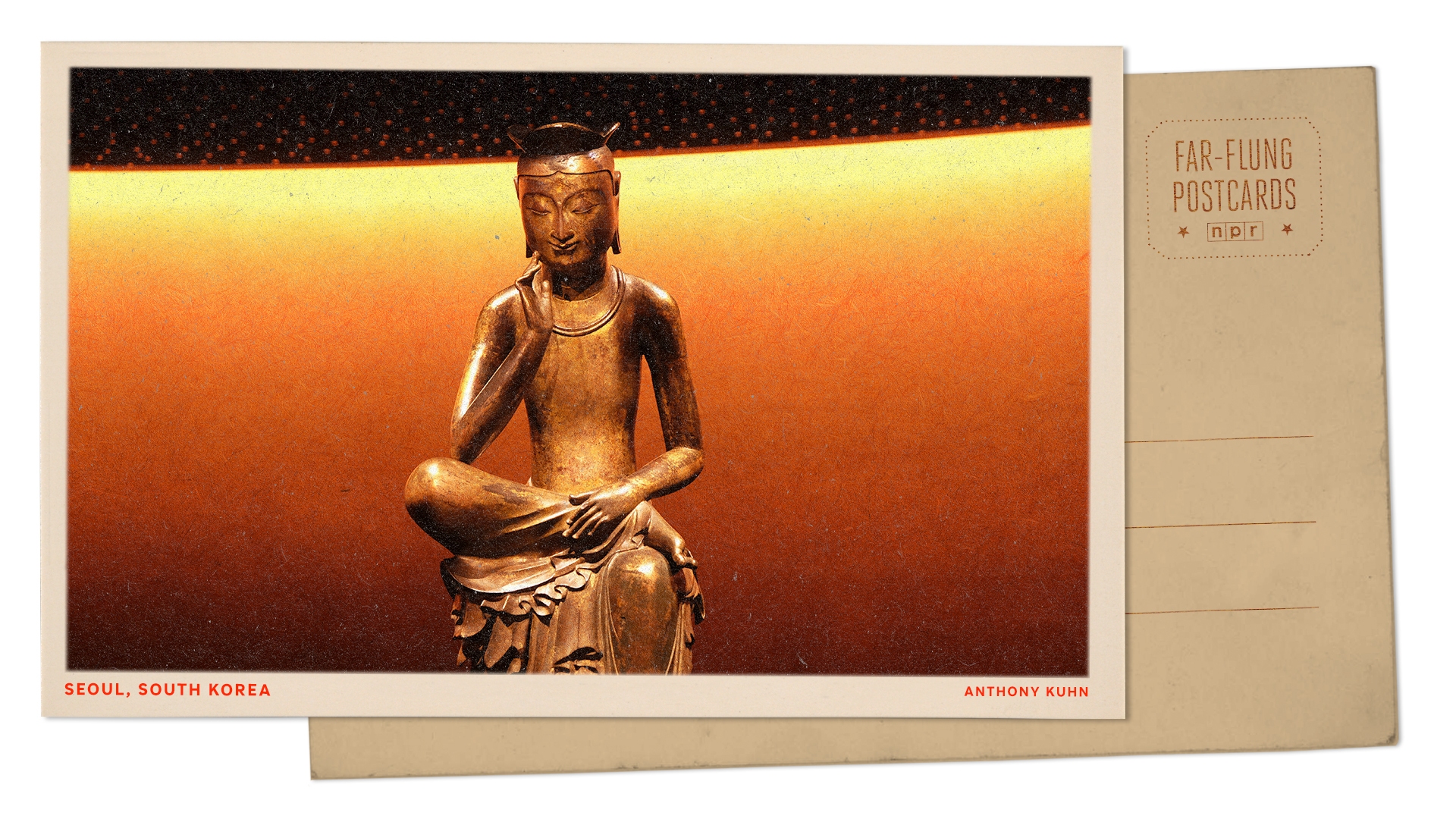
Travel writers love to hawk the myth of the museum as a spiritual decompression chamber. You have read the standard boilerplate a thousand times: a weary traveler steps off the neon-soaked, hyper-caffeinated streets of Seoul, slips into the National Museum of Korea, and instantly achieves a state of Zen while staring into the serene face of a bronze Pensive Bodhisattva. It is a beautiful, romantic narrative.
It is also total nonsense. Recently making news lately: The Architecture of Aqueous Exhibits Why Institutional Aquariums Fail at Gelatinous Biology.
Treating ancient Buddhist masterpieces as mere ambient relaxation aids—the cultural equivalent of a white-noise machine or a luxury spa day—completely misunderstands the art, insults the creators, and sanitizes history. The current consensus positions the museum as an escape from the city. But art was never meant to be an escape from reality. It was built to confront it.
When you strip these artifacts of their friction to serve a lifestyle trend focused on self-care, you are not engaging with culture. You are just consuming a glorified tranquilizer. More details regarding the matter are covered by Lonely Planet.
The Sanitization of the Sacred
The National Museum of Korea houses National Treasures No. 78 and No. 83: two bronze Pensive Bodhisattvas. They sit in a dimly lit, minimalist room designed specifically to induce quiet contemplation. Visitors whisper, walk on tiptoe, and praise the "calm" away from the Seoul bustle.
But look at the mechanics of what you are actually viewing.
These statues represent Maitreya, the future Buddha, frozen in deep contemplation. But he is not meditating on a beach or relaxing in a garden. He is contemplating the staggering weight of human suffering and the inevitable decay of the universe before his eventual rebirth. The slight smile on his face is not a smug expression of relaxed bliss; it is a profound, razor-sharp psychological response to the tragic nature of existence.
Historically, these images were not stashed away in climate-controlled vaults for lonely urbanites to gaze at during a weekend trip. They were focal points of intense state ritual, dynastic anxiety, and raw existential crisis. During the Three Kingdoms period, Korean rulers commissioned these works during times of brutal warfare and shifting political alliances. They were symbols of survival, power, and the desperate hope for cosmic intervention.
To walk into that room and feel "cozy" is a failure of imagination.
Reducing a masterpiece born from centuries of philosophical struggle to a quick dose of mental hygiene is the ultimate form of modern cultural tourism. It is lazy.
Why the "Escape" Premise is Fundamentally Flawed
The standard travel guide positions the city and the museum as opposites. The city is noisy, chaotic, and stressful; the museum is quiet, structured, and peaceful.
This binary is entirely wrong.
The museum is not an escape from Seoul; it is a direct product of it. The immense wealth, technological infrastructure, and geopolitical stability required to curate, protect, and display these treasures are generated by the very city hustle that tourists claim to flee.
Furthermore, the idea that silence equals peace is a psychological trap. When people look for "calm" in a museum, they are usually just looking for isolation. They want to turn off their brains. But true engagement with complex historical art requires cognitive friction. It demands that you ask uncomfortable questions:
- Who paid for this masterpiece, and how many peasants starved to fund it?
- How did this artifact survive the Japanese colonial era and the destruction of the Korean War?
- Why does an object stripped from its original temple and placed under a spotlight still hold power?
If you leave the gallery feeling relaxed, you didn’t actually look at the art. You looked at the reflection of your own desire for comfort.
The Industrialization of Curated Quiet
Museums around the world have leaned heavily into this wellness marketing, transforming galleries into secular churches for the burnt-out millennial. I have spent years tracking how cultural institutions manage foot traffic and visitor psychology. From London to Tokyo to Seoul, the playbook is identical: dim the lights, paint the walls dark grey, limit the text plaques, and sell the experience as a digital detox.
It is a brilliant business strategy, but a terrible artistic one.
When a museum curates for "calm," it inevitably flattens the collection. Works that are jarring, politically charged, or aesthetically aggressive are sidelined in favor of objects that fit the aesthetic of a premium meditation app. The Pensive Bodhisattva becomes a prop. The historical reality of Korean Buddhism—which involved fierce philosophical debates, political machinations, and radical social upheavals—is replaced by an idealized, bloodless version of Asian spirituality designed to soothe Western and domestic tourists alike.
How to Actually Look at a Masterpiece
Stop trying to feel peaceful. Start trying to feel challenged.
If you want to move past the superficial tourist gaze and actually experience the depth of Seoul’s cultural landscape, you need to change your entire approach to the museum grid.
1. Look for the Friction
Do not look for pieces that match your living room decor or make you feel safe. Seek out the tension. In the case of Korean Buddhist art, look at the transition from the rough, localized stone Buddhas of the early eras to the highly refined, gilded iron Buddhas of the later Goryeo dynasty. That transition represents shifts in trade routes, metallurgy breakthroughs, and massive wealth accumulation. The art is an economic map, not just a spiritual vision.
2. Reject the Audio Guide Consensus
The standard museum audio guide is designed to give you a safe, universally accepted narrative. It tells you what to look at, how long to stand there, and what emotions to feel. Turn it off. Force yourself to stand in front of a single object for twenty minutes without reading the plaque. Notice the imperfections—the cracks in the celadon glaze, the asymmetry in the bronze casting, the wear on the stone base where thousands of hands touched it before it was locked behind glass.
3. Reconnect the Art to the Concrete
When you step out of the National Museum of Korea, do not lament the return to the city noise. Look at the city through the lens of what you just saw. The same ambition, drive, and existential anxiety that fueled the creation of the Baekje gilt-bronze incense burner is currently driving the tech labs in Gangnam and the creative studios in Hongdae. The hustle is not the enemy of the art; it is the raw material from which the art is made.
The Cost of the Wellness Trap
The danger of using historical masterpieces as a therapeutic band-aid is that we lose our capacity for genuine awe. Awe is not comfortable. It is overwhelming. It makes you feel small, insignificant, and acutely aware of your own mortality.
When you stand before a piece of art that has survived over a millennium of fire, war, and ideological collapse, the appropriate response is not a deep, relaxing sigh. It is a sharp intake of breath. It is the realization that entire civilizations rose and fell just so this piece of bronze could sit in front of you today.
Stop using museums to hide from the world. Go to them to confront it.