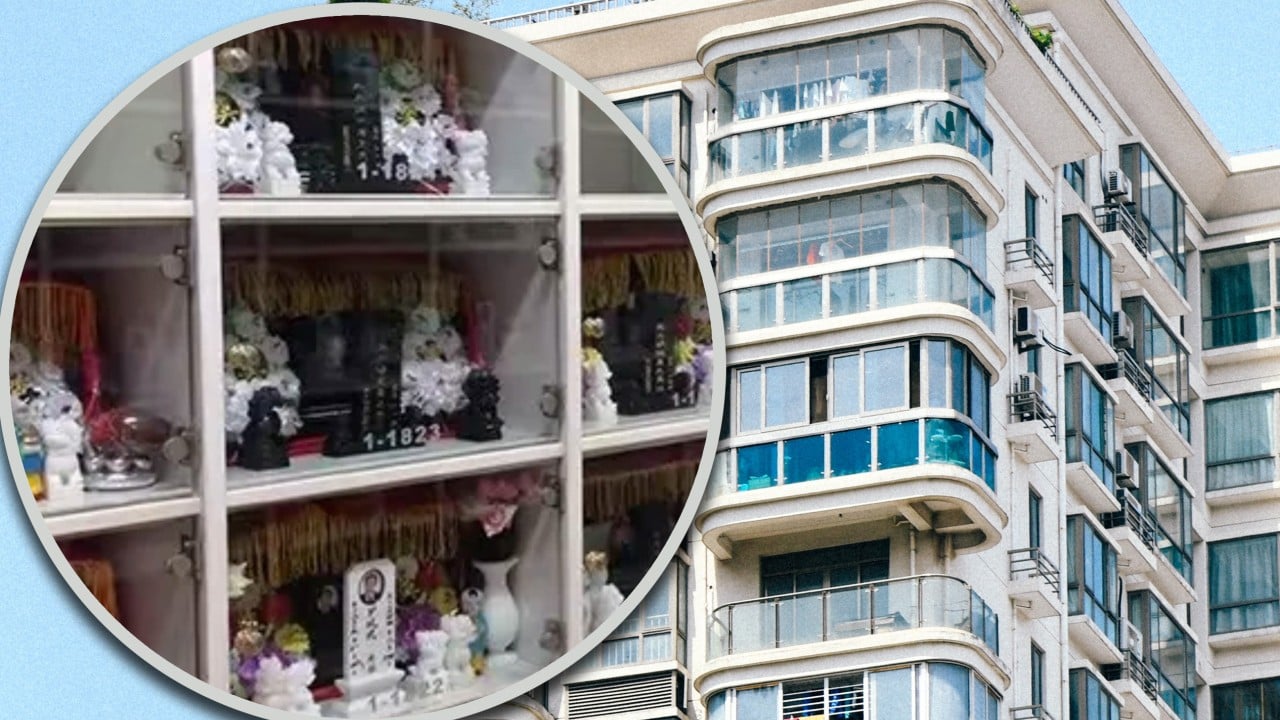
The convergence of extreme urbanization, limited land supply, and cultural rigidity in China has birthed an unconventional asset class: "Ash Apartments." This phenomenon is not a spontaneous cultural quirk but a predictable market response to the failure of traditional deathcare infrastructure to scale alongside real estate prices. When the cost of a cemetery plot exceeds the price per square foot of residential property, rational actors move to arbitrage the difference. This shift represents a structural breakdown in the urban land use model, forcing the state to intervene as the line between residential zoning and funerary use dissolves.
The Economic Drivers of Funerary Arbitrage
The emergence of ash apartments—residential units purchased specifically to house the cremated remains of ancestors—is governed by a clear cost-benefit function. Several variables dictate why a middle-class family in a Tier 1 or Tier 2 city would choose a 50-square-meter apartment over a traditional grave.
The Cemetery Cost Function
Traditional burial plots in major metropolitan areas like Shanghai or Beijing are subject to artificial scarcity. Local governments control land quotas, prioritizing industrial and residential development over funerary zones. This creates a supply-demand mismatch where:
- Purchase Price: A single grave in a premium cemetery can cost upwards of 200,000 RMB ($28,000 USD) for a space often smaller than one square meter.
- Maintenance Fees: Cemetery management fees are recurring, typically billed every 20 years.
- Usage Limitations: Rights of use are not perpetual. If a family fails to renew or the cemetery is relocated for urban expansion, the remains are at risk.
The Residential Value Proposition
By contrast, residential property in lower-tier cities or the outskirts of major hubs offers a different utility profile:
- Price Per Square Meter: In satellite cities like Nantong (near Shanghai) or Zhuozhou (near Beijing), residential prices are significantly lower than cemetery rates. A family can purchase a small apartment for 400,000 RMB, gaining 50 square meters of space.
- Asset Appreciation: A cemetery plot is a depreciating or stagnant liability. An apartment remains a liquid real estate asset that can, theoretically, be resold if the remains are moved.
- Climate Control and Access: Apartments provide a private, weather-proof environment for ancestral worship, free from the crowds and logistical hurdles of public cemeteries during the Qingming Festival.
Structural Tensions in Urban Zoning
The rise of "ghost neighborhoods"—clusters of residential buildings where more units house urns than living people—creates a localized market failure. This transition triggers a negative feedback loop for the remaining living residents and the developers.
The Social Devaluation Cycle
Real estate value is heavily dependent on "neighbor quality" and community sentiment. The discovery of ash apartments within a residential complex triggers an immediate "horror premium" or price floor collapse.
- Psychological Barrier: Cultural taboos regarding death and proximity to the deceased reduce the pool of potential buyers to near zero for adjacent units.
- Operational Friction: Living residents often report "spooky" behavior, such as units that only show activity once a year or have windows permanently blacked out with bricks or heavy curtains.
- Utility Imbalance: Buildings designed for human habitation require specific maintenance flows (water usage, sewage, trash). An "urn-only" unit consumes no utilities but pays management fees, creating a strange "zombie" occupancy rate that complicates building management.
Regulatory Lag and Legal Definitions
Chinese law differentiates strictly between residential land (70-year lease) and funerary land (50-year lease or less). The use of a residential unit for the sole purpose of storing remains technically violates the "intended use" clause of property contracts. However, enforcement is a logistical nightmare.
- Privacy Protections: Property management cannot legally enter a private residence without cause.
- Definition of Residency: There is no clear legal threshold for how many hours a human must occupy a space to distinguish it from a storage facility.
- Cultural Sensitivity: Forcing the eviction of ancestral remains is a high-stakes social risk for local officials.
The Three Pillars of State Intervention
In response to the proliferation of these apartments, the Chinese government has shifted from passive observation to active suppression. This strategy rests on three distinct pillars.
1. Mandatory Green Funerals
The state is aggressively promoting "Ecological Burials"—sea scatterings, tree burials, and flower bed interments. By removing the physical requirement for a permanent stone monument, the government aims to decouple the act of mourning from the consumption of land. Financial incentives, such as direct subsidies for families choosing sea burials, are being deployed to shift the cost-benefit analysis.
2. Zoning Enforcement and Inspection
New regulations target the "alteration of residential purpose." In regions where ash apartments are prevalent, local authorities have begun monitoring electricity and water usage patterns to identify units that are perpetually dark but under active ownership. If a unit is identified as a funerary site, owners face fines and orders to vacate. This creates a new risk profile for the "ash apartment" strategy: the risk of forced relocation.
3. Supply-Side Management of Funerary Land
To deflate the cemetery bubble, some municipal governments are experimenting with "public-interest cemeteries." These are low-cost, government-subsidized plots designed to provide an affordable alternative to the private market. However, these plots often lack the "prestige" or "feng shui" that many families seek, leading to a bifurcated market where the wealthy buy premium graves, the poor use public plots, and the middle class continues to eye the real estate market for loopholes.
Operational Risks for the "Death Real Estate" Investor
For those viewing residential property as a funerary solution, several unquantified risks exist that threaten the viability of this strategy over a 20-to-30-year horizon.
- Policy Volatility: The Chinese government can reclassify or seize property under eminent domain for urban renewal. Unlike a cemetery, which has specific legal protections against disturbance, a residential block can be demolished.
- Management Company Hostility: Property management firms are increasingly adding "no-funeral" clauses to community bylaws. This allows them to cut off utilities or deny access to owners suspected of using the unit for urn storage.
- Secondary Market Illiquidity: Selling an apartment that was formerly an ash repository is nearly impossible in the current market. The "stigma" remains even after the remains are removed, resulting in a permanent loss of capital.
The Demographic Bottleneck
The fundamental issue is demographic. As the "silver tsunami" approaches—with China’s elderly population expected to peak in the coming decades—the demand for funerary space will hit a hard ceiling of land availability.
The current cemetery model is spatially unsustainable. In a country where the urbanization rate has surpassed 65%, the competition for every square meter of land between the living and the dead is a zero-sum game. The ash apartment is a symptom of a system that has failed to modernize its mourning rituals at the same pace as its economic development.
The strategic pivot for the Chinese state will likely involve the digital transformation of deathcare. "Cloud Graves" or digital memorials, where the physical remains are stored in high-density, high-tech columbariums while the "visit" happens via VR or digital interfaces, are the only way to resolve the land-use conflict. Until these digital solutions gain cultural legitimacy, the pressure on the residential real estate market will persist.
The final strategic move for local governments is not merely to ban ash apartments, but to aggressively de-stigmatize high-density columbariums. By building high-quality, centrally located, and culturally respectful vertical cemeteries, the state can recapture the revenue currently leaking into the residential real estate sector. For the individual, the move is clear: the era of the "hidden urn apartment" is closing due to heightened surveillance and community pushback. Diversifying toward digital or ecological alternatives is the only way to ensure long-term stability for ancestral remains without risking capital in a volatile, highly-regulated property market.